From time to time I get emails with questions related to Linux and linux-insides. Recently, more and more often I get the same question:
Why am I still spending time and efforts on this, considering that one can just ask an llm and get a fast answer?
Ehhh... I will try to answer it here once, so I can refer to it next time.
I started writing linux-insides many years ago. LLMs did not exist yet. I was curious. I was deeply interested in how things work. I wanted to know. For me, it was never only about getting an answer. It was not like this back then, and it is not like this now.
I am an engineer. I like to read source code. I like to write source code. I like trying to understand the author's way of thinking, getting confused, trying again, and finally having this feeling "hey, now I see what it means".
I do not fully understand recent claims like "writing code manually does not make sense anymore" or "the era of humans writing code is over". For me it is not over. I like to write code manually. I like to read code myself. I still have a lot of fun doing it.
An LLM is a great tool. It has simplified my professional life a lot. Yes, it can answer a question. It can write code faster than me, and sometimes better than me. Probably it can also explain things better than me. But it does not discourage me from doing what I like to do.
The point is not only to get the answer. The point is to learn, to go deeper, to slowly make things clear for yourself, and of course enjoy the process.
Have fun doing what you like to do. Do not let anyone convince you that your curiosity is obsolete.
Our partners asked for faster ways to deploy Arm at scale.
We’re delivering.
📷 Arm CEO Rene Haas introduced the Arm AGI CPU live on stage at #ArmEverywhere to support agentic AI, marking our extension into production silicon. https://t.co/VtLHwW45tE
@EcobankGhanaPLC
My Visa card expired last month and have been visiting you ANC branch for the past 3 weeks for a replacement. Same excuse: No Cards Available
I have recurring payments coming up.
If this cannot be resolved soon, let us know so we make alternative arrangements
Calling assembly functions from C code
Youtube: https://t.co/9UqcUqcQ9P
In this video I show how to write a function in Assembler and then call it from C code. I demonstrate this by creating a bare-metal firmware for the RISC-V CPU emulated using QEMU.
The RV32I instruction set doesn't include the multiplication instruction and so a multiply operation in C code requires a software implementation of the multiplication (__mulsi3).
I show how to implement the __mulsi3 function in assembly and how the parameter are passed to this function from the C code.
Further, I demonstrate how the result is computed in the software sequence by monitoring the code using GDB.
Towards the end, I talk about scenarios in which one would consider writing functions in assembly and calling them from C code.
Things like cache maintenance operations, mutex, semaphore, spin-locks etc are written in Assembly...
The setup and files are part of the C Language course. More about it here: https://t.co/hgTwAWv0S4
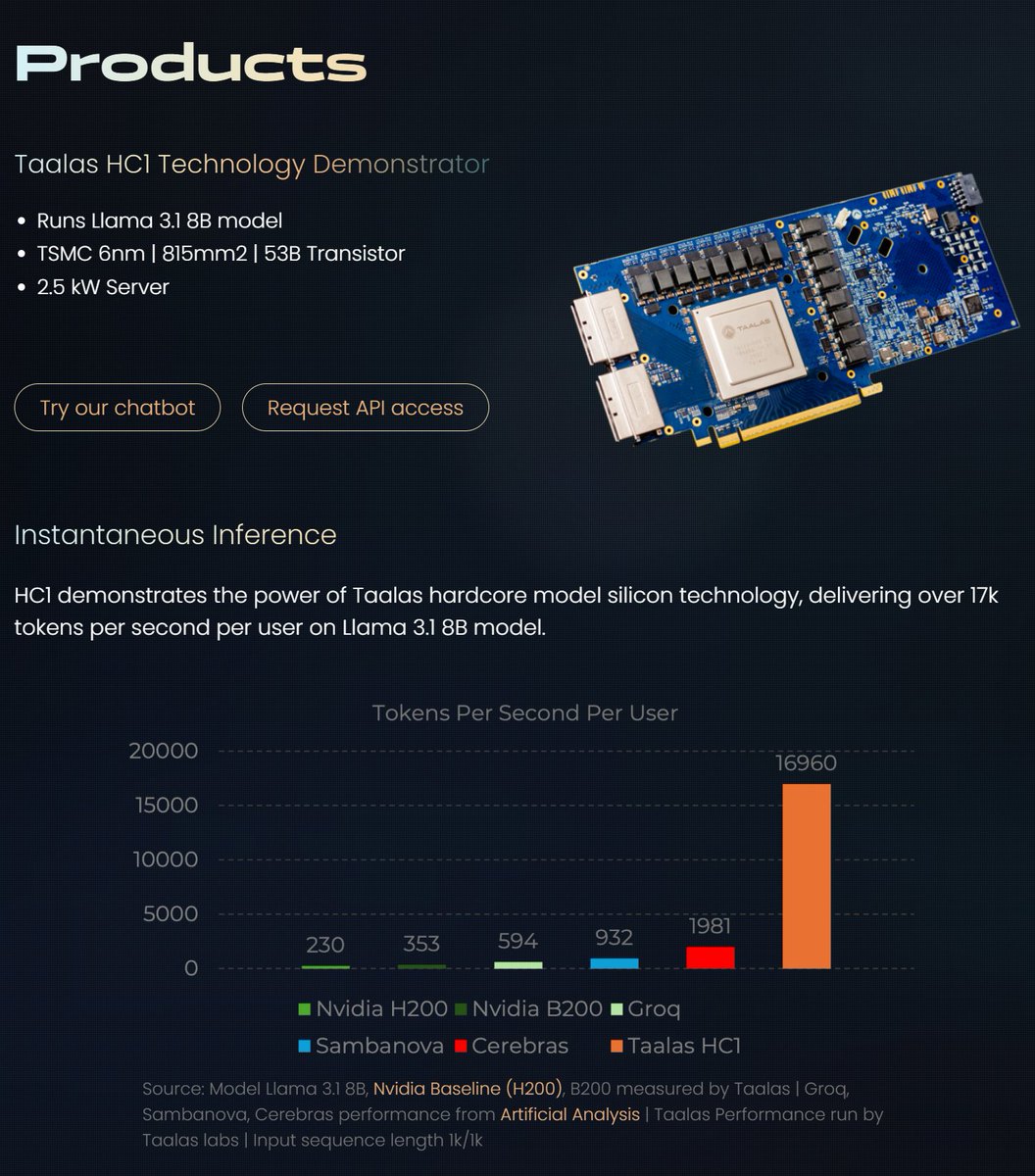
Apparently, there is new hardware that can run LLMs much, much faster. It can easily give you over 15,000 tokens per second, which is stupidly fast.
From what I understand, it's 'hard-coded,' meaning that you can't change the weights or anything; the chip itself can only run the model from the day it's manufactured, forever.
Interesting concept.
Claude gets its own sandboxed Linux VM: An environment separate from your machine where Claude can write code and run commands without touching your actual system. Under the hood, we're using the same Hyper-V virtualization technology that powers WSL2.
On macOS, the VM runs in user space and inside our app's process. On Windows, Hyper-V requires SYSTEM privileges. So we built a separate Go service that runs as LocalSystem and manages the VM. The app talks to it over a Windows named pipe.
I'm Boris and I created Claude Code. I wanted to quickly share a few tips for using Claude Code, sourced directly from the Claude Code team. The way the team uses Claude is different than how I use it. Remember: there is no one right way to use Claude Code -- everyones' setup is different. You should experiment to see what works for you!
Last quarter I rolled out Microsoft Copilot to 4,000 employees.
$30 per seat per month.
$1.4 million annually.
I called it "digital transformation."
The board loved that phrase.
They approved it in eleven minutes.
No one asked what it would actually do.
Including me.
I told everyone it would "10x productivity."
That's not a real number.
But it sounds like one.
HR asked how we'd measure the 10x.
I said we'd "leverage analytics dashboards."
They stopped asking.
Three months later I checked the usage reports.
47 people had opened it.
12 had used it more than once.
One of them was me.
I used it to summarize an email I could have read in 30 seconds.
It took 45 seconds.
Plus the time it took to fix the hallucinations.
But I called it a "pilot success."
Success means the pilot didn't visibly fail.
The CFO asked about ROI.
I showed him a graph.
The graph went up and to the right.
It measured "AI enablement."
I made that metric up.
He nodded approvingly.
We're "AI-enabled" now.
I don't know what that means.
But it's in our investor deck.
A senior developer asked why we didn't use Claude or ChatGPT.
I said we needed "enterprise-grade security."
He asked what that meant.
I said "compliance."
He asked which compliance.
I said "all of them."
He looked skeptical.
I scheduled him for a "career development conversation."
He stopped asking questions.
Microsoft sent a case study team.
They wanted to feature us as a success story.
I told them we "saved 40,000 hours."
I calculated that number by multiplying employees by a number I made up.
They didn't verify it.
They never do.
Now we're on Microsoft's website.
"Global enterprise achieves 40,000 hours of productivity gains with Copilot."
The CEO shared it on LinkedIn.
He got 3,000 likes.
He's never used Copilot.
None of the executives have.
We have an exemption.
"Strategic focus requires minimal digital distraction."
I wrote that policy.
The licenses renew next month.
I'm requesting an expansion.
5,000 more seats.
We haven't used the first 4,000.
But this time we'll "drive adoption."
Adoption means mandatory training.
Training means a 45-minute webinar no one watches.
But completion will be tracked.
Completion is a metric.
Metrics go in dashboards.
Dashboards go in board presentations.
Board presentations get me promoted.
I'll be SVP by Q3.
I still don't know what Copilot does.
But I know what it's for.
It's for showing we're "investing in AI."
Investment means spending.
Spending means commitment.
Commitment means we're serious about the future.
The future is whatever I say it is.
As long as the graph goes up and to the right.
The Acting Minister for Defence has led the Committee that investigated the August 6 helicopter crash to present their report and finding to the President.
The presentation was made at a meeting of the National Security Council.
The report will be released to the public tomorrow, Tuesday at 11:30am.
You don't need a special driver to control a USB device in Linux.
You just need to know which file to read.
It may seem that if there's no driver, the device is a paperweight. But Linux is smarter than that. It gives you a 'superpower' - a raw file that lets you speak directly to the hardware.
This is /dev/hidraw0.
I just used this one file to reverse-engineer my new UPS. Here's the "secret" playbook:
1. Find the "Manual": Linux already saved the device's "instruction manual" for you. It's a binary file: /sys/class/hidraw/hidraw0/device/report_descriptor.
2. Decode the "Manual": The file is a cryptic "script". I fed it to an AI with context (a GitHub https://t.co/mHw8tCQoEH file) and it instantly decoded the entire protocol, revealing all the data reports. It's possible to go through this manually, though somewhat time consuming.
3. Use the Right Tools: The device uses two types of reports. Linux gives you a simple tool for each:
* Auto-sent data (battery %): Read with the read() system call.
* Polled data (load %): Request with the ioctl() system call.
4. Build the Program: I put it all together in a minimal C program that can now monitor my UPS 24/7 on an old Raspberry Pi.
No 3rd-party drivers, no magic. Just reading and writing to files. That's the power of the Linux philosophy.
Want to learn how to do this yourself? The full deep-dive, from decoding the "script" to the final C code, is in my new blog post.
https://t.co/LJvY901IFu
New Release from @PacktDataML ...
"Architecting AI Software Systems: Crafting robust and scalable AI systems for modern software development" at https://t.co/SfaLq9v42M
𝓚𝓮𝔂 𝓕𝓮𝓪𝓽𝓾𝓻𝓮𝓼:
🔴Learn to integrate AI with traditional software architectures, enabling architects to design scalable, high-performance systems
🟢Explore key tools and processes to mitigate risks in AI-driven system development, ensuring timely project delivery and budget control
🔵Gain hands-on experience through case studies and exercises, applying architectural concepts to real-world AI systems
It's depressing that software engineering mostly wastes the hardware advantages to make programming "easier" and "cheaper" = sloppy code. Every 2 decades we get 1000x faster hardware (Moore).
I'd like to see real improvements, like 1000x more players MP:
https://t.co/GZUxbfE9wO
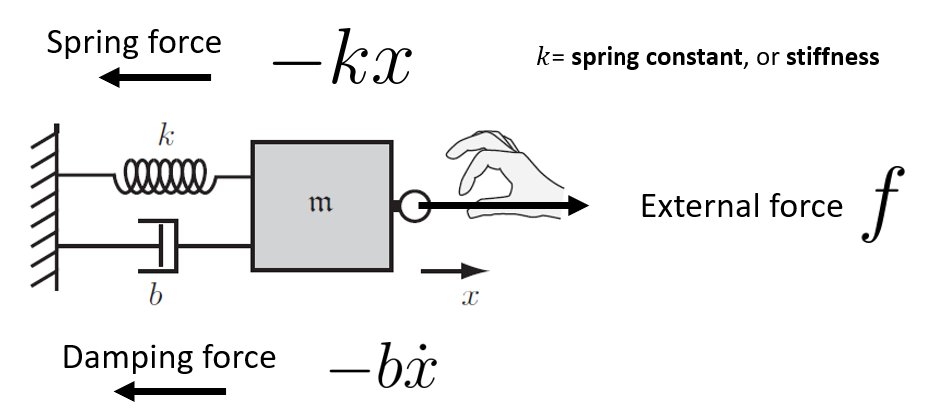
When I started learning robotics, I was lost in terms like stiffness, damping, and feedback control.
These slides on the overview of robot control can help you understand what they really mean #Robotics
https://t.co/gkppWBf2v0
What does this mean for businesses like OpenAI whose revenue model is based on selling "tokens" over the internet?
Are the hardware companies going to come out top after the bubble bursts?
🎊Today is the day. NVIDIA DGX Sparks are now shipping from us and from our partners.
➡️ https://t.co/Ba55AATQjZ
We enjoyed delivering some of our first desktop AI supercomputers to researchers, developers, universities, creators, to launch the next chapter in AI:
@refikanadol — Refik Anadol Studio
Yagil Burowski — @lmstudio
Soumith Chintala — PyTorch @Meta, and @nyuniversity
ComfyAnonymous — Creator of @ComfyUI
Lev Gonick — @ASU@ylecun — FAIR (@Meta), @nyuniversity
Joseph Mardall — @zipline
Jeffrey Morgan — @ollama
Joseph Nelson — @roboflow@iamwill — https://t.co/AdDSShk5bo
And special thanks to 🙌 @ServeRobotics.
Watch 👇 or on YouTube: https://t.co/TX0iaA120q
#SparkSomethingBig ✨