A new chapter for CertiK.
Our new identity reflects an evolution years in the making, and a broader mission for the future of digital value.
The Trust Layer for Digital Value.
Visit our website to discover our new identity.
@devhenrico That’s what makes these hardware-dependent triggers particularly interesting.
We’ll dive deeper into the research and its security implications in our upcoming write-up.
Weight2Shell: Silent on NVIDIA, Shell on Apple
Same weights. Same prompts. In this demo, an LLM backdoor stays dormant on NVIDIA GPU but triggers on Apple Silicon, making a local coding agent run arbitratry shell command.
Floating-point differences across hardware and runtime stacks can be used as backdoor triggers. We covered the underlying research in our SDC 2026 talk. Write up coming soon
Most AI code is only tested, never truly proven, which is what makes TensorLean from CertiK and Columbia University stand out, since it already found 18 bugs in widely used AI libraries.
As models keep growing, correct code matters as much as fast code
Data races depend on thread scheduling, and a test run only sees the schedules that happened to occur. TensorLean proves race freedom for all runtime shapes, inputs, and thread schedules, which is how it found a race in FlashAttention-4 that 17,760 test runs never hit.
Everyone is racing to make AI kernels faster, but almost nobody can prove the faster version still computes the right thing.
CertiK and Columbia just put 149 production GPU kernel instances through formal verification, including FlashAttention and DeepSeek's DeepGEMM, with machine-checkable proofs in Lean.
They proved 83 of them correct and found 38 bugs that had slipped past testing for months and years. 23 were in FlashAttention and 2 in DeepGEMM.
Tests only check the cases you thought of. A proof covers everything inside the spec.
Feels like this should become a normal step before any optimized kernel touches a big training run.
If AI makes a mistake because of faulty code, it can affect the answers, results and services people rely on.
That’s why what CertiK and Columbia University have achieved with TensorLean is so important.
They’ve found a way to mathematically check that the code powering AI is working correctly, uncovering 18 hidden bugs across more than 100 AI kernels.
It’s not just about making AI faster. It’s about making it safer, more accurate and more reliable.
A big step forward for the future of AI. 🚀
For LLM builders, the practical opportunity is to make correctness verification part of performance engineering.
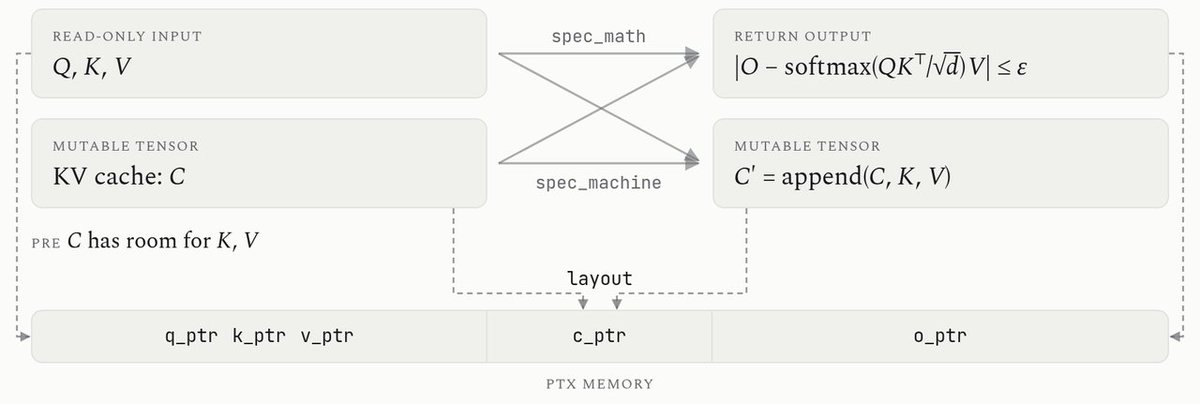
Start with a tensor-level specification: the intended computation, valid inputs, and allowed numerical error. Then verify the compiled implementation against it.
When the intended computation and assumptions remain valid, teams can reuse that specification to check new optimized versions. If an optimization changes those assumptions or error requirements, the specification needs to be revisited.
That creates a repeatable workflow for improving training and inference efficiency while checking correctness before large-scale runs.
Formal verification can do more than find bugs. It can prove that code meets its specification and is free of specified classes of bugs under defined conditions.
Researchers at CertiK and Columbia built TensorLean—a world-first breakthrough in automated formal verification for production AI kernels.
Evaluated on 100+ production GPU kernels, it found 2 bugs in DeepSeek kernels and 23 in FlashAttention. All proofs are developed in Lean and are machine-checkable.
For LLM builders: verify optimized code before costly runs, while pursuing faster training and cheaper inference.
🧵👇
Is a faster AI kernel still correct?
We built TensorLean with researchers at @CertiK and
@ColumbiaCompSci, the first framework to formally verify production GPU kernels with complex optimizations.
149 GPU kernel instances verified
38 bugs in total
2 in @deepseek_ai’s DeepGEMM
23 in FlashAttention
All proofs are developed in Lean and are machine-checkable. 👉 https://t.co/QmWpqR4u9o
Why is verifying production AI code difficult? The optimizations that make it fast also make correctness harder to establish.
• Dynamic shapes and launches: input sizes and GPU work assignments change at runtime. TensorLean reasons symbolically about these configurations, so verification can cover a family of supported cases.
• Asynchronous operations: data transfers overlap with computation. Verification must account for ordering and synchronization across permitted concurrent executions.
• Floating-point arithmetic: reordering operations and using lower precision introduce rounding errors. TensorLean checks computations against tensor-level specifications with explicit numerical tolerances.
TensorLean verifies the compiled PTX implementation against these requirements. All proofs are developed in Lean and are machine-checkable.
Web3 threats are evolving. Is security keeping pace?
Today at 2 PM UTC, @Concordium's CTO @PeterMarirosans joins CertiK Security Engineer @de3p4c1to to discuss recent hacks, emerging AI threats, and the future of Web3 security.
There may be more to the conversation than the agenda suggests.
Set your reminder ↓
https://t.co/msIeA6OWyV
⏳ Less than 3 hours to go!
How will the U.S. midterm elections reshape the future of crypto regulation?
Join us for CertiK Spotlight EP4 as Hudson Jameson (@hudsonjameson), Stefan Muehlbauer (@stefanm2025), and Chris Brodersen discuss the evolving regulatory landscape and what comes next for the digital asset industry.
🔴 Live at 9 AM EST.
https://t.co/E99nhvy1Qm
Institutional adoption of digital assets depends on trust backed by independent verification and evidence.
CertiK has completed independent technical verification of @XRPLF’s and Partior’s self-attestations under the Global Layer One (GL1) Market Infrastructure Toolkit, developed by global financial institutions and policymakers.
Our team reviewed all 112 controls, identified those suitable for technical verification, and assessed the operators’ self-attestations under the Architecture and Resiliency principles.
By examining code, configurations, logs, and test results, we provide financial institutions with additional evidence to evaluate the security, resilience, and operational readiness of digital financial infrastructure.
How does a public ledger answer a control written for a single operator?
@XRPLF showed how XRPL addresses the underlying risks and assessed the ledger against all 10 GL1 principles.
We independently checked its responses and evidence on Architecture and Resiliency.
The XRP Ledger Foundation has completed the attestation of the XRP Ledger against the Global Layer One (GL1) Market Infrastructure Toolkit.
It is the first public, permissionless layer-1 blockchain to have the toolkit's Architecture and Resiliency principles independently verified.
GL1 is a multilateral initiative between global financial institutions and policymakers to foster an ecosystem of compatible financial infrastructures upon which tokenised assets can be transacted seamlessly across borders.
The toolkit assesses networks for tokenised assets across ten principles, built on international standards such as the Principles for Financial Market Infrastructures (PFMI) and emerging industry best practices.
For banks and asset managers, it is a standards-based reference for their own due diligence on the XRP Ledger.
More details:
https://t.co/EvLH2kTHa3
As AI agents become more autonomous and attack vectors continue to evolve, securing Web3 requires a new approach to identifying and mitigating risks.
CertiK Security Engineer @de3p4c1to will join @Concordium on November 20 at 2 PM UTC to discuss recent exploits, emerging AI threats, and the future of Web3 security.
🎙️ Web3 Under Attack
Hackers are evolving. AI agents are gaining autonomy.
Is Web3 security keeping up? 👀
Our CTO, @PeterMarirosans, joins @de3p4c1to, Security Engineer at @CertiK, to discuss hacks, AI threats & the future of trust.
🗓️ 20 November
⏰ 2 PM UTC
Set your reminder 👇 (link in the first comment)
Formal verification for a general-purpose zkVM.
Yesterday at ACM CCS, CertiK’s Vilhelm Sjöberg presented our collaboration with @DelphinusLab to formally prove the soundness of zkWasm’s circuits, including its memory system.
Read the full research paper ↓
https://t.co/6ZLmeH0kLI
AI auditing earns trust through real findings. Eight security issues uncovered in Zcash with @CertiK’s AI Auditor / Chain Scan show what this can deliver in complex blockchain infrastructure. Proud of the team.