The US government, citing national security authorities, has issued an export control directive to suspend all access to Fable 5 and Mythos 5 by any foreign national, whether inside or outside the United States, including foreign national Anthropic employees.
The net effect of this order is that we must abruptly disable Fable 5 and Mythos 5 for all our customers to ensure compliance.
Access to all other Claude models is not affected.
We apologize for this disruption to our customers. We believe this is a misunderstanding and are working to restore access as soon as possible.
Read our full statement: https://t.co/bwn0sximKZ
¿Cansados de leer sobre política? 😡
Despeje su mente 😂
Mi artículo recientemente publicado "The credit-to-GDP gap revisited: A link to instability measures" estará disponible para descarga libre hasta el 25/07/2026.
Enlace: https://t.co/uRvPfWU1o1
🚨 Due to high demand, I created a new (and much improved) version of the Econ Journal Matchmaker.
New tool here:
https://t.co/kvrQQmo5SG
#EconTwitter Please help spread the word by reposting. 🙏
More details below 👇
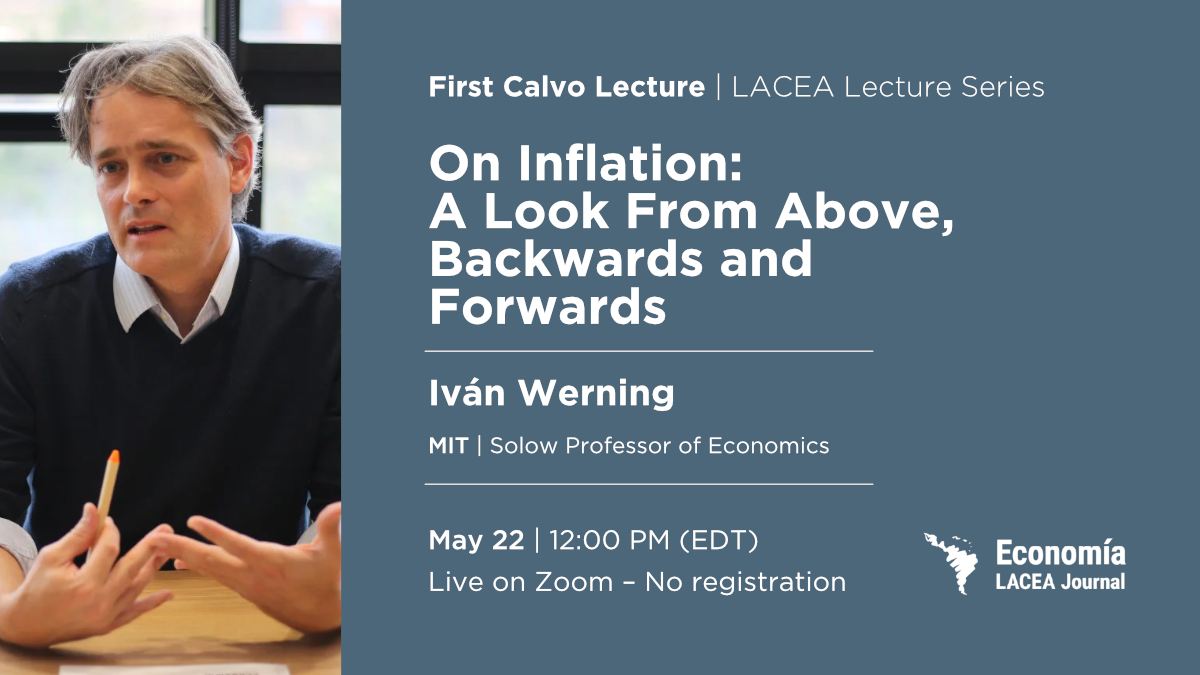
I am thrilled to be giving this virtual lecture this Friday (noon ET).
The lecture is named after a personal hero of mine Guillermo Calvo (may be in attendance, which ups the stakes). Equal among the greatest in macro+international and a special role model within Latin America.
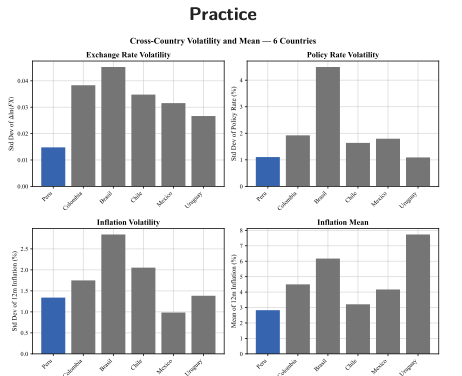
Slides of the presentation where I discuss Peru's successful joint control of inflation and FX via a creative deployment of central bank tools, which defied conventional wisdom.
My slides end with lessons for other small economies:
https://t.co/LvRFIpK6e3
🎙️ First Calvo Lecture
We are pleased to launch the Calvo Lecture Series with @IvanWerning (MIT), introduced by @SFGaliani:
“On Inflation: A Look From Above, Backwards and Forwards”
📅 May 22
⏰ 12:00 PM (EDT)
💻 Live on Zoom (no registration)
🔗https://t.co/hsWLaZdifN
Algunos mensajes clave acerca de la última conferencia sobre “Finanzas Públicas y Retos Macrofiscales en el Perú” organizada por el Consejo Fiscal
https://t.co/vWAK372guK
Creí que este artículo estaba saliendo con un poco de atraso, pero tristemente “la nostalgia por la maquinita” va siendo cada vez más patente.
Los invito a leerlo: https://t.co/sy9WxnRxlj
📈🎓Dos jóvenes economistas peruanos que obtuvieron el primer puesto en los cursos de Economía y Finanzas Avanzadas del Banco Central de Reserva del Perú, explican la exigencia académica del programa, su rol como semillero de talento para la institución y cómo esta experiencia impulsa sus carreras profesionales.
👉 https://t.co/vFONVr4Ft2
#ADNRPP
https://t.co/i7uQeNUjZl
📢 Call for Papers! The MN Workshop in Macroeconomic Theory is now accepting submissions. Conference runs July 29–31 at the University of Minnesota, featuring 14 discussions. Submit your paper by April 24. #MacroEcon#CallForPapers
Successfully concluded the first Macro Week at @UdelPacifico!
Our deepest gratitude to all speakers, participants, and especially Òscar Jordà (UC Davis & FRB San Francisco) for his masterful course on Local Projections 📈🇵🇪 #MacroWeek2026#Economics
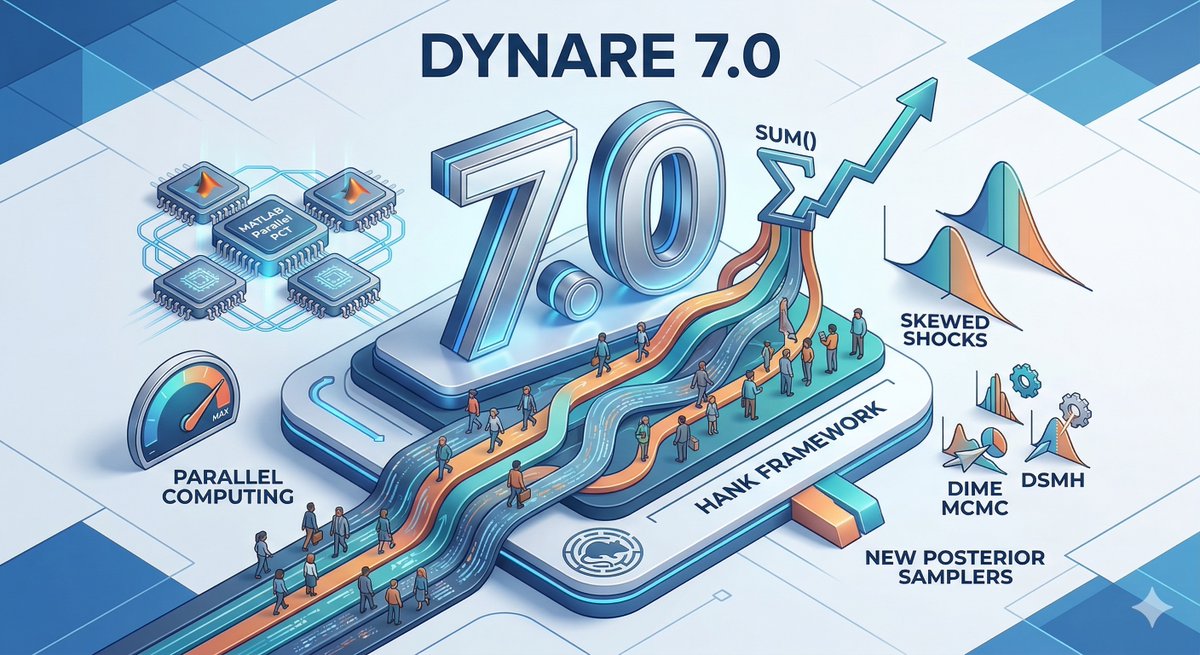
🚀 Big News: Dynare 7.0 is out!
Introducing powerful new toolkits for HANK, samplers, perfect foresight and massive performance improvements.
Packages are available for download NOW: 👉 https://t.co/OycGbbCN26
A quick summary below 👇 (1/5)
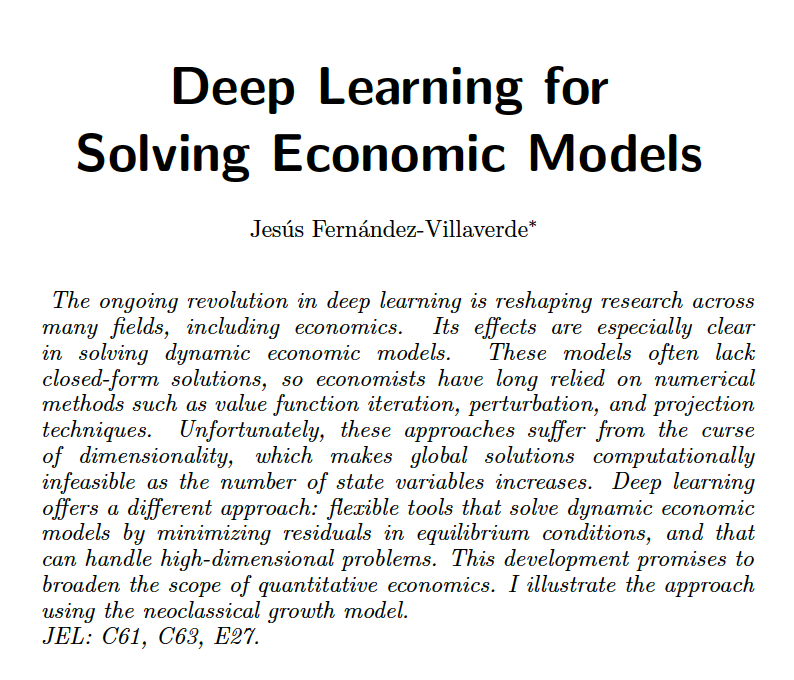
I am very happy that my survey paper, "Deep Learning for Solving Economic Models," is forthcoming in the Journal of Economic Literature (pending final replication checks, which should be quick).
The paper benefited greatly from the editor, David Romer, five referees, and many friends who read earlier versions. I believe the result is a solid introduction to the field, though in 48 pages, there is only so much one can do. So, I created a companion webpage:
https://t.co/zZpOLFXpDk
where you can find the paper, the code, and some slide decks with my teaching material. My plan is to expand the slides over time, adding new material and updating them as new results appear. I will probably do a thorough revision once the spring semester is over.
Those who follow my feed know that I think deep learning is the most fundamental change to computational economics in the last 40 years. I am by now convinced it is more important than the development of Markov chain Monte Carlo methods in the early 1990s or the introduction of projection and perturbation methods in the 1980s. To find a comparable shift, one would probably need to go back to Richard Bellman's invention of value function iteration in 1957.
More pointedly, we need to redesign the Ph.D. in economics. Not at the margin. From the ground up. Economists can either fully embrace the deep learning revolution or become irrelevant, as has already happened, I would dare say, to some fields in academia that refused to accept reality.
Finally, let me apologize to everyone working in this area whom I could not cite. Space was a binding constraint.
And yes, this post was written with the considerable help of AI. There is nothing I am prouder of than the fact that AI is now an integral part of every step I take in my professional life.
A true giant whose work defined modern macro. In my advanced courses, I usually talk about the Gensys algorithm to solve models of linear rational expectations (before introducing Dynare), a testimony to its lasting influence on the field. RIP Christopher Sims