Seeing @Revolut in the wild a lot now in Portugal to pay for things
Very soon it will be the biggest bank in Portugal and many other European countries too
Amazing to see how fast the dinosaur banks here are getting destroyed by an intl fintech app that actually does its job
It’s official — we’ve secured a $75 billion company valuation.
This (still) makes us Europe’s most valuable private company and in the top 10 of the world's most valuable private companies.
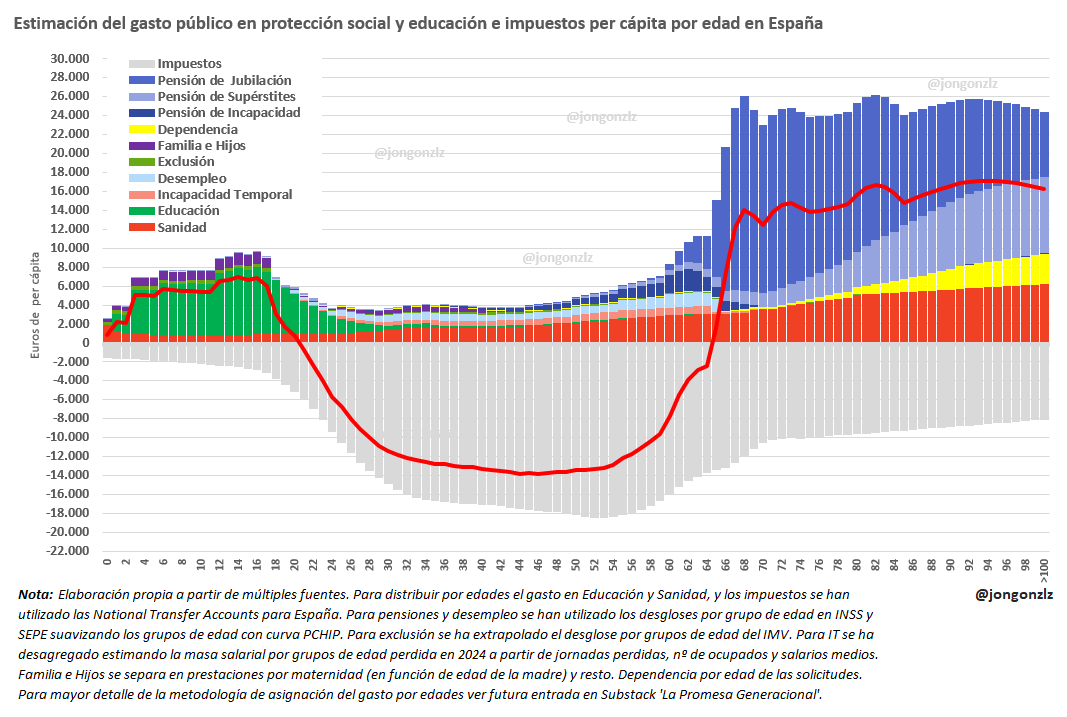
A coauthor of mine, @Jongonzlz, just computed age-indexed per-capita social spending and taxes for Spain. The figure below shows the results (any LLM can translate the axes if needed).
Why should you care? Because the broad patterns apply to most Western countries.
This is a quick calculation, and some details could be refined, but the main ideas are clear:
1️⃣ Above zero on the x-axis you see per-capita social spending: pensions, disability, survivor benefits, etc.
2️⃣ Below zero you have per-capita taxes.
3️⃣ The red line is the difference. It highlights the large transfers from people in their 30s–60s toward older and younger groups, a natural feature of pay-as-you-go systems like Spain’s.
4️⃣ The red line is not the net fiscal position of an individual: you must add other public spending (defense, police, general administration, etc.).
5️⃣ Discounting the red line at a 2% real interest rate (roughly in line with long-run debt-financing costs), the government’s net present value for the average individual is around €60,702.
6️⃣ Adding each person’s per-capita share of the rest of government spending yields a net present value of about €–21,375. This is one way to illustrate the long-run pressure on the welfare state.
7️⃣ This average figure naturally reflects a wide distribution: individuals with different educational backgrounds, skills, and earning trajectories contribute very differently over their lifetimes. Some have strongly positive fiscal contributions; others have lower or negative ones. This is normal in any redistributive welfare state.
If we want to think seriously about the future of the welfare state, we need some basic facts:
1️⃣ Who pays into the system and who receives from it.
2️⃣ How net transfers evolve over the life cycle.
3️⃣ Whether this pattern is the one we want.
4️⃣ Whether this pattern is sustainable.
These fiscal patterns also matter for thinking about how demographic change interacts with the sustainability of the system.
People may differ in their answers to 1️⃣–4️⃣, but it helps to start with the data.
The original post:
https://t.co/8pHK0sWrlw
@marclou How are your energy levels when doing cardio activities? Tried to cut as many carbs as possible as well but felt really unenergetic playing tennis. Curious if you’ve felt some change in that area
Relaxing Sunday at home. Played a tennis match, had a home cooked meal with the love of my life, tried to build a DIY shelf (didn’t manage, will keep trying this week) and now we’re going for a walk in the park. Can’t complain