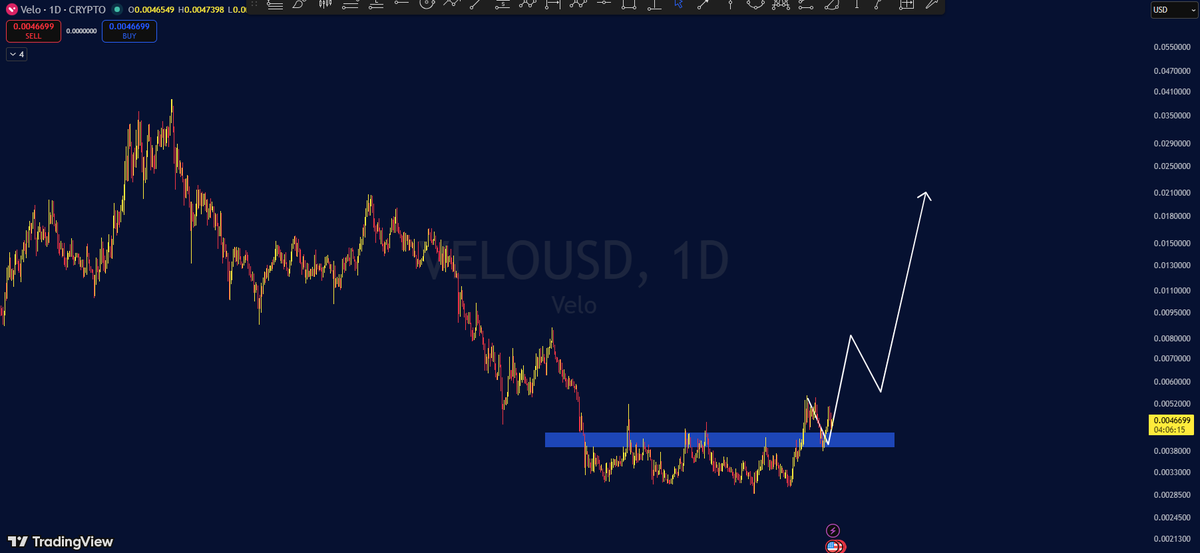
$0.16 VELO sounds crazy until you do the market-cap math.
At today’s circulating supply, that would put $VELO around $2.9B.
Today: ~$82M.
So the real question isn't whether the chart can draw a path to $0.16.
Can Velo build enough adoption to justify becoming a multi-billion-dollar network?
That's the thesis worth watching.
#VELO #RWA #PayFi #Crypto
Velo protocol $VELO is has a clear path for a higher high than last cycle,
How do you feel about a $0.16 as a pr,ce target. it is about 30X away from current price btw.
A BORING REVENUE CHART CAN TELL YOU MORE THAN A VIRAL CRYPTO POST.
That thought crossed my mind when I saw Dusk Domains appear on DefiLlama.
Now anyone can follow its fees and revenue instead of relying entirely on announcements.
I could open that dashboard tomorrow, next month, or six months from now and see how the numbers have evolved.
Maybe registrations increase. Maybe marketplace activity slows down. Maybe something unexpected happens.
That's what I enjoy about transparent data.
It doesn't have to tell a beautiful story.
It just has to reflect what's actually happening.
And there's something almost philosophical about that.
The market is full of opinions about the future. Meanwhile, the blockchain quietly records the present.
I'll be keeping an eye on those numbers.
Dusk Domains is now on @DefiLlama.
It tracks fees and revenue on-chain. Every registration, renewal and 2.5% market fee, read from the treasury vault's events.
https://t.co/6uusn91qzW
I'd put RWA at the top of my list.
Not because I expect every RWA token to explode, but because tokenization is starting to address problems that exist far beyond crypto.
Think about it. Stocks, bonds, and other financial assets could increasingly move onto blockchain infrastructure.
And DeFi could benefit from that shift too, as tokenized assets become usable in lending and other financial applications.
I wouldn't be surprised if RWA and DeFi end up growing together rather than competing for attention.
The interesting question is whether that progress translates into token demand before 2026 ends.
In my opinion, these are the 4 sectors that could steal the show before 2026 ends.
• AI
• RWA
• DeFi
• Layer 1s
Which sector are you betting on for the biggest moves in the final months of 2026? 👇
Wall Street: “We’re closed for the weekend.”
Aster: “That's adorable.” 😂
There's something funny about the idea of trading stock-linked assets at 2 AM on a Sunday.
But that's exactly the kind of flexibility Aster is bringing through bStocks.
These are tokenized assets offering stock exposure, not necessarily the same legal rights as owning traditional shares.
And Aster adds another interesting option: eligible holdings can serve as collateral for perpetual futures.
So you're not necessarily forced to sell an asset just to open another position.
The trade-off? Your collateral is now exposed to liquidation risk, and trading outside stock-market hours can mean thinner liquidity.
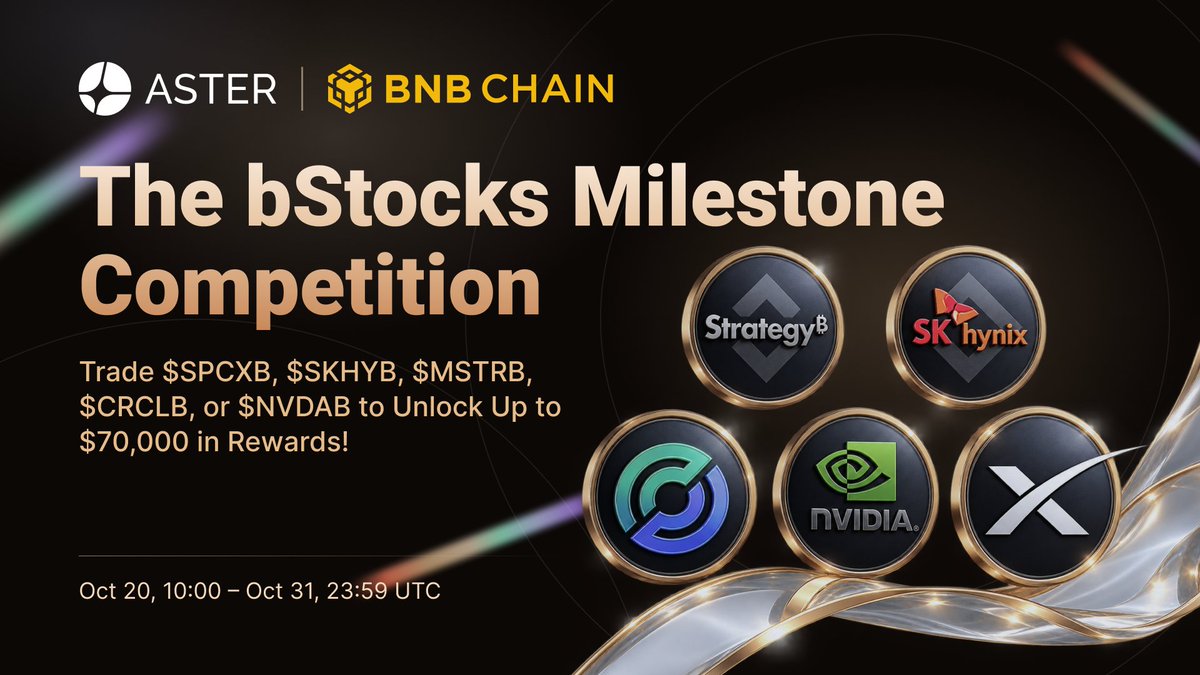
Aster and BNB Chain are also running a campaign with up to $70,000 in rewards for eligible participants.
A nice incentive, although trading extra just to chase rewards can get expensive.
Wall Street may close at 4 PM.
Risk, unfortunately, has never respected business hours. 😂
#Aster
Trade bStocks 24/7 on Aster, or use your holdings as perp collateral without selling.
Now we're teaming up with @BNBCHAIN to reward you for both, with up to $70,000 in prizes.
Before you start, make sure to register for the campaign and turn off Account Privacy. Only eligible Spot volume after registration counts.
👉 Register here: https://t.co/2bU2IybkrR
🏆 Up to $50,000 in $NVDAB for Spot Trading
Trade $SPCXB, $SKHYB, $MSTRB, $CRCLB, or $NVDAB on Aster Spot to earn rewards based on your share of the total eligible trading volume.
The prize pool grows as total trading volume increases:
- Up to $50M: $10,000
- $50M–$100M: $30,000
- Over $100M: $50,000
Only trades made directly on Aster Spot count. Trading through Aster Code or other brokers is not eligible.
💰 $20,000 in $ASTER for bStocks Collateral
Holding bStocks? You can also earn rewards by using them as collateral for perp trading.
To qualify, enable Multi-Assets Mode and meet two requirements during the campaign:
- Maintain at least $500 in eligible bStocks as collateral in your Perpetuals account.
- Reach $5,000 in perp trading volume.
Your reward depends on your collateral balance and how long you hold it, capped at $50 in $ASTER per user.
📅 Oct 20, 10:00 – Oct 31, 23:59 UTC
Market makers are excluded. Sub-account trading volume will be combined under the main account. Registered users' wallet addresses and trading volumes will be publicly visible.
Full rules: https://t.co/cD401q0U2v
$VELO CAN BUILD ALL THE TECHNOLOGY IT WANTS. BUT WHAT HAPPENS WHEN SOMEONE ACTUALLY TRIES TO USE IT?
That's the part I'm curious about.
Imagine downloading Orbit Plus for the first time.
You don't know much about blockchain. You just want to understand what the app does, how easy it is to use, and whether it offers something better than your current financial services.
If you need twenty minutes just to figure out where to start, there's already a problem.
And that's something I think crypto developers sometimes underestimate.
People don't necessarily choose the most advanced technology.
They often choose whatever makes their lives easier.
For Velo, making Orbit Plus available is an important step. But making someone comfortable enough to return tomorrow is an entirely different challenge.
I'd love to see how first-time users experience the app, especially those who aren't already familiar with crypto.
#VELO.
Product access matters.
Expanding into new markets gives more people the opportunity to explore a platform and understand how it fits their needs.
Orbit Plus has added 15 countries to its availability list, including Canada, New Zealand and 13 European markets.
Check it out
👉 iOS: https://t.co/g5DLXdMeve
👉 Android: https://t.co/Drd417mpRi
#Velo #OrbitPlus
YOUR CRYPTO WALLET CAN BE PERFECTLY SECURE. YOU CAN STILL LOSE EVERYTHING.
Not because someone hacked the blockchain.
But because you trusted the wrong link.
Zebec's latest community protection report with ChainPatrol reveals something interesting.
Of the threats they report blocking:
• 40% involved X/Twitter
• 24% involved websites and URLs
• 14% involved crypto addresses
That first number really stands out.
We're spending hours researching which tokens to buy, yet sometimes a convincing fake account is all it takes to put someone's money at risk.
And scammers don't need to defeat sophisticated blockchain security when they can simply convince someone to hand over access.
I like seeing Zebec take this seriously.
Because the uncomfortable reality is that some of the biggest vulnerabilities in crypto aren't hidden in the code. They're sitting behind the screen, making decisions.
Trusted by Coinbase, Chainlink, Polymarket and other leading crypto brands, @ChainPatrol keeps communities safe across the internet.
We work with ChainPatrol to help protect the Zebec community from impersonation accounts, scams, fake wallets and more.
$DOS at $0.70? Let's put some numbers behind that target.
At around $0.26, reaching $0.70 would mean roughly a 2.7x increase.
With 200M tokens circulating, that's a $140M market cap.
Sounds achievable in a strong market, but here's the catch: only 20% of the 1B total supply is circulating.
At $0.70, the fully diluted valuation would be $700M.
DAPPOS has an interesting AI narrative, but I'd pay just as much attention to token unlocks, real product adoption, and whether trading volume can sustain the move.
A price target is easy to draw on a chart. Justifying it is the interesting part.
A blockchain can be incredibly fast and still be a very lonely island.
That's something I think we overlook when discussing crypto.
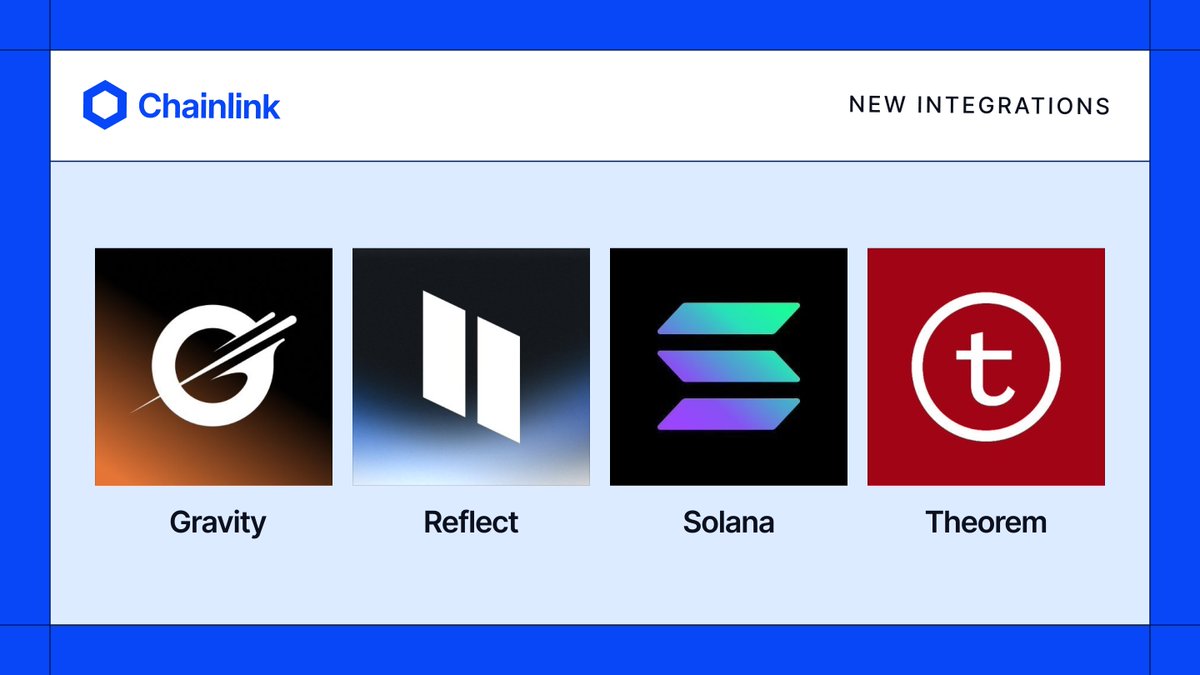
Look at Chainlink's latest integrations.
Gravity needs cross-chain transfers and market data. Reflect needs reliable pricing. Theorem is working on compliance, while Solana is exploring automated workflows through CRE.
Four different problems, yet they all point toward something bigger.
We're building an entirely new financial infrastructure, but its different parts still need ways to communicate, verify information, and follow common rules.
It's a bit like building the internet all over again.
Having powerful computers wasn't enough. They needed protocols that allowed them to communicate.
I wonder how much of blockchain's future will depend on solving that same problem.
Not particularly glamorous, I know. But neither were internet protocols when they were being developed.
#Chainlink #Interoperability
TODAY: New Chainlink integrations ↓
• @GravityChain: CCIP & Data Streams to power cross-chain WETH & USDC transfers and deliver high-speed market data.
• @reflectmoney: Data Streams to power verifiable pricing for PRIME & ReUSD.
• @solana: CRE to automate & orchestrate workflows across blockchains & existing systems.
• @theorem_markets: ACE to enforce compliance policies on exchange infra.
LINK everything.
200,000 TRANSACTIONS PER SECOND SOUNDS INCREDIBLE. UNTIL YOU REALIZE YOU HAVE TO STORE ALL THAT DATA.
Here's a problem I rarely see people discussing.
Imagine building a highway capable of handling millions of cars, but forgetting that every car also needs somewhere to go.
That's essentially the challenge blockchain developers face when scaling transaction throughput.
Sei's Giga upgrade is targeting 200,000 TPS.
At that scale, the network could generate as much historical state data in a single day as Ethereum has accumulated over roughly a decade.
That's an enormous engineering challenge.
Sei Labs is working on separating recent data from long-term historical records, so nodes don't have to handle everything in the same way.
And I actually think this side of blockchain development deserves more attention.
Because making transactions faster is impressive.
Making sure the infrastructure can handle everything those transactions leave behind? That's where things get complicated.
#Sei #GigaUpgrade #Blockchain #Scalability
At max speed, Giga will generate as much data in a single day as Ethereum has in its entire history.
Stock exchanges process millions of orders, cancels and trades every day.
Giga is built to carry that load onchain, and bring Nasdaq-grade markets with it.
ZEBEC JUST REVEALED SOMETHING MORE INTERESTING THAN ANOTHER PARTNERSHIP.
Actual businesses using blockchain for payroll.
According to Zebec, over 20 enterprise accounts are processing payroll through Stellar, with more than $5 million in reported volume.
But pay attention to how the system works.
XLM covers network fees, while ZBCN is used for payroll fees.
Stablecoin conversion helps keep things simple for businesses.
Now picture yourself managing payroll for hundreds of employees.
The last thing you want is to worry about blockchain tokens, wallets, or complicated transactions.
You just want everyone paid correctly and on time.
And that's where this approach starts making sense.
The remaining question is how much recurring economic activity these payments actually generate for ZBCN.
Processing payroll is a real service. Understanding who captures the economic value is what makes the business model worth studying.
#Zebec #ZBCN #Stellar #PayFi
20+ enterprise accounts now run payroll on @StellarOrg through Zebec, with $5M+ in payroll volume.
Network fees are paid in XLM and payroll fees in $ZBCN, with stablecoin conversion helping keep the experience simple for enterprise HR and finance teams.
@simonb_ldn explains.
DUSK HAS A NEW OPPORTUNITY TO GET NOTICED.
And getting noticed is only half the battle.
Dusk is sponsoring a Binance Pick campaign where eligible $DUSK trading activity can earn points for virtual predictions and leaderboard rewards.
I can see why this is useful for exposure.
Someone who has never researched Dusk might discover the project through the campaign and start exploring what it actually builds.
But there's a distinction I think is worth making.
A reward can convince someone to participate once.
A genuinely interesting project can give them a reason to stick around.
For Dusk, I'd be more interested in how many new people continue following the ecosystem after the campaign ends than in any temporary spike in attention.
#DUSK #BinancePick #Crypto
Dusk is sponsoring @binance Pick, powered by @predictdotfun.
→ Earn Scores through eligible dusk-network:native trading
→ Use them to make virtual predictions
→ Compete for a share of 1,000,000 USDC
Explore the campaign ↓
DUSK IS WORKING ON SOMETHING BANKS HAVE UNDERSTOOD FOR CENTURIES: FINANCIAL PRIVACY MATTERS.
Imagine if every time you made a bank transfer, the entire world could see how much money you sent.
Sounds ridiculous, doesn't it?
Yet public blockchains often expose exactly that kind of information.
Dusk's latest Phoenix improvements address a different challenge: how do you verify a private transaction without revealing its sensitive details?
Using zero-knowledge proofs, the system can check that transactions follow the rules without making everything public.
And the engineering is improving too.
Dusk reports 36% less CPU time for certain wallet ownership checks, alongside stronger transaction validation.
That might sound technical, but consider what it means for financial institutions handling sensitive information.
They need transactions to be verifiable. They don't necessarily want their customers' financial activity exposed to everyone.
Privacy and accountability aren't opposites. Good financial infrastructure should be able to support both.
#DUSK #ZeroKnowledge #Privacy #Blockchain
We've upgraded private transfers on Dusk.
The latest Phoenix releases brings stronger user protection, with more efficient proof generation.
Here's the simple version of what's improved ↓
→ Finding your funds (ownership checks)
Phoenix represents private funds as records called notes. Your wallet checks which ones belong to you. Each check now uses 36% less CPU time, so the same processing time can handle about 156 checks instead of 100.
→ Reading private amounts (note validation)
Your wallet decrypts a note to read its amount. Phoenix checks that the recovered amount is consistent with the note, rejecting mismatches. This helps prevent inconsistent payment data from being accepted.
→ Checking private transfers (zero-knowledge proofs)
A proof lets the network verify that a transfer follows the rules without seeing its private details. The updated proofs reject malformed keys and attempts to use the same note twice in one transfer.
→ Protecting the sender (sender encryption)
Phoenix uses random values to help hide sender data. The updated proofs reject values that could reveal a sender's key or make transfers linkable to the same sender.
→ Protecting key data (secret handling)
Phoenix now clears key's secret data from memory when discarded. It also hides secret key material and private proof inputs from debug output, reducing exposure when developers troubleshoot software.
These go live with Dusk's next network upgrade.
DUSK just made one of crypto's most annoying problems a little easier to deal with.
Be honest, have you ever checked a wallet address five times before sending funds? 😂
One wrong character can turn a simple transfer into a very expensive mistake.
Now Dusk Domains is live on mainnet, allowing users to replace those long addresses with readable .dusk names.
Registration starts at 10 $DUSK per year.
There's even a marketplace where names can be bought and sold.
I like the simplicity of this idea. Something as small as making wallet addresses easier to remember can improve the experience for everyday users.
Of course, readable names still need to be verified before sending funds.
And I'm curious to see whether people actually start using them regularly.
Crypto has spent years making the technology more sophisticated. Making it less intimidating might be just as important.
#DUSK #Blockchain #Web3
Dusk Domains is live on mainnet.
Give your long wallet address a memorable .dusk name.
→ Register from 10 dusk-network:native a year
→ Buy and sell names on the marketplace
Get yours today at https://t.co/fBLQ9tnicC
Bro, you literally said “nobody cares about utility.” 😂
I never said you personally don't value it. I challenged your claim about everyone else.
And sure, existing payment networks are massive. But their existence doesn't automatically mean there's no room for alternatives.
Whether VELO can compete is a separate discussion. Let's not confuse the two.
$VELO IS REACHING MORE USERS THROUGH NOW WALLET. AND THAT MATTERS MORE THAN YOU MIGHT THINK.
Here's something I've noticed about smaller crypto projects.
Having good technology isn't enough if people struggle to access it.
Imagine this, bro.
You've spent years building a project, improving its technology, and expanding its ecosystem.
But what happens if most potential users don't even know where to find it?
That's where platforms like NOW Wallet can make a difference.
VELO becomes accessible to people who already use crypto wallets, giving the project another opportunity to attract attention beyond its existing community.
And there's another benefit.
NOW Wallet isn't just providing access to VELO. It's also introducing its cross-border payment infrastructure to an audience already familiar with digital assets.
That doesn't guarantee adoption, of course.
But think about how many successful products started gaining traction simply because they became easier to discover and use.
#VELO #NOWWallet #PayFi
Cross-border payments need more than speed — they need the right infrastructure to connect traditional currencies and digital assets.
That’s where Velo comes in, combining collateral-backed digital credit with blockchain-based transfers to support real-world value movement.
Get $VELO on NOW Wallet 👇
🔗 https://t.co/b2D1LLaZxI
#Velo #Payments #DigitalAssets
AI CAN WRITE CODE. BUT DOES IT KNOW WHERE YOUR KEYS ARE?
That's a completely different challenge.😂
Imagine asking an AI assistant to find something in your house.
To answer properly, it would need to understand the layout of your home, recognize objects, and know where things are.
Now imagine connecting that same intelligence to a robot that could actually help you.
This is the direction Auki is exploring: giving AI systems spatial context and ways to interact with physical environments.
I find the idea fascinating because we've spent years teaching AI to understand language.
Now we're trying to teach it to understand the world around us.
And suddenly, a simple question like "Where did I leave my keys?" becomes a surprisingly complicated engineering problem.
#Auki #AI #Robotics #PhysicalAI
Smart homes and spaces on steroids: give your physical AI harness to any LLM and you can query/prompt it.
Of course, your robots plug right in, out of the box.
What if the best use case for $SHX is something people never even notice?
Picture yourself paying for coffee, sending money to a friend, or running a small business.
You probably don't care what technology processes those transactions.
You care about three things: speed, cost, and reliability.
Personally, I'd love to see SHx become part of a payment experience where the technology does its job quietly in the background.
But there's an important question for Stronghold to answer: what role would the SHx token actually play in making that experience possible?
Because using blockchain for payments is one thing. Giving a specific token a meaningful role in those payments is another.
And that distinction deserves attention.
#SHx #Stronghold #Crypto
If you could use SHx in your everyday life, what would that look like?
Payments? Transfers? Apps? Something else?
💬 Join the conversation in our Discord: https://t.co/dB1eM7b1Wl
The market doesn't care how certain you are.
You can spend weeks researching a project, understand its technology, study its competitors, and still watch its price move in the opposite direction.
And that's something I find fascinating about investing.
Knowledge gives us a better understanding of possibilities, but our brains have a strange habit of turning that understanding into a feeling of control.
Psychologists call this the illusion of control.
We start believing that because we've studied something carefully, we somehow have more influence over what happens next.
But think about it.
A thousand other investors might have reached entirely different conclusions using the same information.
And none of them gets to decide what the market does tomorrow.
There's a subtle difference between understanding a risk and believing you've eliminated it.
The first is knowledge. The second is a story we tell ourselves to feel safe.
SEI JUST TURNED 9 HOURS OF WORK INTO ABOUT 10 MINUTES.
And the funny thing is, most investors will probably scroll past this news.
It's not a flashy announcement about token prices or some massive partnership.
It's about making the network easier to operate.
Sei reports that certain snapshot operations are now 25–50x faster.
If you're running blockchain infrastructure, spending minutes on something that previously took hours is a pretty big deal.
I wouldn't confuse this with transactions becoming 50x faster, though. That's a different metric entirely.
Still, I have to give the developers credit.
Not every meaningful upgrade makes headlines. Some just make life a lot easier for the people doing the actual work.
#Sei #SEI #Blockchain
Last week Sei completed it's largest migration since 2024.
Nodes on Sei have become much faster and lighter to operate, with some operations improving 50x.
Sei will continue to implement the Giga Upgrade, becoming the ultimate trading blockchain.
“Nobody cares about utility” is a classic example of overgeneralization, bro. 😂
In psychology, it's a cognitive distortion where you take a few observations and apply them to everyone.
Just because memecoins have made people rich doesn't mean nobody values utility.
You're confusing what gets attention in a speculative market with what actually creates long-term value.
Nobody gets excited about payroll. Until blockchain starts handling millions of dollars of it.
Zebec's September report includes a number worth discussing: $55 million in reported monthly payroll volume.
That's an annualized pace of $660 million, assuming the volume stays constant.
Now imagine being one of the 16,000 employees Zebec says its services reach.
You probably don't care which blockchain processes your salary. You care that your money arrives reliably and is easy to access.
And that's what makes payroll such an interesting use case for crypto.
Zebec also reports 271 enterprise clients and over 25,000 cards issued.
These figures don't tell us everything about profitability or customer retention.
But they give us something concrete to examine beyond token prices.
Sometimes the most interesting developments in crypto look surprisingly ordinary.
#Zebec #PayFi #Blockchain
Zebec continued to scale throughout September.
Stablecoin payroll reached more markets, new networks joined the SuperApp and Zebec Cards, and enterprise adoption continued to grow across partners and products.
Our September recap. 👇
Eight years doesn't automatically mean failure.
Building financial infrastructure, developing products, and navigating regulatory requirements takes time.
VELO has evolved beyond its original concept, with developments around payments, cards, and ecosystem expansion.
Does that guarantee success? Absolutely not.
But dismissing eight years of development simply because the project hasn't achieved mainstream recognition seems like a pretty shallow way to evaluate it.
I'd rather judge what they're building, who actually uses it, and whether adoption is growing.