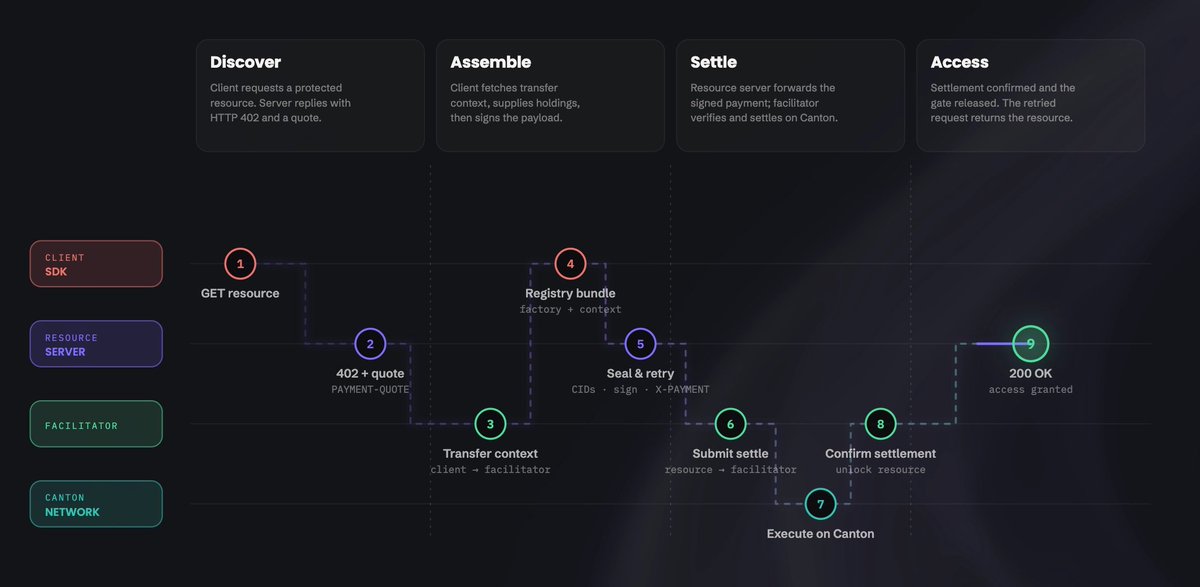
Announcing the ChainSafe x402 Facilitator, connecting institutional data to @CantonNetwork
Financial institutions can now instantly monetize internal datasets natively, without bulk data transfers or moving off legacy databases.
Learn more about account-free HTTP monetization below ⤵️
Super handy bird's-eye view of onchain credit coming each week.
Follow our friends at @sprinter_ux to keep up with RWAs, tokenization, all that good stuff.
Introducing the first edition of "This week in onchain credit".
The week's credit stories in one thread. Lending markets, RWAs, tokenization, and whatever the credit stack is quietly doing underneath.
Here's what moved this week 👇
Forest vs. Lotus: How do Filecoin's two primary implementations compare? We put both clients head-to-head under real traffic to analyze latency, resource efficiency, and feature parity. https://t.co/eO2SbmPyEQ
Forest vs. Lotus: How do Filecoin's two primary implementations compare? We put both clients head-to-head under real traffic to analyze latency, resource efficiency, and feature parity. https://t.co/eO2SbmPyEQ
Data monetization for banks usually hits a compliance wall.
The x402 Facilitator fixes this using Predicate Logic.
Autonomous agents pay micro-fees for cryptographic True/False answers.
Your raw records never leave the firewall.
for anyone that wants to join the network, it's very simple by running @lodestar_eth using our `chainsafe/lodestar:next` image with the `--network plataberget` flag 🐻❄️
There’s no gas to sponsor on Canton. That means anyone can self-host the Facilitator on their own infrastructure, with no dependency on a foundation. It’s just your data, your pricing, and your compliance posture.
https://t.co/MH5hKkhnkZ
We built the x402 Facilitator to solve our own problem. We had agents on @CantonNetwork that needed to pay for things, per action, with no human in the loop. It started as the payment layer under our MCP dev-assistant, Daml Autopilot, but we realized we had built something that stands on its own.
Institutions on Canton are sitting on high-value data that other institutions need: sanctions checks, compliance lookups, reconciliation. Today, that requires calls and bulk data agreements. Our x402 Facilitator changes the economics: agents can query a specific data point, pay per-answer, and never touch or see the underlying records.
Announcing the ChainSafe x402 Facilitator, connecting institutional data to @CantonNetwork
Financial institutions can now instantly monetize internal datasets natively, without bulk data transfers or moving off legacy databases.
Learn more about account-free HTTP monetization below ⤵️
Our first speaker announcement for ETHTaipei 2026: @MatthewKeil from @ChainSafeth, an Ethereum core developer and engineering manager of the Lodestar team.
Matthew returns after joining our 2024 Ethereum L1 R&D panel, where he discussed account abstraction, single-slot finality, MaxEB, and making Ethereum easier to use.
This year, his talk, “The Root of Trust: A Case for Optimism in Ethereum’s Future,” looks beyond how Ethereum works to what its trust layer makes possible.
He’ll explore how a root of trust maintained by no single institution can support ownership, provenance, identity, credentials, voting, supply chains, and public infrastructure.
Explore more and attend: https://t.co/QOVLAsmjhc
You don't rewrite a production Ethereum client all at once. That would make validation and rollout unnecessarily risky. You replace one performance-critical subsystem at a time.
Zig compiles to native code. lodestar-z exposes it to JavaScript through N-API, generated by zapi, our in-house binding library, which is the same interface Node already uses to load blst and hashtree.
Native performance where it earns its keep. A stable interface around it. A migration we can validate step by step.