In 2001, I tried to build what Starlink has become today, a satellite broadband service for businesses and remote users.
Way ahead of the curve, I bought transponders on traditional GEO satellites and leased connectivity. Clients connected via massive C-band dishes (think 8-12+ feet across, nothing like Starlink’s compact terminals).
We solved a real problem: delivering broadband where fiber couldn’t reach. But the economics were brutal.
Leasing transponders was expensive. Client terminals were costly to install and maintain. Service + upkeep prices were out of reach for most. Scaling was a nightmare.
I wasn’t alone. Teledesic, Iridium, and others poured billions into similar visions using traditional satellites and expensive rocket launches. Most failed or pivoted hard. The dependency on third-party launch providers, satellite manufacturers, and spectrum owners created an unbridgeable cost moat.
Fast forward: Elon Musk & SpaceX built the full vertical stack, reusable rockets, in-house satellites, laser interlinks, and rapid iteration. That moat changed everything. Starlink isn’t just better tech; it’s a fundamentally different business model.
Key lesson for founders planning startups today:
•Control your critical inputs. Don’t build a business hostage to suppliers who don’t share your urgency or economics.
•Obsess over unit economics from day one. High fixed costs + low margins kill even great ideas.
•Vertical integration (when it makes sense) can be your superpower. Elon didn’t just launch satellites, he reinvented the supply chain.
•Fail fast, but learn deeply. My experience taught me resilience and the power of first-principles thinking.
This is an amazing case study in why execution + moat-building beats being “first.” Huge respect to what @elonmusk and @SpaceX has achieved. The second internet is here.
What’s one supply chain or dependency you’re rethinking in your startup?
The future of driving isn’t being built.
It’s being computed.
At @Huawei, what stands out isn’t just another autonomous driving system, it’s the scale of intelligence behind it:
→ CNY 18B+ in R&D (2026 est.), the biggest in China, larger than the next 4 auto makers combined
→ AI cloud clusters scaling toward ~60 EFLOPS
→ Billions of kilometers of real-world driving data
Because in autonomy, data isn’t an advantage.
It’s the game.
While others rely heavily on simulation, Huawei is compounding actual driving behavior at scale, learning how humans react in real conditions, not ideal ones.
That’s where ADS 5 steps in:
• Multi-agent learning systems
• Real-time decision-making trained on real roads
• Safer edge-case handling
• More human-like driving responses
But here’s the bigger shift most people miss:
Huawei isn’t just building autonomous driving.
They’re building a full-stack intelligent mobility system.
With HarmonySpace 6, the car becomes:
→ A smart, adaptive cockpit
→ A seamless device-cloud experience
→ A high-end entertainment hub with immersive audio
→ A space optimized for comfort, safety, and personalization
So while Tesla pushes a vehicle-first approach…
Huawei is going compute-first, ecosystem-first, experience-first.
And that changes the game.
Because the winners won’t just build better cars.
They’ll build the intelligence behind them.
The Ten Commandments of Investing in the Age of AI
Both San Eng and me did a firechat on AI at the Phuket AI Summit 2026 and one thing is clear:
The AI era isn’t coming.
It’s already here.
Here is a summary from what we discussed on what separates investors who will thrive from those who will be left behind in the age of AI:
1. Never Stop Learning
AI commoditizes knowledge. Judgment is the edge.
2. Prepare for a Multi-Polar World
AI power is shifting. Think beyond one market.
3. Be NAILAI or Be Irrelevant
AI-native + Lean is the new default.
4. Build Your AI Workforce
Winners deploy agents, not just hire people.
5. Own Your Data
No data = no moat.
6. Embrace East/West AI
The biggest opportunities sit in the intersection.
7. Software is Free. Distribution Wins
Product alone is no longer enough.
8. Invest in Builders
Ignore hype. Follow execution.
9. Brand is Your #1 Asset
Trust will be the scarcest currency.
10. Design for a Work-Optional Future
AI isn’t about working more, it’s about freedom.
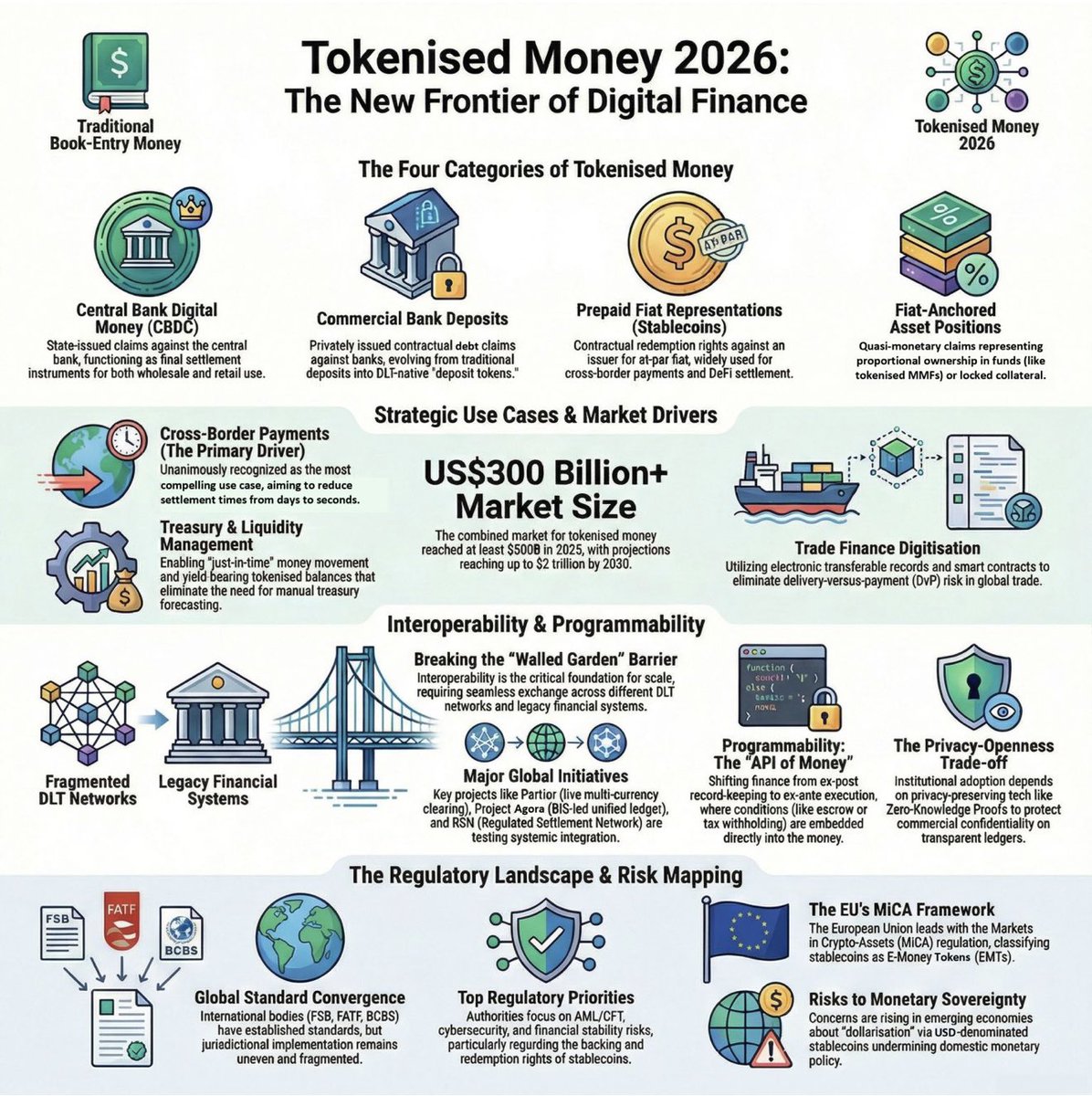
Tokenized money is reshaping our financial landscape, representing traditional assets on the blockchain, think cash, deposits, and securities while enhancing accessibility and efficiency.
Benefits of Tokenized Assets:
1. Stability: Stablecoins offer a digital currency that's pegged to stable reserves, reducing volatility.
2. Efficiency: Instant transactions and reduced settlement times are game-changers for global finance.
3. Accessibility: Lower entry barriers enable diverse participation in financial markets.
4. Transparency: Every transaction is recorded on the blockchain, enhancing trust and security.
Future Uses:
Imagine a world where cross-border payments are seamless and instant, or where real estate transactions occur on smart contracts without layers of bureaucracy. From central bank digital currencies (CBDCs) to tokenized commodities, the possibilities are endless!
Credit : Chiara Munaretto
Tokenized Money: What It Really Means
Think of it as money getting a major software update, not becoming something new
The Big Picture
Tokenized money isn't about inventing a new kind of currency. It's about making existing money work faster, smarter, and 24/7. According to Cambridge University research, we're looking at an infrastructure upgrade, not a financial revolution.
What Actually Changes?
Speed becomes the superpower
Money will move in real-time, any time. No more waiting for bank processing windows or business days. This particularly transforms international payments, currently plagued by delays and money stuck in transit.
Automation replaces manual work
Through programmability, payments can execute automatically when conditions are met. Think of it like setting rules: "Pay the supplier only when goods are delivered and verified." This cuts out middlemen, reduces errors, and builds trust into the transaction itself.
The system becomes always-on
Banks currently close. Markets have hours. Tokenized money doesn't sleep. This unlocks entirely new ways for global businesses to operate.
The Real Challenges
Systems that don't talk to each other
The technology works. The problem? Different banks, blockchains, and countries use incompatible systems. It's like having a great phone that can't call half your contacts. Without solving this interoperability problem, tokenized money stays fragmented and limited.
Geography determines destiny
Different countries are writing different rules. Where you're based will increasingly determine which tokenized money systems you can access and how useful they are. This regulatory patchwork is actively shaping winners and losers.
The Future Landscape
We're not heading toward banks or crypto. We're heading toward banks and crypto, a hybrid system where traditional financial institutions run on tokenized infrastructure. It's convergence, not replacement.
The question isn't whether money gets tokenized. It's how fast interoperability gets solved and which jurisdictions create the most enabling environments.
Openclaw : The AI Agent That’s Quietly Killing Legacy Business Models
As an entrepreneur and technologist who has seen and witnessed tech disruptions from the dot-com boom to the crypto crash, I’ve seen tools that promise to change everything. But OpenClaw? This open-source AI agent isn’t just hype, it’s a seismic shift. Here’s why it’s game-changing, how it’s torching old business models, and what it means for the future of work.
First, what is OpenClaw?
Born from the mind of developer Peter Steinberger, it’s an autonomous AI assistant that runs locally on your device (Mac, Raspberry Pi, even a cheap VPS). It doesn’t just chat, it acts. Clears your inbox, books flights, manages calendars, runs scripts, all via WhatsApp or Telegram. Open-source, community-driven, and exploding in popularity since late 2025. It’s agentic AI made real.
Why game-changing?
Traditional AI like ChatGPT generates text. OpenClaw executes. It has persistent memory, integrates with APIs, and learns from interactions. Need to negotiate a deal? It can browse, email, and haggle. For individuals, it’s a personal COO. For teams, a shared brain. In weeks, it’s gone viral with hundreds of thousands of users, faster than any GitHub project in history.
Now, disruption: Business models are crumbling. Virtual assistant services? Obsolete, why pay humans $20/hour when OpenClaw does it for pennies in API costs? Software companies selling task management tools? Redundant. Even big tech’s walled gardens (Siri, Alexa) look archaic next to this open, customizable beast. Consultancies, admin firms, low-level IT support—poof. We’re talking billions in legacy revenue evaporating.
The future of work? Brutal honesty: Many jobs will vanish. Routine admin, data entry, basic customer service, scheduling, AI agents like OpenClaw handle them better, faster, 24/7. White-collar roles aren’t safe; junior analysts, paralegals, even some marketers could be automated. McKinsey estimates 45% of work activities could be AI-disrupted by 2030. With agents mainstream, that’s accelerating to mass displacement.
Picture the future: AI agents everywhere by 2030. Your “workday” shrinks, agents handle grunt work, leaving humans for high-level strategy, creativity, and relationships. Businesses become lean: A startup with 5 people + 50 agents outpaces a 500-person corp. Society? Universal basic income debates intensify as inequality spikes. But innovation booms—agents democratize expertise, letting anyone build apps, analyze markets, or run ops.
How does it look? Optimistic view: A renaissance. Humans focus on meaning, art, science, exploration. Pessimistic: Ghost towns of unemployment, social unrest if we botch the transition. Reality? Somewhere in between. Agents won’t “take all jobs,” but they’ll redefine them. The winners? Those who wield AI like a superpower.
What should people do to prepare? Don’t panic, pivot. First, get AI-literate: Experiment with tools like OpenClaw now. Learn prompt engineering, agent customization. Second, build irreplaceable skills: Emotional intelligence, complex problem-solving, ethical decision-making, stuff AI sucks at. Third, diversify: Side hustles in AI consulting or creative fields. Reskill via online courses (Coursera, edX). The key? Adaptability over expertise.
For kids: Whatever they’re studying might indeed be obsolete by graduation. STEM is great, but pair it with humanities, philosophy to grapple with AI ethics, arts for creativity AI can’t mimic. Teach them coding not as a job, but to command agents.
Encourage entrepreneurship: Build with AI, not against it. Schools must shift from rote learning to project-based, AI-augmented education. Obsolete curriculums? Time to disrupt education too.
Honored to be included into the Top 100 B2B Thought Leader for APAC 2026 by @thinkers360. Congrats to all the top 100 experts for making into the list!
Thanks Thinkers360 for the inclusion!
Source : https://t.co/mB0b22yJiK
ARK Invest Cathie Wood just dropped the mic: Tokenized assets exploding from ~$20B today → $11 TRILLION by 2030.
Public equities, sovereign debt, bank deposits, all moving onchain at scale.
This isn’t hype. This is the future of finance. 🚀
Beyond exchanges & stablecoins, @cz_binance highlights 3 massive growth areas for crypto:
1️⃣ Tokenization: Governments are exploring tokenizing assets to unlock financial gains and develop industries.
2️⃣ Payments: Crypto will increasingly underpin traditional payment methods, creating seamless bridges for users & merchants.
3️⃣ AI: Crypto will be the *native currency* for AI agents. As AI evolves into true agents, their transactions will naturally be in crypto, not traditional bank cards!
The future is decentralized and intelligent!
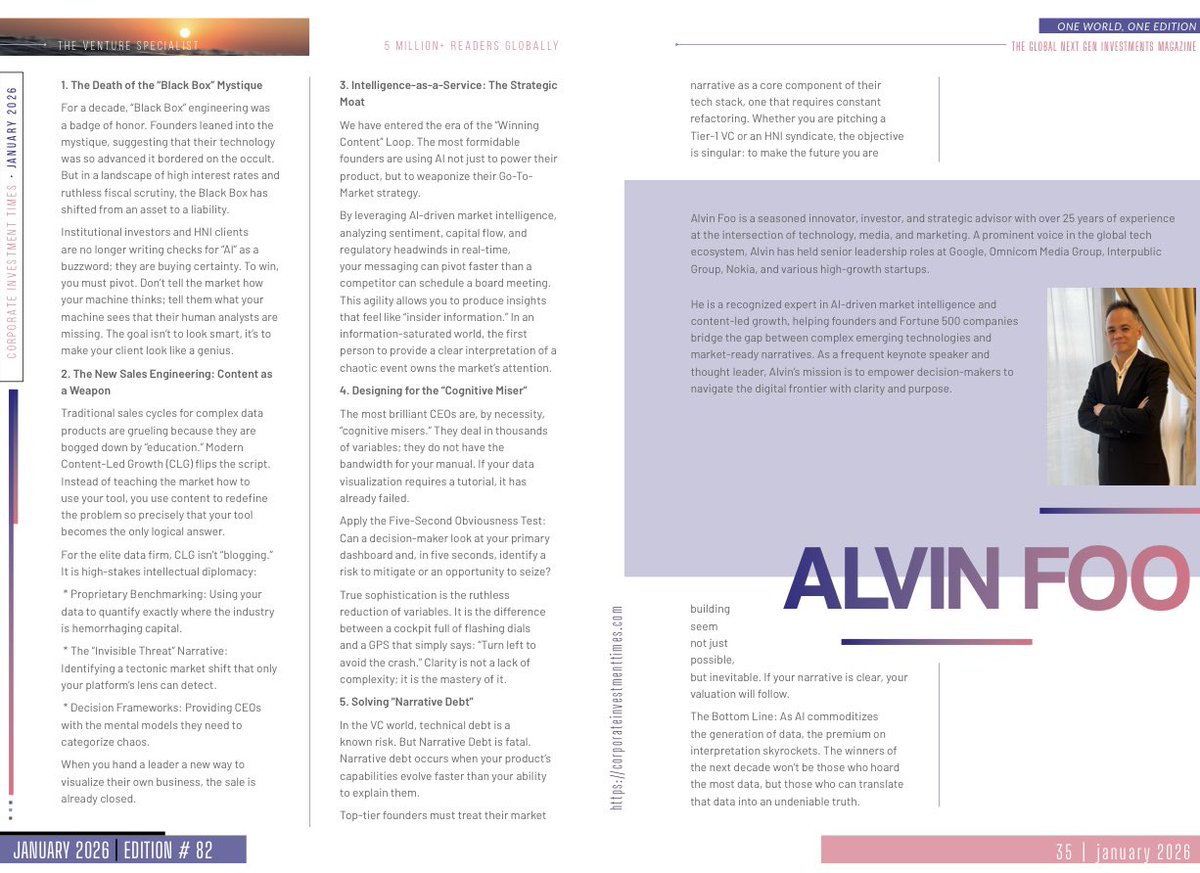
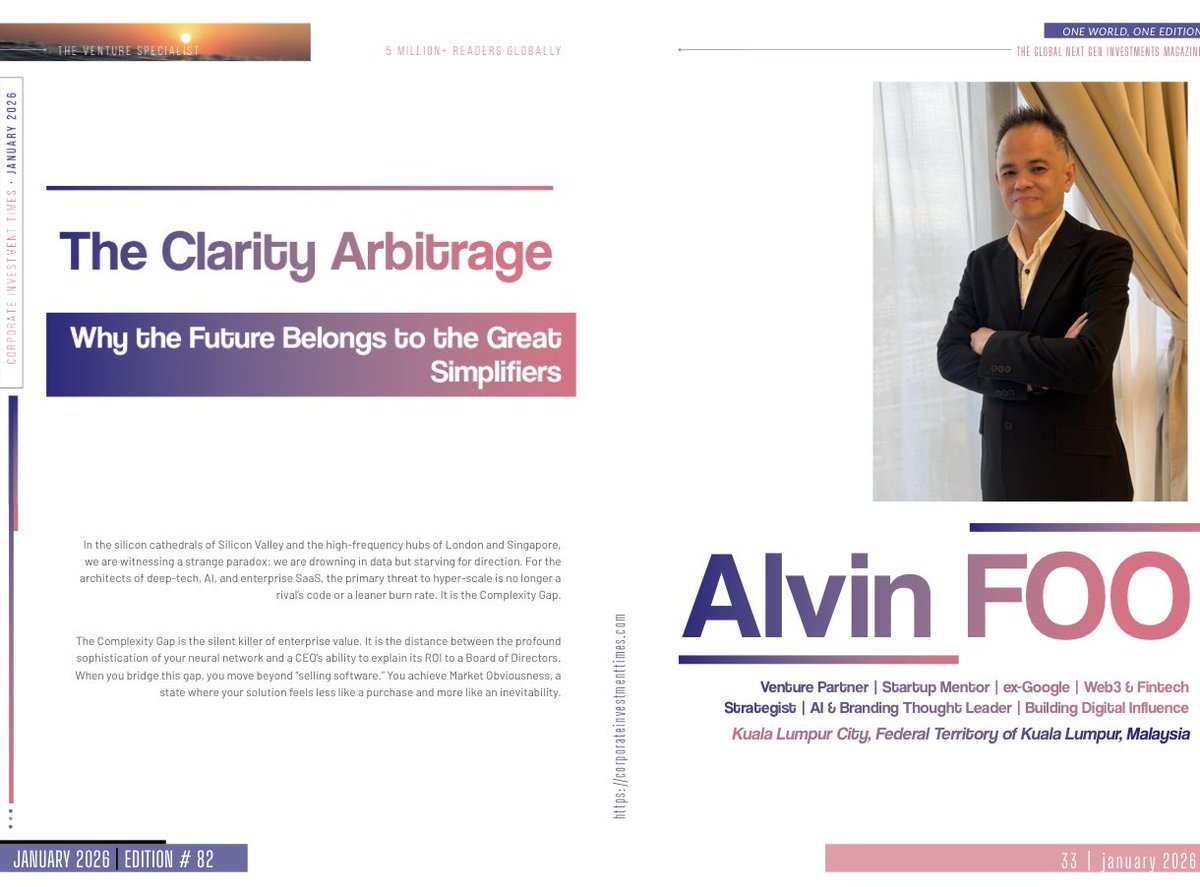
Read my latest article on AI where I was featured with other industry leaders sharing our views on AI, New Energy, Deep Tech, Quantum Technologies, Defense Tech, Institutional Finance, Real-World Adoption (tokenized assets & private markets), and Aerospace.
Congrats to all the leaders who are featured on this edition of Corporate Investment Times and thanks to Gareema Maheshwari for the inclusion.
Download your FREE PDF copy of the January 2026 edition here: https://t.co/Th1zdmUQ4Y
Why is Tokenization a structural transformation for financial markets, not just a simple tech upgrade?
@The_DTCC’s Dan Doney highlights blockchain's unique ability to form a "consensus record of ownership in near real-time at global scale." This means all parties get the same ground truth instantly, fundamentally streamlining back-office operations and eliminating massive reconciliation efforts.
Tokenized Stocks are the Future!
@Coinbase CEO Brian Armstrong believes the forces behind the stablecoin surge could soon revolutionize U.S. equities.
Why It Matters:
- Global access to U.S. stocks
- 24/7 trading
- Fractional ownership by default
- Easier settlement and payments
Get ready for the next big thing in tokenization on RWA! 🚀🚀
Metafyed and NXMarket just announced a strategic partnership to expand compliant access to tokenized real-world assets from tokenized securities and yield-bearing instruments to equities, options, and more by leveraging NXMarket’s regulated digital securities infrastructure.
This collaboration aims to make issuance, trading, and settlement of digital securities simpler, safer, and more transparent, helping bridge the gap between traditional finance and digital markets while reaching beyond current crypto adopters.
2026 is shaping up to be the year tokenization moves from debate to real adoption, with compliance, secondary trading, and regulated access at the forefront.
Read more : https://t.co/eDGf3JC3Nu
$META #RWA @NXMarket
BNY CEO Robin Vince calls TOKENISATION a MEGA TREND:
“As mentioned RWA Tokenisation will be the Next BiG Thing globally and tokenisation will happen to Big and Small Companies Globally. Those that ignore it will lack behind …”
The next Trillion-Dollar Crypto Market isn’t DeFi, it’s RWAs!!
RWAs aren’t a crypto trend. They’re becoming financial infrastructure.
By 2026, Real-World Assets (RWAs) have quietly crossed a line:
They’ve moved from experiments to institutional-grade building blocks.
What’s changed?
• Tokenization is no longer about hype, it’s about utility
• Real estate, treasuries, private credit, commodities, and ESG assets are moving on-chain
• Banks, asset managers, and funds are adopting RWAs for liquidity, faster settlement, and programmable compliance
• DeFi is no longer isolated, it’s merging with TradFi through RWAs
• “Digital vs real” assets is a false debate, everything becomes programmable
The real signal?
RWAs aren’t trying to replace the financial system.
They’re upgrading it.
Direction from here:
•2026–2028: Infrastructure + regulation solidify
•2028–2030: Trillions in assets tokenized
•Post-2030: RWAs become the default rails for capital markets, trade finance, and yield
Crypto isn’t becoming more speculative.
It’s becoming more boring, regulated, and useful and that’s exactly why it will scale.
The question is no longer “Will RWAs matter?”
It’s “Who controls the rails when everything is on-chain?”
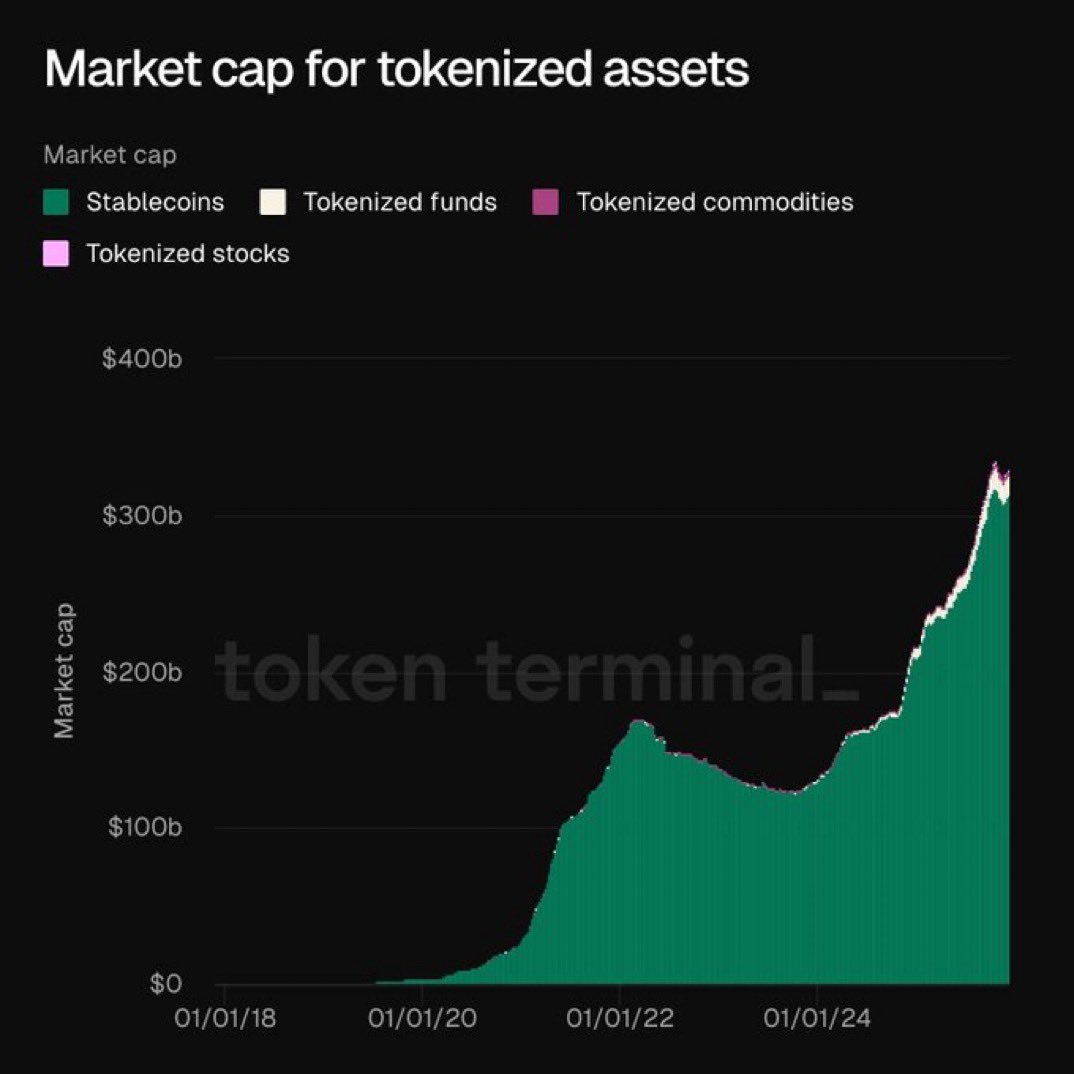
Tokenization is no longer a future narrative, it’s a live market.
Tokenized RWAs just hit a new ATH at $330B, led by stablecoins, tokenized funds, commodities, and stocks (via Token Terminal).
This isn’t hype.
It’s capital moving on-chain.
The rails for global finance are being rebuilt in real time, faster, more liquid, more accessible.
RWA momentum is undeniable.
Follow @nasdex_xyz & @metafyed to receive more updates on tokenization in RWA.