This #GivingTuesday, you can support effective policy change across the nation! Your contribution will help us host regional convenings that offer critical policy resources and know-how to support community health goals. https://t.co/p1FQpsNPgC
A new blog from @ChangeLabWorks and @Brown_SPH argues that proactive rather than complaint-driven enforcement of public health laws like those affecting housing is essential to avoid worsening health disparities: https://t.co/y1GHnhnAw6
By bringing together people who are working on issues related to housing, #ADHD, Tourette syndrome & #ChildrensMentalHealth, we can reduce many of the challenges that prevent children from living in safe, stable & affordable homes.
Learn more: https://t.co/0IOSTBBCvC
As I reflect on the election results, what they mean for our nation, for our work in public health policy, and for our communities, I know that as advocates and changemakers, our collective heritage is one of determination, hope, and resilience.
https://t.co/qekiP8gs2r
I’m excited to share the second entry in my Democracy & Governance blog series, which highlights the importance of community involvement in state and local elections and policymaking. https://t.co/qUNOE746CO
#LocalGov#StateGov#Voting
OPINION: Big Soda’s ads on Santa Cruz’s Measure Z fail to tell the full story https://t.co/P36uCt5eUb ⬅️ Dr. John Maa of @AHACalifornia and Sabrina Adler of @ChangeLabWorks on proposed sugary beverage tax
A new blog from authors @ChangeLabWorks and @Brown_SPH argues that proactive rather than complaint-driven enforcement of public health laws like those affecting housing is essential to avoid worsening health disparities: https://t.co/f16y0Qt3xP @NLIHC@NILC
Inspiring panel on democracy and health - big takeaways - voting allows us to hold policymakers accountable, voting impacts our lives at all levels from local to global, our work doesn’t stop on Nov 5, it’s only beginning. #apha2024@ChangeLabWorks
As jurisdictions continue to make changes to the authority of #PublicHealth departments, it is critical to examine the legal authorities that can affect preparedness for and response to emerging and zoonotic infectious diseases.
Read our new resource: https://t.co/HFCd9dQ2Rb
A10: In 50 years, we hope to—and believe we can—be talking about lead poisoning like an old health & environmental hazard from another time! We need buy-in from governments at all levels & a concerted effort along with community & private industry partners. #NLPPWchat#NLPPW2024
#NLPPWchat Q10: In keeping with the theme of bright futures, what’s your vision of how we’ll be talking about lead poisoning 50 years from now? What partners will help us realize that vision? (Maybe you met one of them today? Don’t forget to tag them!) #NLPPW2024#LeadFreeKids
A7d: Funding at scale is the biggest barrier to finishing the fight against lead. We’ve been excited to see innovation in approaches to financing this work (we’re looking at you, @LeadSafeCLE) and hope to see even more advances in this space. #NLPPWchat#NLPPW2024
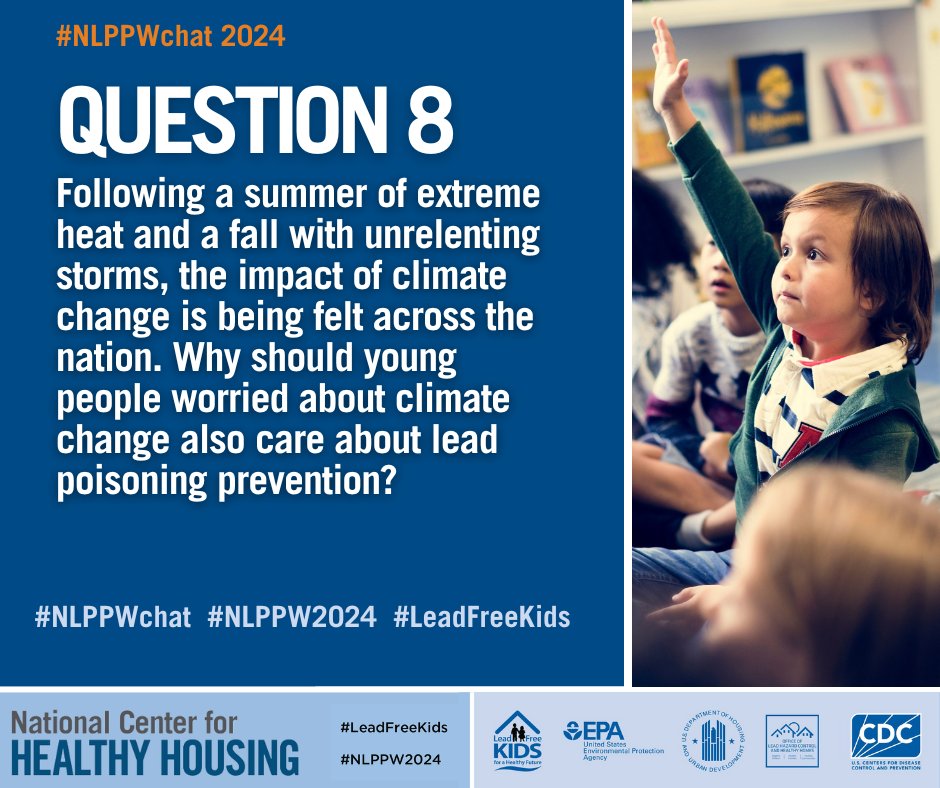
A8b: Climate change may also end up forcing people to spend less time outside and more time in their houses, increasing overall potential housing-related lead exposure. #NLPPWchat#NLPPW2024
A8a: Both are environmental justice issues that disproportionately impact vulnerable communities! Climate change will likely further stress/degrade existing housing structures, potentially leading to increased lead exposure. #NLPPWchat#NLPPW2024
#NLPPWchat Q8: Following a summer of extreme heat and a fall with unrelenting storms, the impact of climate change is being felt across the nation. Why should young people worried about climate change also care about lead poisoning prevention? #NLPPW2024#LeadFreeKids