We're pleased to announce the QIP 2027 call for submissions. The key dates are as follows; refer to the website https://t.co/dDji42FJTD for detailed instructions.
A question for quantum info community and QIP program committee: how would you review AI-generated solutions to important problems in our field? There are already examples of very strong results which several teams claimed simultaneously. 1/n
I am very happy to be part of this project on classical simulation of fermionic dynamics beyond the noninteracting regime.
In our new paper, we study fermionic systems initialized in a product of fermionic magic states and evolving under particle-number-preserving fermionic Gaussian transformations.
https://t.co/N0LyMNhQFm
While sampling from the resulting quantum states is believed to be hard for classical computers [1] , we prove that, quite surprisingly, several quantities related to this scenario can be classically approximated efficiently up to additive accuracy:
-output probabilities
-Majorana product expectation values in the output state
-transition amplitudes
These findings have consequences to quantum alghorithms used for quantum chemistry [2] and can be used to benchmark certain regimes of recent Phasecraft experiments implementing Fermi-Hubbard dynamics [3].
Many thanks to my amazing collaborators @ChanghunOh6 , @ZoltanZimboras , and Olivier Reardon-Smith.
[1] M Oszmaniec, N Dangniam, MES Morales, Z Zimborás, Fermion sampling: a robust quantum computational advantage scheme using fermionic linear optics and magic input states, PRX Quantum 3, 020328 (2022)
[2] W. J. Huggins, B. A. O’Gorman, N. C. Rubin, D. R. Reichman, R. Babbush, and J. Lee, Unbiasing fermionic quantum monte carlo with a quantum computer, Nature 603, 416 (2022).
[3] F Alam, Fermionic dynamics on a trapped-ion quantum computer beyond exact classical simulation, arXiv:2510.26300
Noisy boson sampling is shown to retain classical hardness even when a logarithmic fraction of photons are mutually distinguishable.
https://t.co/YZEQhAs7Ck
Gaussian boson sampling reproduces distributions that are hard to calculate classically and were claimed to show quantum advantage in the noiseless limit. But now a classical algorithm is shown to reproduce experimental results when noise is large.
https://t.co/ztTYCq3vVR
Share our recent work (https://t.co/BKOQ8JYwba). We show that a bosonic random displacement channel can be learned to good precision efficiently and robustly with entanglement, while any entanglement-free scheme requires exponentially many samples to achieve the same task.
It has been suggested that Gaussian boson sampling may provide a quantum computational advantage for calculating the vibronic spectra of molecules. Now, an equally efficient classical algorithm has been identified.
https://t.co/TD7fltQddX
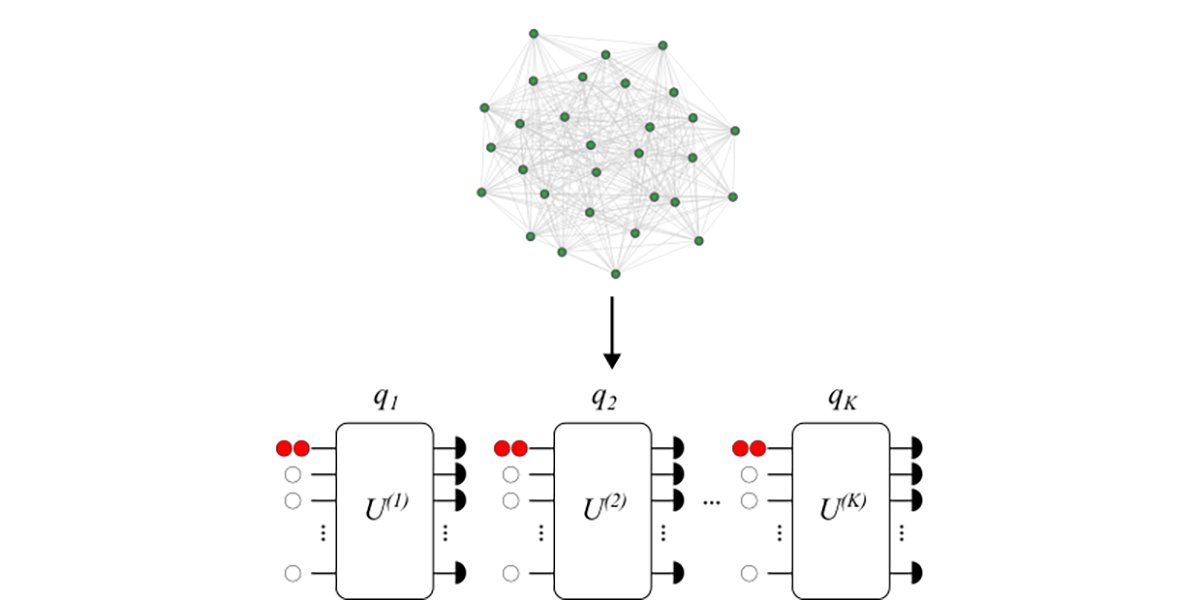
A quantum-inspired classical method is employed to solve graph theory problems with a comparable performance to Gaussian boson sampling. @UChicagoPME
📝 https://t.co/LcBCHU146i





![MichalOszmaniec's tweet photo. I am very happy to be part of this project on classical simulation of fermionic dynamics beyond the noninteracting regime.
In our new paper, we study fermionic systems initialized in a product of fermionic magic states and evolving under particle-number-preserving fermionic Gaussian transformations.
https://t.co/N0LyMNhQFm
While sampling from the resulting quantum states is believed to be hard for classical computers [1] , we prove that, quite surprisingly, several quantities related to this scenario can be classically approximated efficiently up to additive accuracy:
-output probabilities
-Majorana product expectation values in the output state
-transition amplitudes
These findings have consequences to quantum alghorithms used for quantum chemistry [2] and can be used to benchmark certain regimes of recent Phasecraft experiments implementing Fermi-Hubbard dynamics [3].
Many thanks to my amazing collaborators @ChanghunOh6 , @ZoltanZimboras , and Olivier Reardon-Smith.
[1] M Oszmaniec, N Dangniam, MES Morales, Z Zimborás, Fermion sampling: a robust quantum computational advantage scheme using fermionic linear optics and magic input states, PRX Quantum 3, 020328 (2022)
[2] W. J. Huggins, B. A. O’Gorman, N. C. Rubin, D. R. Reichman, R. Babbush, and J. Lee, Unbiasing fermionic quantum monte carlo with a quantum computer, Nature 603, 416 (2022).
[3] F Alam, Fermionic dynamics on a trapped-ion quantum computer beyond exact classical simulation, arXiv:2510.26300](https://pbs.twimg.com/media/HHLjXPEXoAE9Fs0.jpg)