🪇Disambiguating Pauli noise in quantum computers
https://t.co/vjFfFQkKjq
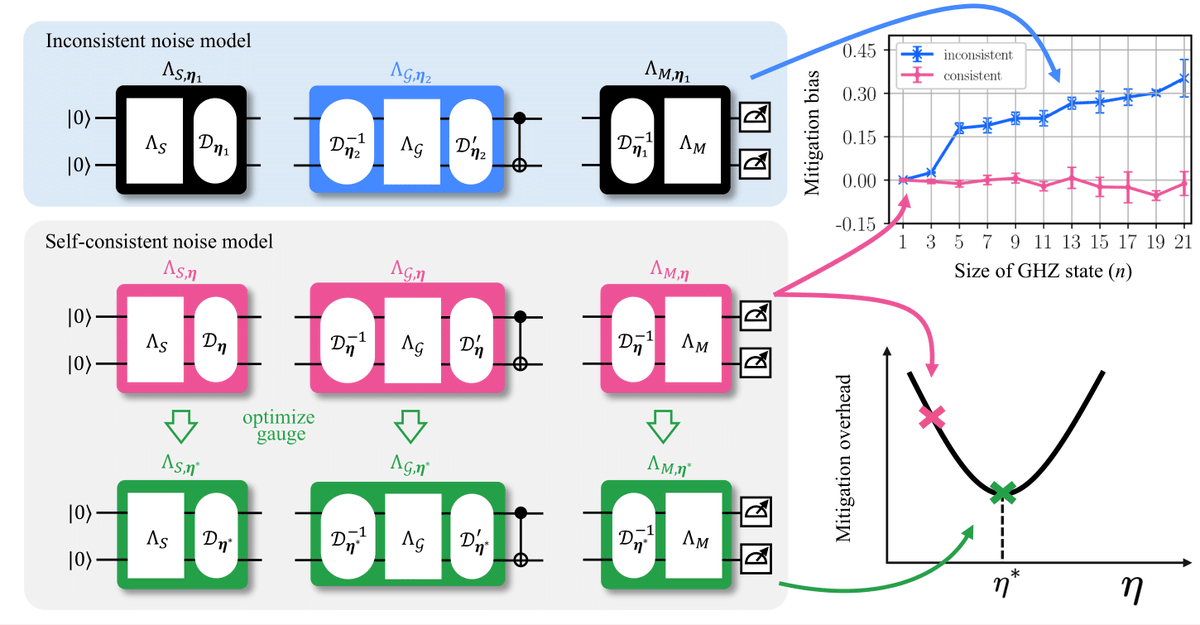
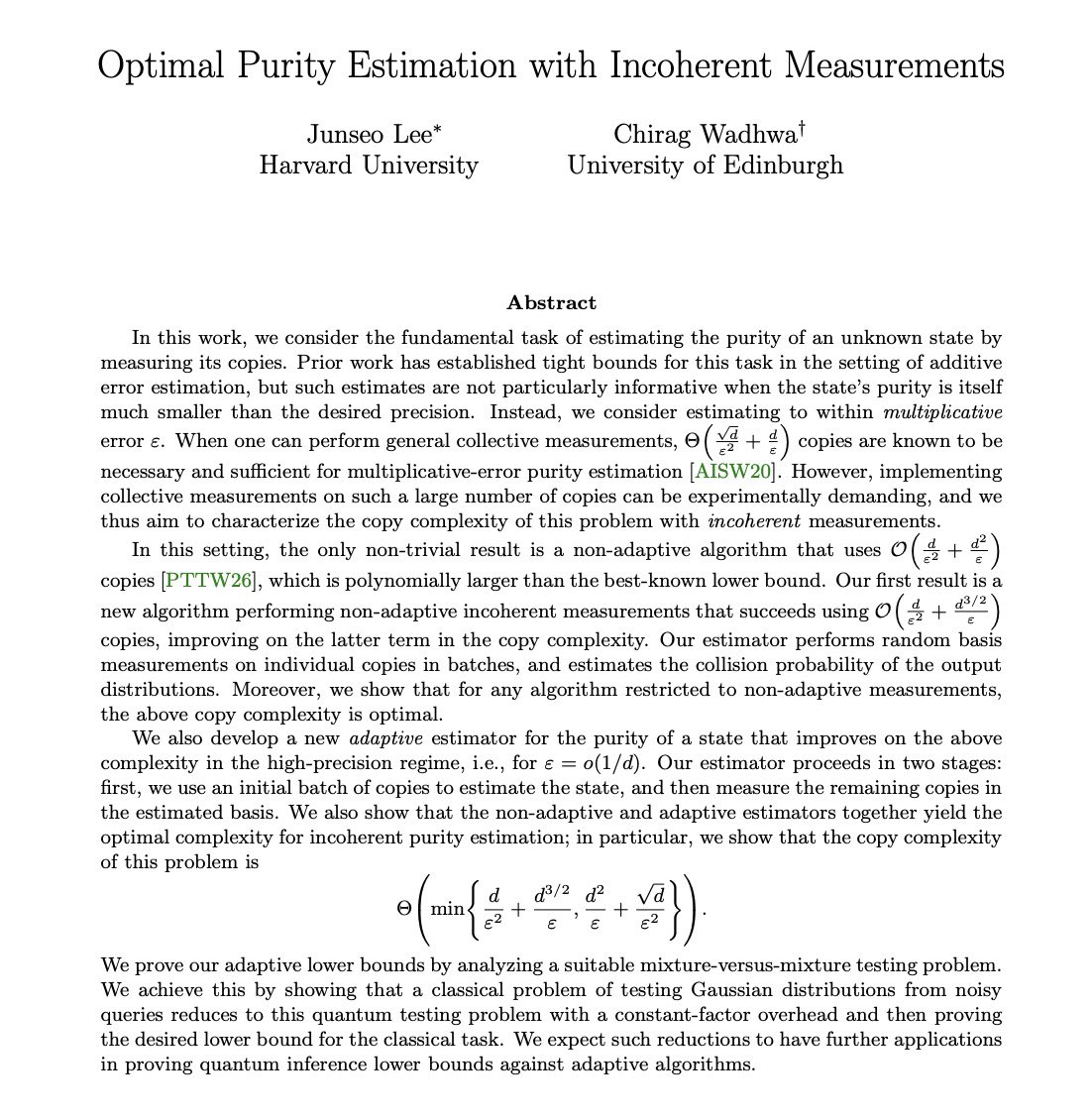
Quantum noise characterization suffers from "gauge ambiguity" due to noisy initialization and measurements. We show this does not stop us from correctly mitigating errors, with up to 92-qubit experiments
I’m excited about two papers we posted this week.
The first, with Chris Pattison and Jeongwan Haah, proposes a design for a fault-tolerant quantum processor that receives instructions via just a few external wires, a promising step toward a more scalable solid-state quantum architecture.
https://t.co/XfRuFSeMzh
The second, with Yuanxi Liu and @RobertHuangHY, constructs an efficient quantum algorithm that outputs the phase diagram of a many-body quantum system, a potentially powerful tool for physics discovery.
https://t.co/VC0gYIeOR0
It occurs to me that all my co-authors, who did almost all the hard work, are my current or former students. I feel lucky.
This is awesome! SETI@home, but for math formalization: this puts your weekly unused tokens towards formalizing projects of your choice on https://t.co/3jiVF78aaa. Maybe someone can make a version that works on ChatGPT? @or_sattath hopefully you’re taking pull requests? :-)
🚀 STOC 2027, a flagship conference in theoretical computer science, made all 1,665 submissions publicly available. So we launched the STOC 2027 Formalization Initiative on Prove2Me!
Our AI agents have translated the main theorems and supporting lemmas of 1,496 submissions into Lean 4 statements!
Some already have completed proof formalizations, with many more awaiting contributions.
You don't need to know Lean or fully understand the underlying mathematics to get started! If you know how to work with AI agents, you can help formalize proofs.
We invite authors, researchers, and the broader community to explore these formalized statements, check them against the original papers, and contribute proof formalizations!
📊 Explore the initiative: https://t.co/KJWtxfRKLB
🤝 Contribute proof formalizations: https://t.co/aQ1NKnO1c0
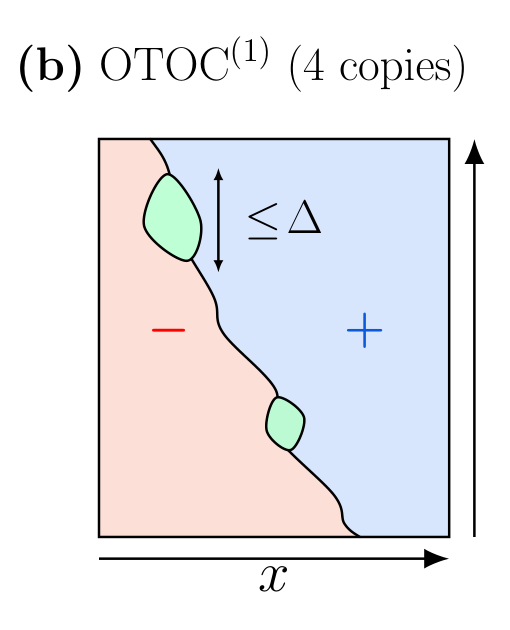
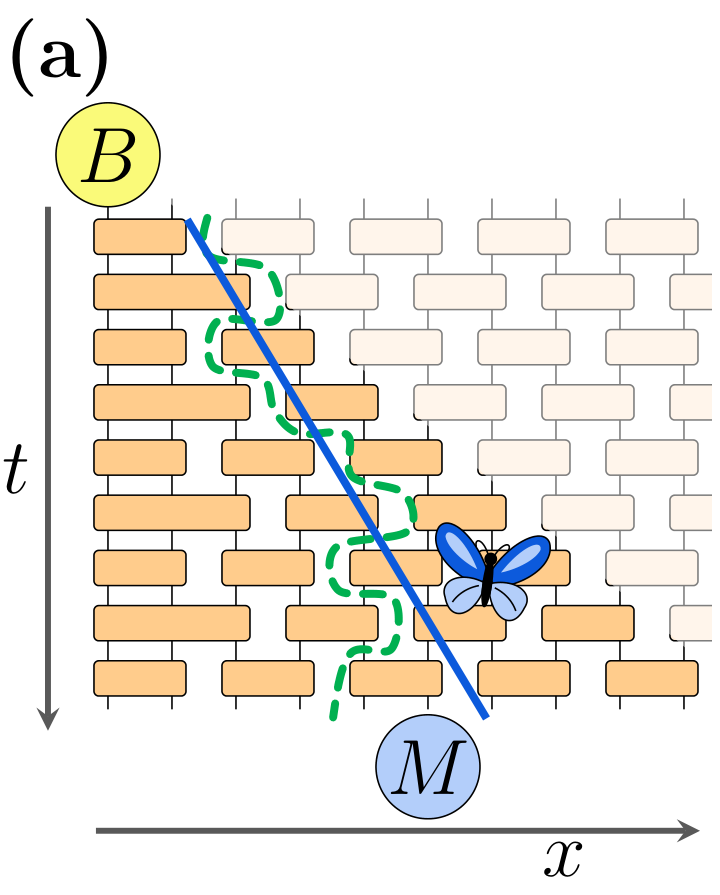
Our new paper: an efficient classical algorithm for simulating OTOCs in 1D chaotic random circuits! 🧵
My takeaway: the right representation can turn apparently intractable chaos into something very simple.
https://t.co/Mc9Fh1d4Hf
STOC 2027 received 1665 submissions. In a bold new experiment, all submissions (and author identities) are immediately made public. This is the most immediate and revealing posting of any conference I am aware of.
Take a look and see what you find!
https://t.co/Ph7RKx6jhc
New paper with @MCrichigno at @Phasecraft. AI agents optimize quantum circuits, and an exact verifier checks every result. https://t.co/haFEoS9CIP
The challenge itself is automated too. An agent works with a researcher to build the verifier, tests it, and freezes it. Then the agents compete.
We observed large gains on every problem we tried, from fermion-to-qubit encodings to qubit routing and unitary synthesis. The method applies to any problem with an exact checker.
It's great to see others working in the same direction this week. Excellent papers from Google Quantum AI and Harvard/QuEra/Anthropic:
https://t.co/eiFwH9kPgU
https://t.co/wFQb4hhfCT
and the inverse square root challenge:
https://t.co/WZLXv9pRWN
Student @Caltech Saleh Naghdi urges scientists to create short videos that explain their work. An example: this 1.5-minute video abstract for his recent paper on simulation of quantum spin systems.
https://t.co/3Nwg51CGDX
As there's renewed interest in quantum waveform metrology, here's a review of our work. https://t.co/rGYyJAcHdB Related work: https://t.co/yYZwqqLzHW, https://t.co/6RnnUjTftJ, https://t.co/ayn1nb3gnO, https://t.co/yJ4FVYbAP5, https://t.co/ayn1nb3gnO
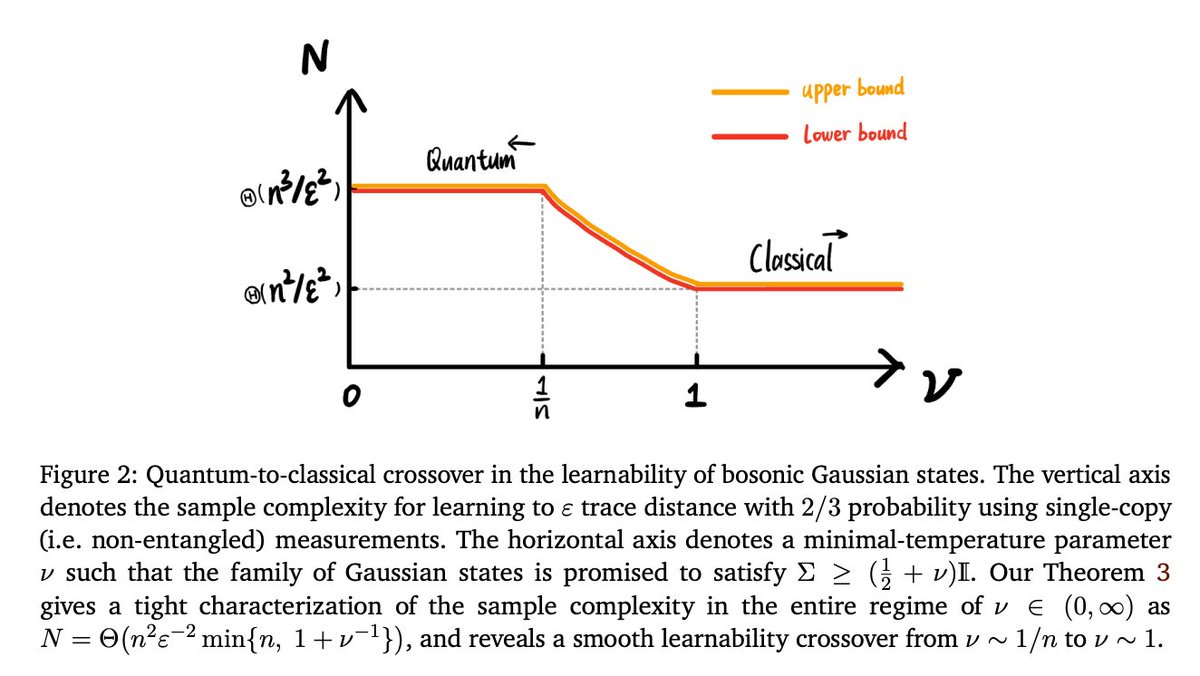
In our new work, we touch one of the beautiful fundamental questions at the heart of quantum physics: when does classical behavior emerge from quantum systems?
We study this question through the lens of learning bosonic Gaussian states, and find a precise quantum-to-classical crossover in their learnability as thermal fluctuations increase. Cold Gaussian states are intrinsically quantum to learn, while sufficiently warm ones can be learned with the same sample complexity as classical Gaussian distributions, using operations that are just as simple.
Thanks a lot to my collaborators @CSenrui, @FrancescoMeleAn, and @preskill for all their great work! I'm also grateful for my visit to Caltech in March, where I had the nice opportunity to brainstorm this project in person with them!
ArXiv link: https://t.co/9rI1aF1Q31
I am happy to see that two projects of mine have recently been published in Nature Communications and PRX Quantum. I would like to share what these two projects mean to me.
[1] Entanglement-enhanced learning of quantum processes at scale
We designed and experimentally demonstrated how entanglement can be used to enhance quantum noise characterization in practice, with a substantial speed-up and without sacrificing precision. This project initially stemmed from (and subsequently stimulated) a series of my theoretical works on exponential entanglement advantages in Pauli channel learning. This is also the project that took me the longest time to complete: it started in 2021, when I was a first-year PhD student, and was published in 2026, when I was in the second year of my postdoc.
[2] Disambiguating Pauli noises in quantum computers
We designed and experimentally demonstrated a scalable quantum error mitigation protocol addressing the issue of “gauge ambiguity,” achieving improved precision and efficiency over state-of-the-art protocols. This work is a culmination of the theory we developed around the learnability of Pauli noise over the past several years.
When we first started both of these projects, although I had some nice theoretical frameworks in mind, I had no idea whether those ideas would work in the real world. In fact, there were good reasons to expect that they wouldn’t work (as our Referee 2 also pointed out 🙂): for example, using entanglement in quantum noise characterization might introduce more noise than the advantage it provides. It is really thanks to close theory-experiment collaboration, and multiple years of failed attempts, debugging, and developing new ideas, that we were finally able to make those ideas work on real devices. These were very different experiences for me as a theorist, and I have learned a lot along the way.
Many thanks to my wonderful collaborators from @UChicagoPME, @IBMResearch, and other institutions, including Liang Jiang, Alireza Seif, Edward Chen, Laurin E. Fischer, Zlatko Minev, Swarnadeep Majumder, Haoran Liao, Derek S. Wang, Moein Malekakhlagh, Ali Javadi-Abhari, Andrew Eddins, Luke Govia, Bradley Mitchell, Andre He, Youngseok Kim.
Papers:
[1] https://t.co/MqCAdDU1PQ
[2] https://t.co/EMRfTXuFOt
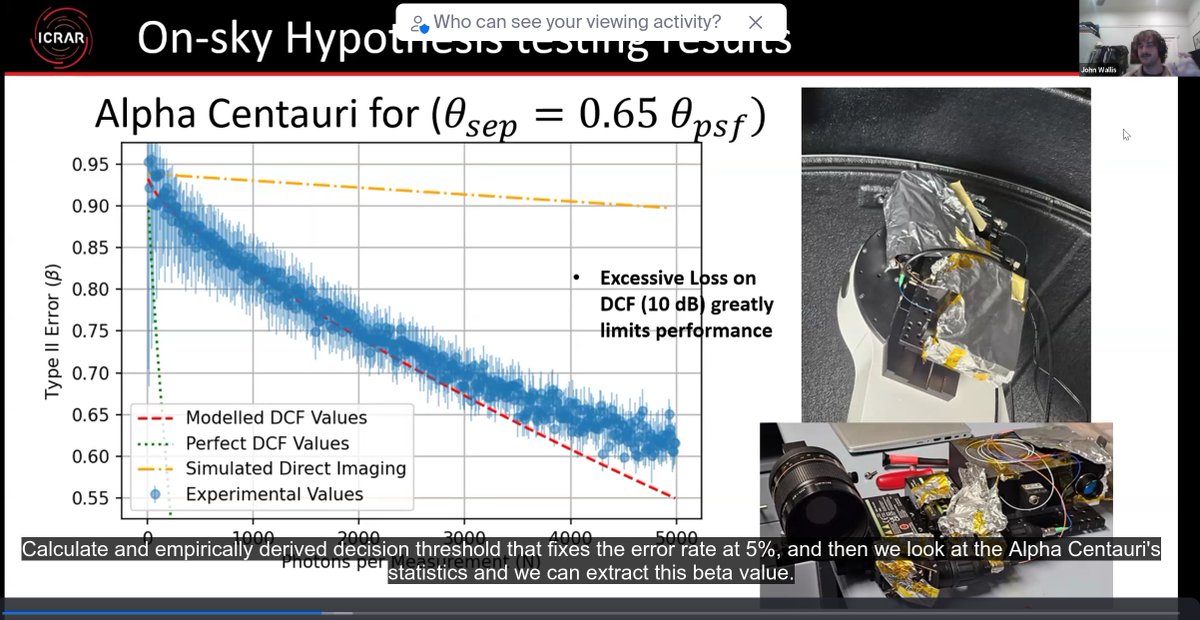
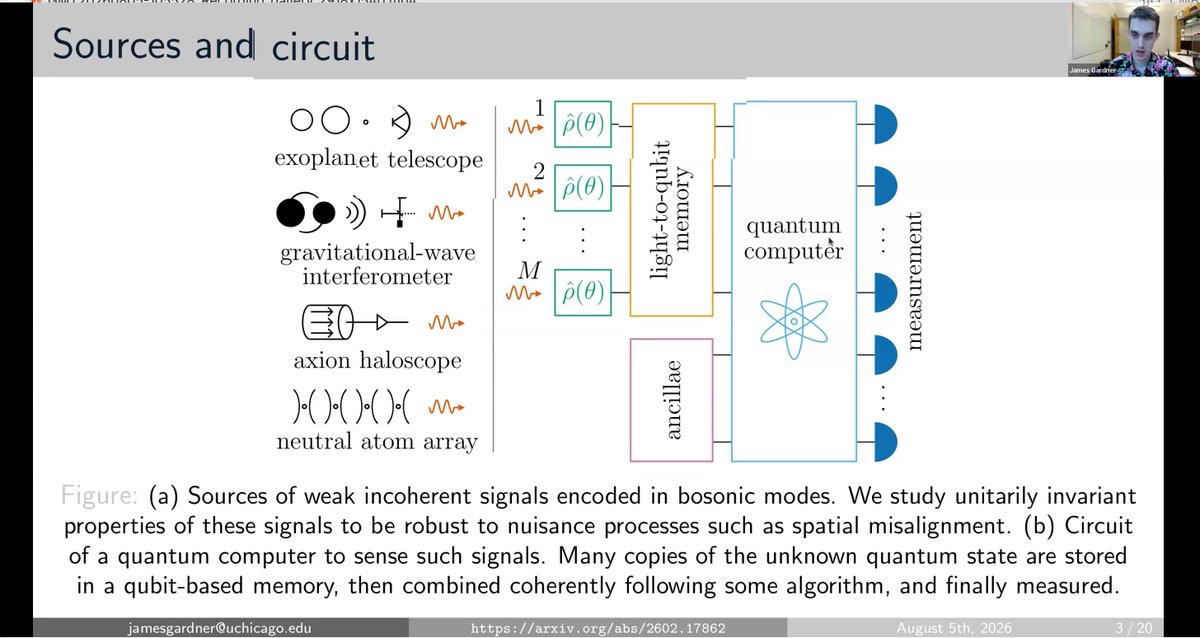
The QM-QISR workshop has been a wild ride so far. In one talk an astronomer reported an on-sky demo using an off-the-shelf fiber mode sorter. In other talks some fearless young theorists proposed that we couple starlight into a quantum computer. (1/2)
We're excited @Caltech and @TeamOratomic about mitten codes, which we hope will accelerate the journey to practical quantum computing. An extraordinary team worked on this project -- I especially appreciate brilliant contributions from Caltech students Aditya Bhardwaj, Richard Ma, and Nadine Meister.
https://t.co/eJ8nk9H6qf
❓Can just 1,000 physical qubits run practical quantum algorithms requiring 10+ billion logical operations without a single error?
Yes!
I am thrilled to share our new work introducing mitten codes: 20%-rate qLDPC processors with parallel fault-tolerant logic and real-time telescoping decoding, offering a practical path toward scalable, fault-tolerant quantum computation. ⚛️
Paper: https://t.co/5vuhGyKSyM
this is a timely talk with the whole research community (at least in QIP) currently pondering this very question:
"How to Respond to the Automation of Research"
by Hsin-Yuan Huang @RobertHuangHY (Caltech & @TeamOratomic )
Excited to share our new QudeLeap/HKUST-GZ work:
“Benchmarking Agents for Proving Theorems in Quantum Algorithms and Quantum Information”
Go towards reliable AI proof agents for quantum research. https://t.co/KrnHgPHhPK