📣📣New Paper Alert📢📢
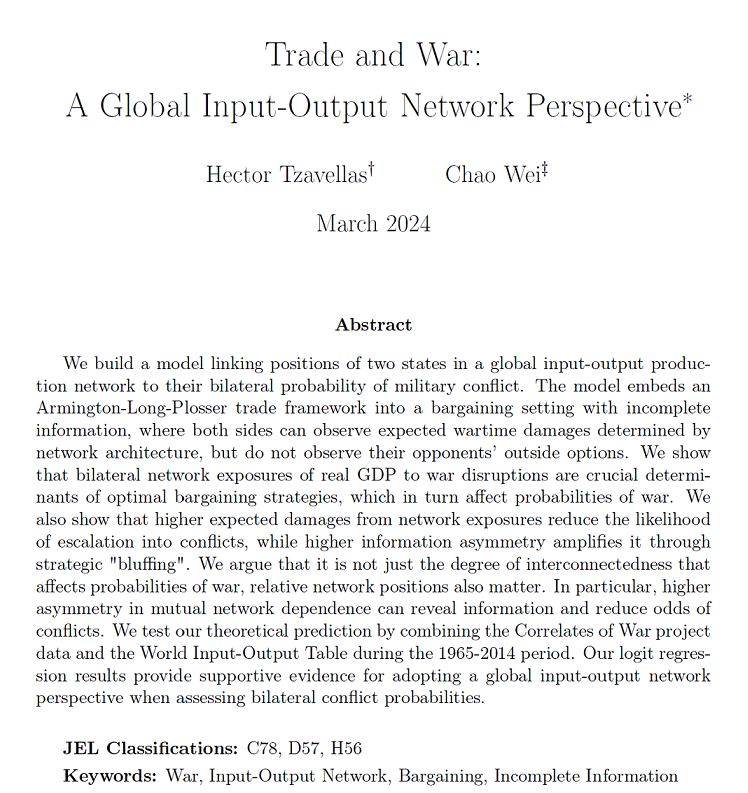
Does increased interconnectedness promote peace?
It depends.
In this paper, we build a model linking positions of two states in a global input-output network to their bilateral probability of military conflict. 1/14
Link: https://t.co/Z07d7LkJD6
The next Network Science and Economics Conference NSE-12 will be held at the University of Luxembourg Oct 23-25, 2026! Here is a call for papers (due July 31):
https://t.co/2YhcpNHo6M
and the conference series webpage: https://t.co/Xj3rKMTBQn
We are happy to announce the MFS Virtual Summer School 2026, taking place online August 25–31. This year’s distinguished speakers are Stavros Panageas, Dimitri Vayanos, John Cochrane, and Pierre-Olivier Weill. Program and registration information:
https://t.co/HxbZ8OS3FL
It would be hard to dream up a system better designed to inhibit child bearing than today’s academia. Endless grad school, pre and postdoc, no location stability, quantity not quality evaluation, etc. yet they wonder why so few women do it
Unpopular Academic Advice #10: I started this series casually, but I have been really touched by how many students have reached out to say they found it useful. I have been busy giving talks and organizing conferences over the past couple of months, so I paused for a while. But at recent conferences, several students told me they had been reading the series and encouraged me to keep writing.
So, as many new PhD students are about to begin their programs, I want to say something about advisors.
It is very tempting to choose an advisor who seems easygoing and has low expectations. I understand why. Low expectations feel safe, especially when graduate school already feels intimidating.
But I would be careful about choosing comfort as the main criterion.
A good advisor should first be a decent human being. They should be willing to spend time on you, support you, and invest resources in your development. But they should also have high expectations. They should push you to think more carefully, write more clearly, and take your own ideas more seriously.
When I was a PhD student, my advisors were often very blunt and honest. They did not always try to frame feedback in a way that made me feel good. At the time, it was uncomfortable. But that discomfort made me take their advice seriously. It forced me to reflect on my weaknesses and improve.
You are not in graduate school simply to enjoy life. You are there to be trained. A key part of success and growth is the willingness to receive, reflect on, and act on constructive feedback.
Of course, high expectations should never be used to justify cruelty or abuse. But if an advisor is kind, invested, and demanding, don’t mistake discomfort for a red flag. Sometimes that is exactly where real training begins.
(1/6) 🧵 Join our "The Micro and Macro Perspectives of Labor Market" Virtual Reading/Workshop Group co-organized with Jesse Wedewer at @DukeEcon!
It allows PhD students to connect with peers outside their home department. Here's how it runs:
#EconTwitter
As economists, we've all been trained to believe that central banks will deliver as long as they're independent and have a sufficiently narrow mandate. As pointed out by @lugaricano last Friday at Hoover's monetary policy conference , the Eurozone's experience teaches us that independent central banks --with a super-narrow mandate-- who are not held accountable can actually stray very far from what those who wrote the mandate had in mind, especially in the face of serious fiscal challenges at home. Long-run outcomes could be worse. Accountability is key, but it's not always clear who's holding central banks accountable.
Check out my post: Lessons from Maastricht.
https://t.co/7EB5opAfrF
In 1700, England and the Netherlands were economic peers. By 1800, England was industrializing and the Dutch weren't. Why? Mokyr's answer isn't coal or colonies — it's that in England, scientific ideas flowed directly into workshops. In the Netherlands, they didn't.
CMU will confer an Honorary Doctor of Science and Technology on Thomas Sargent, a Nobel Laureate in Economic Sciences.
Sargent's scholarship has shaped modern macroeconomics and his research has shaped how economists analyze economic policy and real-world outcomes.
İktisat ile veri biliminin kesişim noktası.
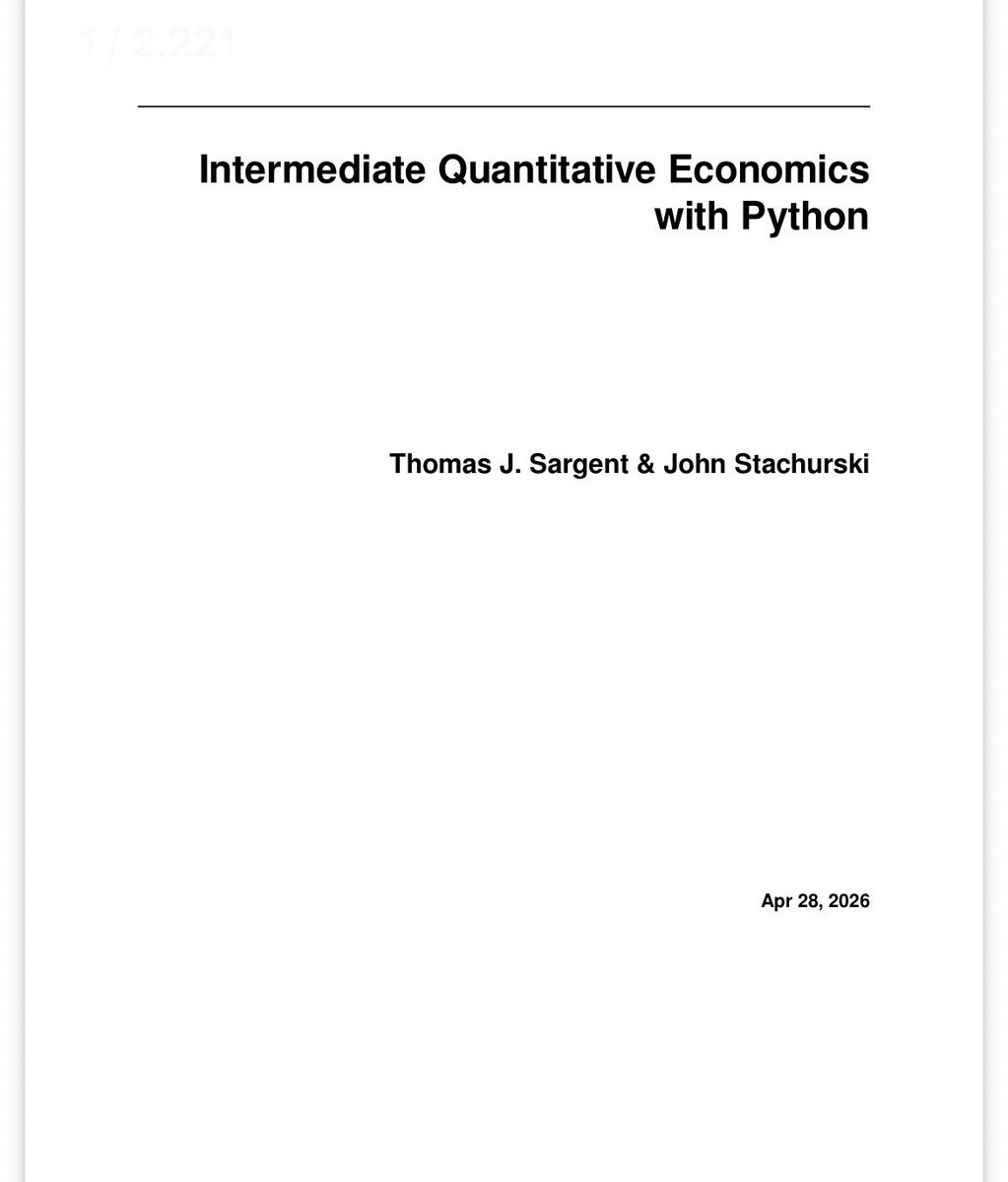
Sargent & Stachurski'den 2221 sayfalık ve ücretsiz bir hazine:
"Intermediate Quantitative Economics with Python"
Hem öğrenmek hem de öğretmek için harika bir rehber.
🔗 https://t.co/ykmIOPHy9i
Very excited to share this. One of the big challenges in studying geoeconomics is measuring how firms respond to pressure. The new GCAP Geoeconomic Monitor uses earnings calls + LLMs to track firm exposure and responses to tariffs, sanctions, and export controls in real time.
Robin's account -@robin_j_brooks- has been hacked. Below you'll find the real Robin @robin_unhacked
Please ignore the crypto nonsense being peddled from the hacked account. (And kindly retweet).
Last night Ben Sasse confirmed my suspicion that Dr. Santiago Schnell, provost at Dartmouth, is quickly becoming the single most influential voice in higher education. If you haven’t already read his essay on AI that broke the internet you should.
“AI has not created new educational problems; it has made old ones impossible to ignore. The habit of rewarding performance over understanding, fluency over depth, and polish over genuine engagement was already present in our institutions before the first language model was trained. AI simply industrializes and accelerates those habits until their emptiness becomes undeniable…”
https://t.co/87WZLfcBtw
Total fertility rates are falling across the globe and, for the first time in history, are below the replacement rate. JFV explains why this matters—and why it could have major economic consequences. His talk is now available for public viewing. https://t.co/CKyJ9rk0z0
Advice for PhD students in economics about using AI, from the brilliant Isaiah Andrews. This should probably be circulated to all PhD cohorts
https://t.co/07xEbmx5n5