Warren Buffett: "Almost anything can happen in financial markets. The only way smart people can get clobbered, really, is through leverage. It's the one thing that can prevent you from playing your hand. All the hands we enter look pretty good. But you have to be able to play them out."
Mes notes personnelles concernant Automatic Data Processing $ADP
Fondée en 1949, Automatic Data Processing (ADP) est le leader historique des service de paie et de gestion du capital humain (HCM). ADP traite la paie de 42 millions de salariés pour 1,1 million de clients dans 140 pays. Ses activités se répartissent en deux segments principaux 1) Employer Services (solutions SaaS de paie et RH) 2) Professional Employer Organization (services de co-emploi global pour TPE/PME). Avec presque 100 % de revenus récurrents, habilement complétés par la bonne gestion financière des fonds de tiers en transit (float sur les fonds clients), ADP dispose de nombreux atouts.
3 avantages compétitifs majeurs :
1) Coûts de changement prohibitifs : La paie est une fonction critique (mission-critical). Migrer vers un concurrent est un processus long, complexe et risqué, ce qui permet à ADP de maintenir un taux de rétention client exceptionnel aux alentours de 92,1 %.
2) Economies d’échelle massives : Sa taille unique (numéro 1 mondial) lui permet d’amortir ses investissements de R&D et de conformité réglementaire de premier ordre, impossibles à répliquer en valeur absolue pour des acteurs plus petits.
3) Barrières réglementaires et capital immatériel : Le secteur dans lequel évolue ADP est hyper-régulé (droit social, fiscalité). Toute erreur peut conduire à des conséquences sociales, réputationnelles et fiscales significatives. La marque et les solutions ADP, éprouvés sur le temps long, sont donc un gage certain de crédibilité.
Indicateurs financiers et allocation du capital
ADP est une entreprise mature de haute qualité. Ses flux de trésorerie disponible (FCF) sont positifs et croissants depuis plus de 30 ans, avec un taux de conversion du résultat net régulièrement supérieur à 100 %. Sa structure légère en intensité capitalistique (asset-light) requiert de faibles dépenses d’investissement (CAPEX). Sa discipline en matière d’allocation de capital privilégie la croissance organique, l’expansion par des petites acquisitions ciblées (M&A bolt-on), une politique de rachat d’actions régulier réduisant significativement le nombre de titres en circulation, et un versement ininterrompu de dividendes croissants depuis 50 ans (Dividend King).
Risques technologiques, disruption et concurrence
Le risque de disruption technologique brutale est jugé faible à modéré sur le long terme. Si des acteurs natifs du cloud plus agiles affichent des croissances organiques plus rapides et gagnent des parts de marché sur certains segments spécifiques, ADP compense cette maturité par des investissements majeurs dans de nouvelles architectures (comme Lyric HCM) et dans l'intégration d'outils d'intelligence artificielle générative (ADP Assist) pour accroître sa productivité et fidéliser ses clients. Aussi, le secteur demeure un oligopole concentré et protecteur.
Gouvernance et bilan
Le management jouit d'une réputation de rigueur et d'une forte cohérence stratégique dans l'exécution de ses objectifs d'expansion des marges opérationnelles. La dilution par la rémunération en actions (SBC) reste particulièrement faible par rapport au secteur du logiciel pur. Enfin, son bilan est extrêmement solide, l'entreprise affichant un endettement quasi nul et une notation de crédit de premier rang auprès des agences S&P (AA-) et Moody's (Aa3).
Conclusion
Simple, prévisible et résilient, ADP est un « compounder » de qualité exceptionnelle dotée d’un moat large et durable, d’une génération de cash robuste et d’une résilience historique remarquable. On peut donc qualifier « de premier ordre » son modèle économique et sa qualité d’exécution.
Lors de la publication de ce document, l’auteur déclarait détenir des actions ADP.
Données (18/05/2026) :
Symbole boursier : ADP (NASDAQ)
Cours actuel :≈ 220,77 USD
Capitalisation boursière : ≈ 88,3 Md USD
Pays du siège social : États-Unis (Roseland, New Jersey)
Secteur d'activité : Services professionnels — Solutions HCM (Human Capital Management)
Performance YTD : − 16,8 %
Performance 1 an : − 29,9 %
Performance 5 ans :+ 9,9 % (cours) / + 58,1 % (total return)
Performance 10 ans :+ 145,6 % (cours) / + 257,6 % (total return)
Ce document présenté par https://t.co/NoX7uScZIW n'a pas fait l'objet d'un audit et doit être considéré comme un commentaire de marché, se limitant à une observation de la conjoncture économique et des marchés. Ces informations sont fournies à titre purement informatif. Elles ne constituent ni une sollicitation ni une recommandation d'investissement et ne doivent en aucun cas être interprétées comme un conseil financier. Les exemples donnés sont fournis à titre indicatif uniquement et aucune garantie n'est donnée quant à la réalisation ou à la probabilité de profits ou de pertes. https://t.co/NoX7uScZIW décline toute responsabilité quant aux décisions prises par des personnes ayant consulté ce document.
https://t.co/LBoHShXFXH
My Personal Notes about Automatic Data Processing $ADP
Founded in 1949, Automatic Data Processing (ADP) is the historic leader in payroll services and human capital management (HCM). ADP processes payroll for 42 million employees on behalf of 1.1 million clients across 140 countries. Its operations are divided into two main segments: 1) Employer Services (SaaS payroll and HR solutions), and 2) Professional Employer Organization (comprehensive co-employment services for SMEs). With nearly 100% recurring revenue, skillfully complemented by sound financial management of client funds in transit (float on client funds), ADP enjoys numerous strengths.
Three major competitive advantages:
1) Prohibitive switching costs: Payroll is a mission-critical function. Migrating to a competitor is a long, complex and risky process, which enables ADP to maintain an exceptional client retention rate of around 92.1%.
2) Massive economies of scale: Its unique size (global number one) allows it to amortize its R&D investments and best-in-class regulatory compliance spending, which smaller players cannot replicate in absolute terms.
3) Regulatory barriers and intangible capital: The sector in which ADP operates is highly regulated (labor law, taxation). Any error can lead to significant social, reputational, and fiscal consequences. The ADP brand and solutions, proven over the long term, are therefore a strong guarantee of credibility.
Financial indicators and capital allocation:
ADP is a mature, high-quality company. Its free cash flow (FCF) has been positive and growing for over 30 years, with a net income conversion rate consistently above 100%. Its asset-light structure requires low capital expenditure (CAPEX). Its capital allocation discipline favors organic growth, expansion through small targeted acquisitions (bolt-on M&A), a steady share buyback policy that has significantly reduced the number of shares outstanding, and uninterrupted growing dividend payments for 50 years (Dividend King).
Technological risks, disruption and competition:
The risk of abrupt technological disruption is judged to be low to moderate over the long term. While more agile cloud-native players show faster organic growth and are gaining market share in certain specific segments, ADP offsets this maturity with major investments in new architectures (such as Lyric HCM) and in the integration of generative artificial intelligence tools (ADP Assist) to boost productivity and retain its clients. Furthermore, the sector remains a concentrated and protective oligopoly.
Governance and balance sheet:
Management enjoys a reputation for rigor and strong strategic consistency in executing its operating margin expansion objectives. Dilution from stock-based compensation (SBC) remains particularly low compared to the pure software sector. Finally, its balance sheet is extremely solid, with the company displaying near-zero debt and top-tier credit ratings from S&P (AA-) and Moody's (Aa3).
Conclusion:
Simple, predictable and resilient, ADP is an exceptional quality “compounder” endowed with a wide and durable moat, robust cash generation, and remarkable historical resilience. Its business model and quality of execution can therefore be described as “top-tier”.
At the time of publication of this document, the author declared holding ADP shares.
Data (05/18/2026):
Ticker symbol: ADP (NASDAQ)
Current price: ≈ USD 220.77
Market capitalization: ≈ USD 88.3 Bn
Country of head office: United States (Roseland, New Jersey)
Sector: Professional Services — HCM (Human Capital Management) Solutions
YTD performance: − 16.8%
1-year performance: − 29.9%
5-year performance: + 9.9% (price) / + 58.1% (total return)
10-year performance: + 145.6% (price) / + 257.6% (total return)
This document presented by https://t.co/NoX7uScZIW has been unaudited and should be construed as market commentary, merely observing business and market conditions. This information is made available for informational purposes only. It is not a solicitation or a recommendation to trade securities and should not be construed or interpreted as financial advice. Any examples given are provided for illustrative purposes only and no representation is being made that any person will, or is likely to, achieve profits or losses similar to those examples. https://t.co/NoX7uScZIW is not responsible for any decisions taken by persons not intended to view this material.
https://t.co/ngs6sg54Eb
My optimistic opinion on this: Only 19 of the largest 500 companies in 1975 have gone bankrupt since then. And even 1975 Kodak shareholders got shares of Eastman Chemical $EMN spun off in 1993, such that $10k in 1975 Kodak would be worth $125k today in Eastman Chemical shares and $0 in Kodak, i.e. even the bankrupt case contains 12.5x returns for shareholders.
For those that initiated a position in Coca-Cola $KO in 1994 right after Berkshire Hathaway finished buying the stock, today's dividend marks $3,000 in cumulative dividends collected for every $1,000 invested. The dividend growth marches on.
The credit rating agencies made a mistake stripping Berkshire Hathaway $BRK.B of its AAA rating in 2009-2010, and it has been an ongoing error of misplaced pride that they have not restored Berkshire to AAA status at any point on the company's road to $370+ billion in cash.
🇶🇦QatarEnergy CEO: We may have to declare force majeure on long-term contracts for up to five years for LNG supplies to #Italy, Belgium, Korea, and China. #QatarEnergy#Qatar
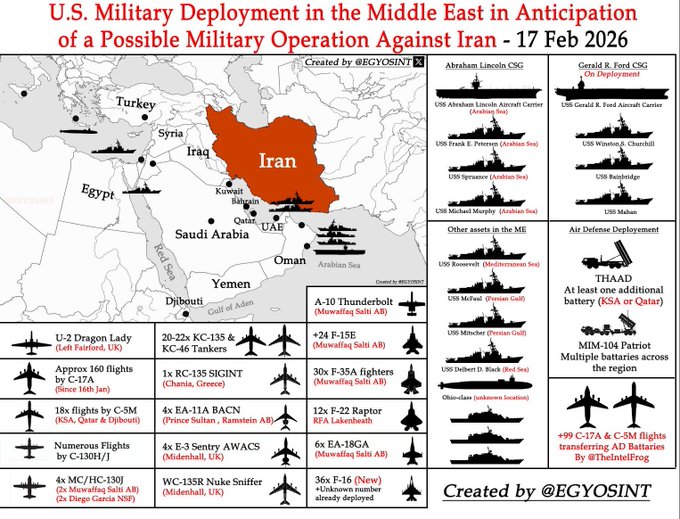
🇺🇸🇮🇷 Negotiations are now dead! War is about to break out across the Middle East. US and #Israel are fully prepared to strike all of Iran’s nuclear facilities and ballistic missile sites. Trump's imminent attack on #Iran will lead to the close of the Strait of #Hormuz and a global economic crisis. That could trigger WWIII. #Axios reports that if a U.S. operation against Iran begins, it would be massive and last weeks, resembling a full scale war. 🇨🇳China assisting Iran with Intel, surveillance and real time tracking through satellites to expose US Military builups and positions into open-source targets for Iran military. #China is effectively serving as Iran's advanced surveillance and reconnaissance. A powerful explosion occurred at depots storing military ammunition and fuel in the city of #Shahriar, Tehran Province of Iran. It seems we are entering the final phase before the start of the war. The US has begun, in the past hours, the massive redeployment of air #tankers and early warning and control reconnaissance aircraft accumulated in European bases towards American bases deployed in the Middle East. Finally seems that 🇷🇺Russian Warships arrive at #BandarAbbas – surprise exercises with Iran set to begin near Hormuz #Chokepoint amid U.S. warships presence Russia, Iran, and China have deployed naval vessels for joint exercises in the Strait of Hormuz region under the "Maritime Security Belt 2026" framework.
Thanks @RealAlexJones@War_Radar2@visionergeo@defense_civil25@Globalsurv
The President of the European Central Bank, Christine #Lagarde, is expected to resign before the end of her 8-year term, according to #FT, Lagarde plans to resign early to let #Macron appoint her successor before France's 2027 election. #BCE
General Electric's market cap five years ago was only $90 billion. Now, one of its three spin-offs is worth $200 billion (GE Vernova $GEV) while the parent entity is worth $300 billion (GE Aerospace $GE), and the other spin-off is $35-40 billion (GE Healthcare $GEHC). The 2010s had a couple of these break-ups in which you realized the legacy conglomerate was dramatically undervalued and long-term shareholders were richly rewarded for sticking through it all. And, of course, the dividends, too.
Kraft Heinz $KHC fell to $22 on news that Berkshire Hathaway $BRK.B *may* unload its 325 million shares. The problems with the company the past decade have been well-documented, but it is trading at only 6x cash flows and is about to undergo spin-offs which does often produce higher P/E ratios years later. I would not sell low here.