Our favorite Karen (& her props) appears positively panicked that Africans might have political opinions about issues that affect them—and worse, the same platform she uses to express them. This is a shady attempt to police Rwandan voices, not an “investigation.” It is 2026, Africans are political, Rwandans can talk back, not just be talked about. We also just talk among ourselves sometimes.
#BREAKING
I have learnt from Kenyan contacts between 40-50% of senior and mid-level Somali officials serving in government in Mogadishu may own a Kenyan passport or ID, fraudulently acquired.
This is astounding.
The Kenyan Immigration, Intelligence and Security Services are all now working in coordination to quietly cancel these IDs and passports.
A second high-ranking Somali official was turned back from JKIA this week for owning a Kenyan passport.
Meanwhile, Somalia has summoned Kenyan ambassador in Mogadishu to protest this embarrassing incidents at JKIA.
BREAKING: According to USGS, Venezuela was struck by two powerful earthquakes in rapid succession — a magnitude 7.2 quake followed by a magnitude 7.5 just 45 seconds later.
VIA:@BNODesk
The Return of Hamza bin Laden
Al-Qaeda released a video yesterday featuring its Emir, Hamza bin Laden, in footage that appears to have been recorded years after 2009, yet not a single major U.S. media outlet has reported on it.
Ask yourself why.
This video was released by al-Qaeda's central media outlet, As-Sahab and shows Hamza alongside Dr. Ayman al-Zawahiri. Accompanying the video is a nasheed performed by an al-Qaeda vocalist, reciting a poetry elegy written by Sheikh Abu Hafs al-Mauritani aka Mahfouz Ould al-Walid, the former mufti and Shura Council member of al-Qaeda, mourning Sheikh Osama bin Laden.
You can clearly see Hamza bin Laden at 5:46. And by the way, he appears identical to the best image of Hamza that I obtained within the last couple years, the image I was suppose to show in-person to the National Security Council last February 2025 but my meeting was canceled by Sebastian Gorka. He even told some serving at the NSC that I was on drugs to stop them from seeing my evidence on Hamza.
For years, the government and its think tank allies have told the public that this threat was gone. They have purposely lied to you. The evidence tells a different story.
Consider this a wake-up call. The next generation of the bin Laden sons is coming to attack our homeland. Pay attention to what is being plotted and who is involved before events force the conversation that we have been preparing you for.
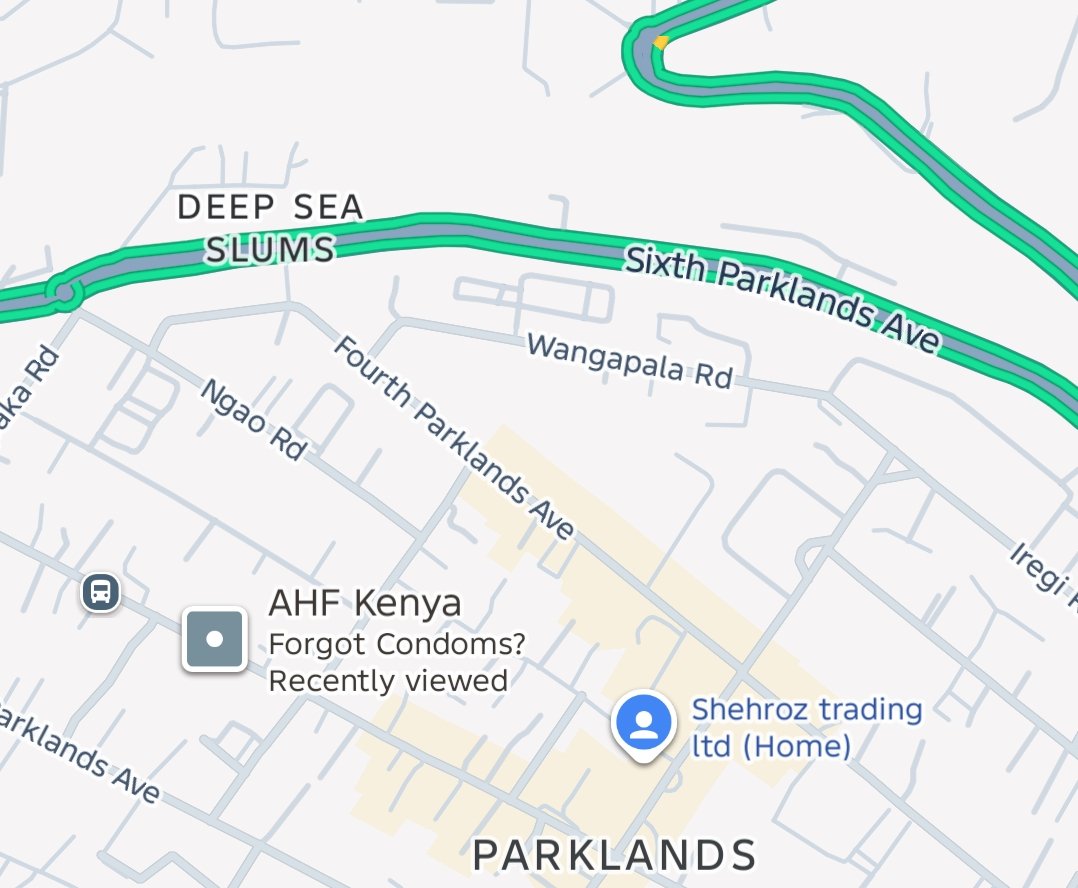
ALERT: Guys from Deep Sea slums along Sixth Parklands Avenue in Nairobi have started putting nails on the road.
Be aware.. and if you encounter this just keep driving no matter what happens to your tyres. You can always buy new rims and tyres.
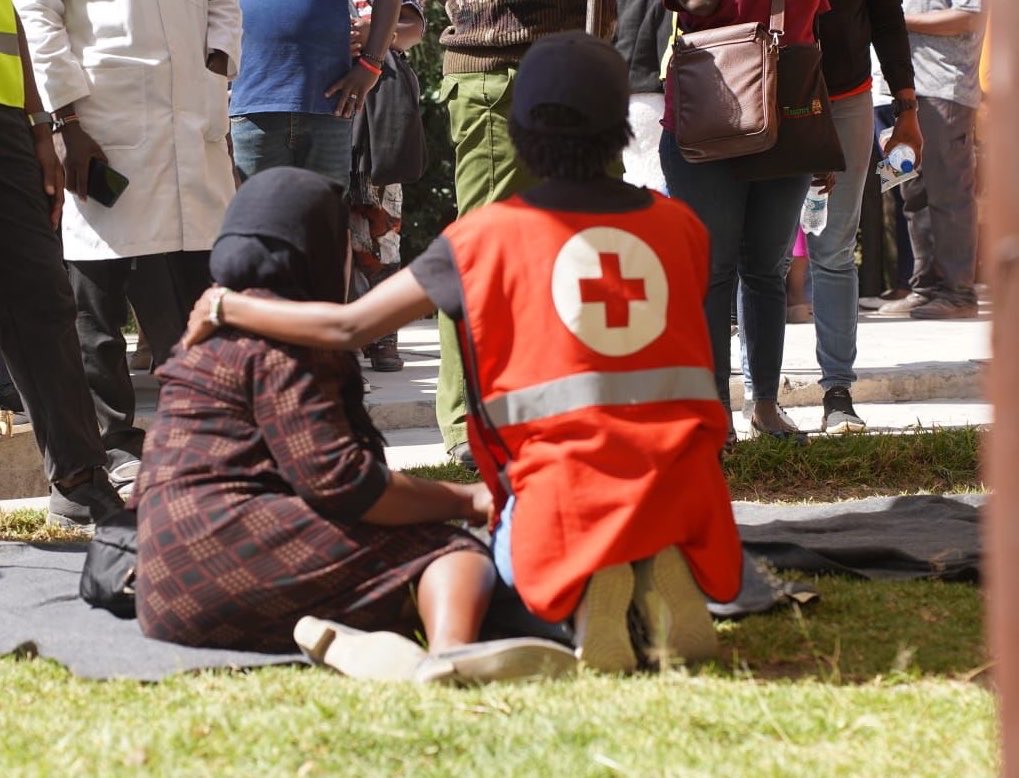
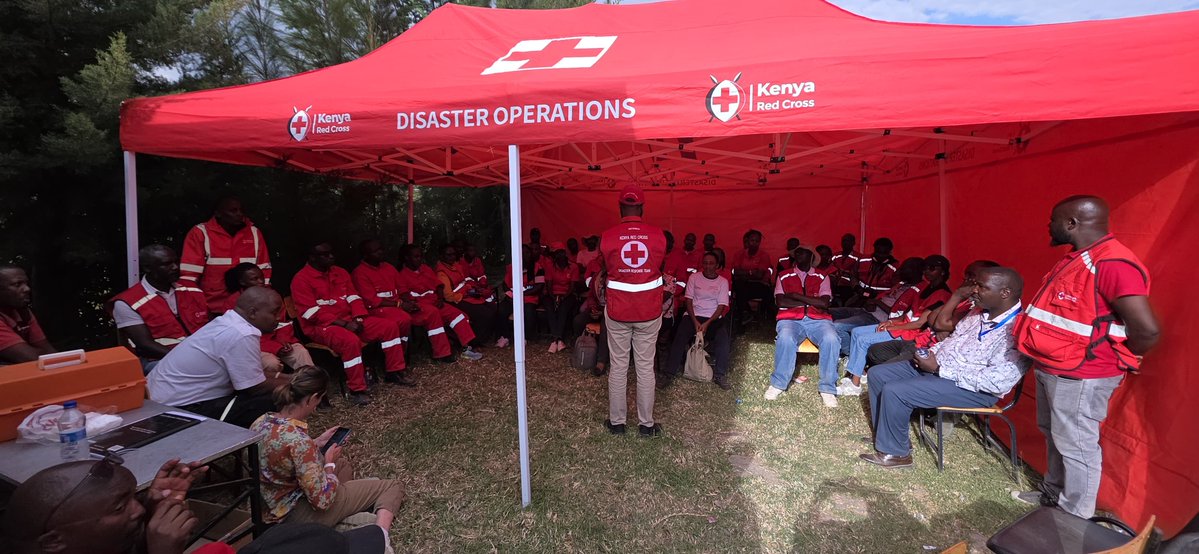
Day 2: As response efforts continue following the Utumishi Girls Academy fire, Kenya Red Cross remains actively engaged on the ground.
We are supporting families with psychosocial services, reunification efforts and coordination with hospitals and authorities.
We continue to stand with all those affected.
The United States has approved an additional $80 million for the Ebola outbreak response. This will help procure and deliver additional PPE for healthcare workers in high-risk areas; enhance border screenings and surveillance at key points of entry; expand contact tracing to identify and diagnose individuals as early as possible; and procure diagnostic supplies including test kits.
C.K. Asango of the Kenya Defense Forces at Cyber Yankee Exercise 2026 🇰🇪🪖🇺🇸
CAMP NETT, Conn. --- The Connecticut National Guard hosts Cyber Yankee 2026, a tactical-level defensive cyber operations exercise in May 2026. The exercise, in its 12th year, involved over 360 members of the National Guard in Massachusetts, Maine, Connecticut, New Hampshire, New Jersey, New York, Rhode Island and Tennessee along with Service members from the Marine Corps, Space Force, Coast Guard and international partners from the National Guard's State Partnership Program, including Kenya, Paraguay, Cyprus, Canada, Sweden, El Salvador, Uruguay and Brazil.
We are launching a "logistics lockdown" for the Russian army. We are scaling middle-strike operations to systematically destroy enemy logistics and supply lines, stripping them of their capacity to mount offensive actions. We’ve allocated an additional 5 billion UAH for direct procurement by our most effective frontline units, while simultaneously launching large-scale competitive tenders.
The enemy’s rear is no longer a safe haven. We are seizing the initiative—using technology and the cold math of war to paralyze their operations.
URGENT:
For any American or LPR who has been in the DR Congo 🇨🇩, Uganda 🇺🇬, or South Sudan 🇸🇸 and is returning to the USA.
You are required to enter 🇺🇸 via Dulles (IAD).
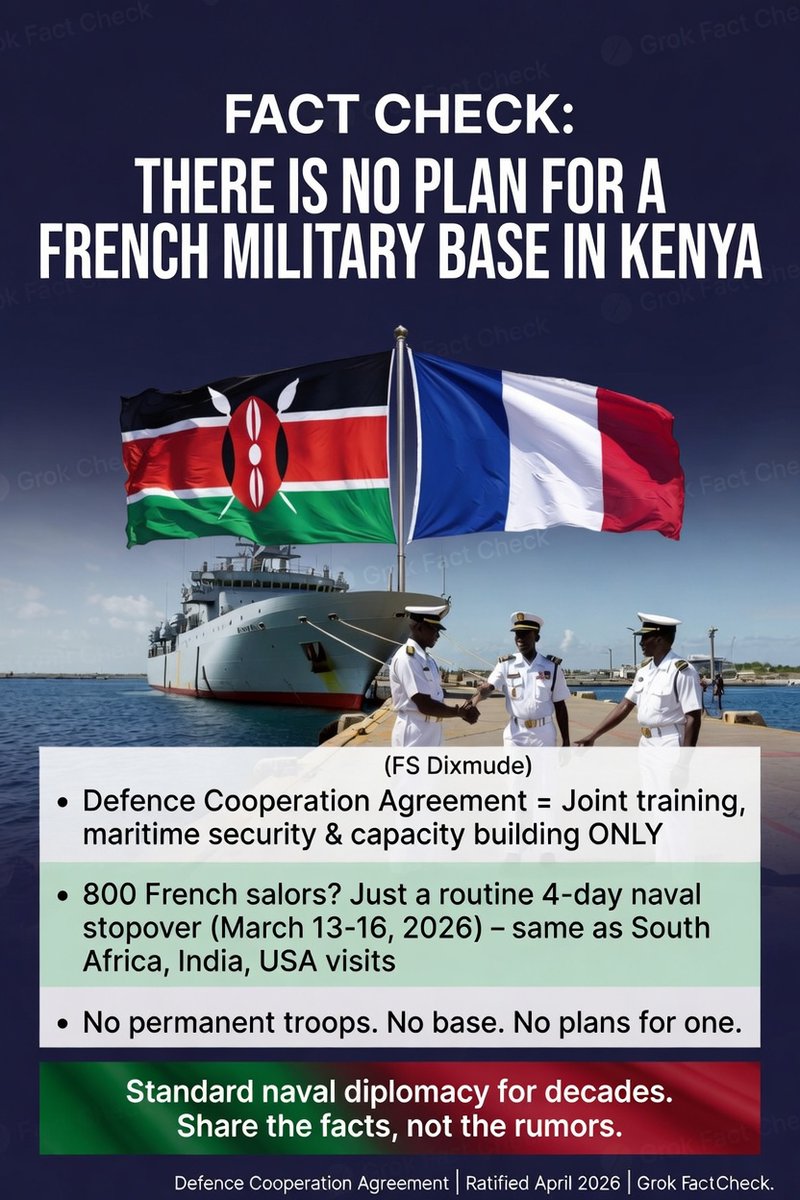
Fact Check: There Is No French Military Base in Kenya, And No Plans for One
Rumors have been swirling on X, Kenyan social media, and talk shows: France is secretly building a "military base" in Mombasa. Opposition voices and analysts claim the new Defence Cooperation Agreement (DCA) is a backdoor for thousands of French troops with full immunity, turning Kenya into Paris's "Plan B" after the Sahel fallout. Some even tie it to the recent Africa-France Summit in Nairobi (May 11-12, 2026).
This is not true. There is no French base agreement. There is no permanent base. There are no plans for one. Here's the clear, documented reality based on official records, parliamentary statements, and on-the-ground reporting.
The Defence Cooperation Agreement Is Exactly What It Says: Cooperation, Not a Base
Kenya and France signed the DCA in October 2025. Kenya's National Assembly ratified it unanimously on April 8, 2026. It is a standard 5-year bilateral framework (automatically renewable once, for a maximum of 10 years) covering:
- Joint military training and exercises
- Maritime security in the Indian Ocean
- Intelligence sharing
- Peacekeeping support
- Humanitarian and disaster response
Official Kenyan government memoranda and statements describe it as a way to "enhance Kenya's defence capacity through access to French training, technology, and expertise." It is explicitly about visiting forces and capacity-building – not leasing land, building facilities, or stationing a permanent garrison.
A senior Kenyan defence official put it plainly: "A defence cooperation agreement does not mean that French forces deployed to Kenya will be in the country permanently." No parliamentary motion, no joint communiqué, and no official document from either side mentions a base, long-term troop stationing, or territorial arrangements.
The "800 French Troops in Mombasa" Was a Routine 4-Day Naval Stopover, Not an Occupation
Yes, around 800 French personnel arrived in mid-March 2026. But they were not troops moving in. They were sailors, officer cadets, and a small tactical group aboard the amphibious assault ship FS Dixmude and frigate FS Aconit – part of the French Navy's annual Jeanne d'Arc 2026 five-month training deployment across the Indian and Pacific Oceans.
- They docked in Mombasa for exactly four days (March 13–16, 2026).
- Activities: resupply (bunkering), crew rest, and joint maritime drills with the Kenya Navy.
- They sailed on afterward as scheduled.
This is textbook naval diplomacy. The French Embassy described it openly as a stopover for "freedom of navigation" and regional maritime security (including support for EU Atalanta anti-piracy efforts). Photos and videos of the warships in port circulated at the time – nothing secret.
Mombasa sees this constantly:
- South African Navy (SAS Amatola, April 2026)
- Indian Navy (INS Trikand, April 2026)
- Regular US Navy visits
- Chinese, Spanish, and other partners
These are not "bases." They are port calls for training, goodwill, and logistics – exactly what Kenya has hosted for decades.
The "France Is Pushing for a Permanent Presence" Claim Is Unverified Hype
Al Jazeera (May 11, 2026) reported unnamed "sources in parliament" saying France has been "pushing to add a permanent troop presence." That's it – anonymous sourcing. No names, no documents, no timeline.
Kenyan officials have directly pushed back against any such interpretation. France already maintains its main African hub in Djibouti (1,500–2,000 troops). There is zero strategic or public indication they need or are planning a duplicate setup in Kenya. The post-ratification training personnel (~600 mentioned in some reports) are for ongoing exercises under the DCA – rotational, not permanent.
Where the Rumors Actually Come From
The "base" narrative exploded from:
- Political opposition and analysts (e.g., Ikua wa Mbote on TV47) framing the DCA as neo-colonialism.
- Legitimate concerns about the agreement's immunity provisions (France has primary jurisdiction over on-duty offenses by its personnel – similar to the long-running BATUK issues with the British).
- Timing: The March port call happened just before ratification, and the May summit with Macron and President Ruto put everything in the spotlight.
These are real sovereignty debates worth having. Kenya already hosts UK training facilities and US arrangements. But turning a cooperation pact and a four-day naval visit into "France's new base" is exaggeration, not evidence.
Bottom Line
There is a Defence Cooperation Agreement. There was a normal naval training stopover. There are ongoing training partnerships.
There is no base. There is no agreement for a base. There are no public or confirmed plans for a base.
Kenya is diversifying its security partnerships in a volatile region – that's pragmatic policy, not a sovereignty sell-out. Spreading unverified "base" claims doesn't strengthen Kenya's position; it just fuels unnecessary panic. The facts are public, the documents are online, and the port logs don't lie.
If new evidence emerges of actual base plans, it should be debated openly. Until then, this is standard international military diplomacy – nothing more, nothing less.
We just delivered the 1⃣,0⃣0⃣0⃣th H130 helicopter to Kenyan operator Rotorjet Aviation.🚁🇰🇪 From passenger transport to aerial work, the H130 continues to define excellence in the intermediate single-engine market. Thank you to our customers worldwide for their continued trust. 🌎🤝
#AirbusHelicopters #MakingMissionsPossible #H130
Good evening patriots. Here is your last dose of anger for the night.
You will recall MT Paloma.
The ship that arrived in March with fuel at 43ppm sulphur.
Four times above Kenya's 10ppm legal limit.
The Energy CS said reject it.
Kenya Pipeline blended it anyway.
Into your engine.
Into your lungs.
Kenyans complained.
Spark plugs failed.
Engines coughed.
Today the government has released a press release.
With official letterhead.
And a very serious signature.
Temporarily adjusting fuel standards to 50ppm sulphur.
For six months.
Owing to Middle East supply constraints.
Let us connect these dots slowly.
Illegal dirty fuel arrives.
Government blends it anyway.
Kenyans complain about engine damage.
Government response?
Change the standard to match the illegal fuel.
They did not fix the fuel.
They fixed the law.
To fit the crime.
This is not fuel standards management.
This is evidence tampering.
On a national scale.
With official letterhead.
The MT Paloma fuel was illegal in March.
It is now government policy in April.
Your engine was not the problem Kenya.
Your standards were just too high.
They have been adjusted accordingly.
Everything else will follow.
As usual, stay angry. No fake optimism: Singapore is a mirage!
Dismas wa Tabu. Dreaming in installments. Billed in full.
JUST IN: Iran just pulled a thirty-year-old empty supertanker out of retirement and began towing it toward Kharg Island. She is moving so slowly that a voyage that should take a day and a half is taking four days.
Her name is NASHA. IMO 9079107. Built 1996. A two-million-barrel very large crude carrier that has been anchored empty off Kharg for years. TankerTrackers confirmed her reactivation yesterday. Gulf News, Iran International, and Fox News all picked it up within hours.
The reason she is moving at all is that Iran is running out of places to put the oil.
Kharg Island handles roughly ninety percent of Iran’s crude exports. Its onshore tanks had about thirteen million barrels of spare capacity when the US blockade began on April 13. Net inflow since has been running at one million to one point one million barrels per day because exports have collapsed to single digits of vessels while upstream production continues. The math is mechanical. Roughly twelve days of spare capacity. The calendar says that window closes this week.
NASHA is not a strategy. NASHA is what you do when you have run out of strategy.
A two-million-barrel floating storage vessel buys Iran approximately forty-eight hours of continued upstream production. After that, either the wells get shut in or the crude goes somewhere else. The parallel options being pursued, ship-to-ship transfers in the Riau Archipelago, AIS-dark transits, sanctioned VLCCs returning home through the blockade line, are not enough. Lloyd’s List Intelligence has tracked roughly twenty-six Iran-linked vessels evading since April 13. That cannot absorb a million barrels a day.
The wells will shut in. The question is which wells, for how long, and whether they come back.
The Asmari and Bangestan carbonate formations that sit under most of Iran’s giant southern fields are high-permeability, strong-water-drive systems. The Society of Petroleum Engineers literature on this specific reservoir class is unambiguous. Remove continuous pressure support for a prolonged shut-in and four damage mechanisms activate simultaneously: water coning upward through the fracture network, fines migration into pore throats, formation compaction under increased effective stress, and clay swelling under altered salinity and pH. The damage is not theoretical. It is documented. And it is measured in months to years of recoverable production capacity, not days.
Maleki and Gordon estimate three hundred to five hundred thousand barrels per day of permanent capacity loss if the current shut-in trajectory completes. That is a directional estimate, not a lab measurement, but the direction is not in dispute.
NASHA is the archaeological signature of the clock.
When a country with the world’s third-largest oil reserves reactivates a thirty-year-old retired tanker to float on top of its main export terminal and buy forty-eight hours of time, the institutional systems designed to absorb shocks have already failed. The insurance market, the shadow fleet, the diplomatic channels, and the reservoir physics are all converging on the same conclusion at different speeds, and NASHA is the one that shows up on satellite.
The market is pricing a ceasefire.
The Pentagon is pricing six months of mine clearance.
Iran just pulled a corpse out of the Persian Gulf and asked it to buy two days.
That is not how a reversible crisis looks. That is how a regime tells you, operationally, that it has run out of options between the blockade and the shut-in. The reservoir does not negotiate.
https://t.co/vLQh7ydMdk