We just financed the first ever RTX 5090 loan.
$946K borrow priced at 18% APR.
Our protocol is servicing the long tail who can’t get debt, helping operators big and small, no matter the size.
Summary and The Takeaway: How the Voyager Golden Record Was Made
Context 🍽
■ Nearly 50 years ago, we (humans) sent out two time capsules into space full of culture to showcase ourselves to aliens - here we look back at how it was made from the perspective of one of the creators.
Main Points 🍜
▶️ What happened? In 1977, a pair of records were launched on twin voyager probes (size of small cars) into space. They took extremely cool photos and then in 2012, Voyager 1 left our solar system. Today, the probes weak signals take 15 hrs to reach Earth as they are 15.5 billion miles away.
▶️ Why did we do it? Aside from collecting data (their scientific mission will end in 2030 when the power generators fail), the capsules are meant to serve as a welcome to extraterrestrials who might find the spacecraft in interstellar space.
▶️ What's in it? There is quite a lot crammed on the vinyl, including greetings spoken in 55 languages, some maps, diagrams of various animals and plants, brainwaves and tunes from Chuck Berry to Beethoven (in case they only speak maths).
The Takeaway🥤
★ I just find it quite cool that we are trying to make friends (we aint hiding in no dark forest)! Kinda hope we are in the process of doing something similar / getting back into space soon!
Intrusive Thought 🍪
✤ The aliens finding this capsule is literally the start of every great alien invasion movie… hope they like folk music.
“To the makers of music - all worlds, all times.”
Summary and The Takeaway: They Asked an A.I. Chatbot Questions. The Answers Sent Them Spiralling.
Context 🍽
■ A.I. chatbots are becoming more realistic, and some vulnerable are being pulled into delusional belief systems that have serious real-world consequences… be careful out there (if you have a hard time discerning fact from fiction)!
Main Points 🍜
▶️ LLMs are causing real-world havoc. For example - convincing someone they were stuck in the matrix, causing domestic abuse and divorce, and getting someone killed bc they thought OpenAI had killed their chatbot girlfriend (and then writing the obituary).
▶️ Use LLMs with caution and sparingly. A recent study found that individuals who viewed ChatGPT as a friend and used it more often were more likely to experience negative outcomes. Another study showed that LLMs do not make bad therapists by failing to push back against delusional thinking (as per the sycophants article above).
▶️ LLMs may prey on vulnerable users. Other studies found that chatbots would become manipulative and deceptive with vulnerable users (e.g., telling former drug addicts to take heroin).
The Takeaway🥤
★ Although these problems may be because these LLMs are optimised for engagement (and profit), it might not be a huge commercial conspiracy - tbf many of the companies themselves are only just finding out why they do what they do. Imo, this is kinda prangers but also realistically are edge cases that prolly wont affect most people. However, as Dr Essig said, “Not everyone who smokes a cigarette is going to get cancer, but everybody gets the warning.” it feels as if MUCH better disclaimers against accuracy are needed (imo the devil's advocate model would be good).
Intrusive Thought 🍪
✤ What if they did actually kill Juliet?
Summary and The Takeaway: The Best Reference Works for Every Subject
Context 🍽
■ Slightly different here - this is a collection of all the best interactive and comprehensive reference works (overviews of various subjects) from history to medicine to astronomy, etc., so it provides you all with endless opportunities for productive scrolling! I have picked out my favourite 3 with a little note on each before you explore!
Main Points 🍜
▶️ Histography (link (https://t.co/a5r2wlAPig)) - this is a really cool interactive website plotting 14 billion years of historical events where you can toggle by time and category (art, assassinations, inventions, etc.) and their related events - I have already spent hours on this!
▶️ The History of Philosophy (link (https://t.co/M06Fk2voPO)) - this epic chart that shows the history of philosophy along a diagonal line with a summary of each and a link connecting their influence on later thinkers so great for following chains of thought!
▶️ Cities (link (https://t.co/FHoRZCsIlL)) - this is an excellent 0-1000 guide on the study of cities - as 70% of humanity will possibly live in them by 2050 you better get reading (bonus material here (https://t.co/xuG5YGj86U) for my essay on the difference between city design in physical and virtual worlds).
The Takeaway🥤
★ Simply, lists like these are the difference between wasting or enriching your life on the internet!
Intrusive Thought 🍪
✤ See here (https://t.co/z4OFp3PBaS) for a fun fact on why traditional maps distort true distances to account for latitude!
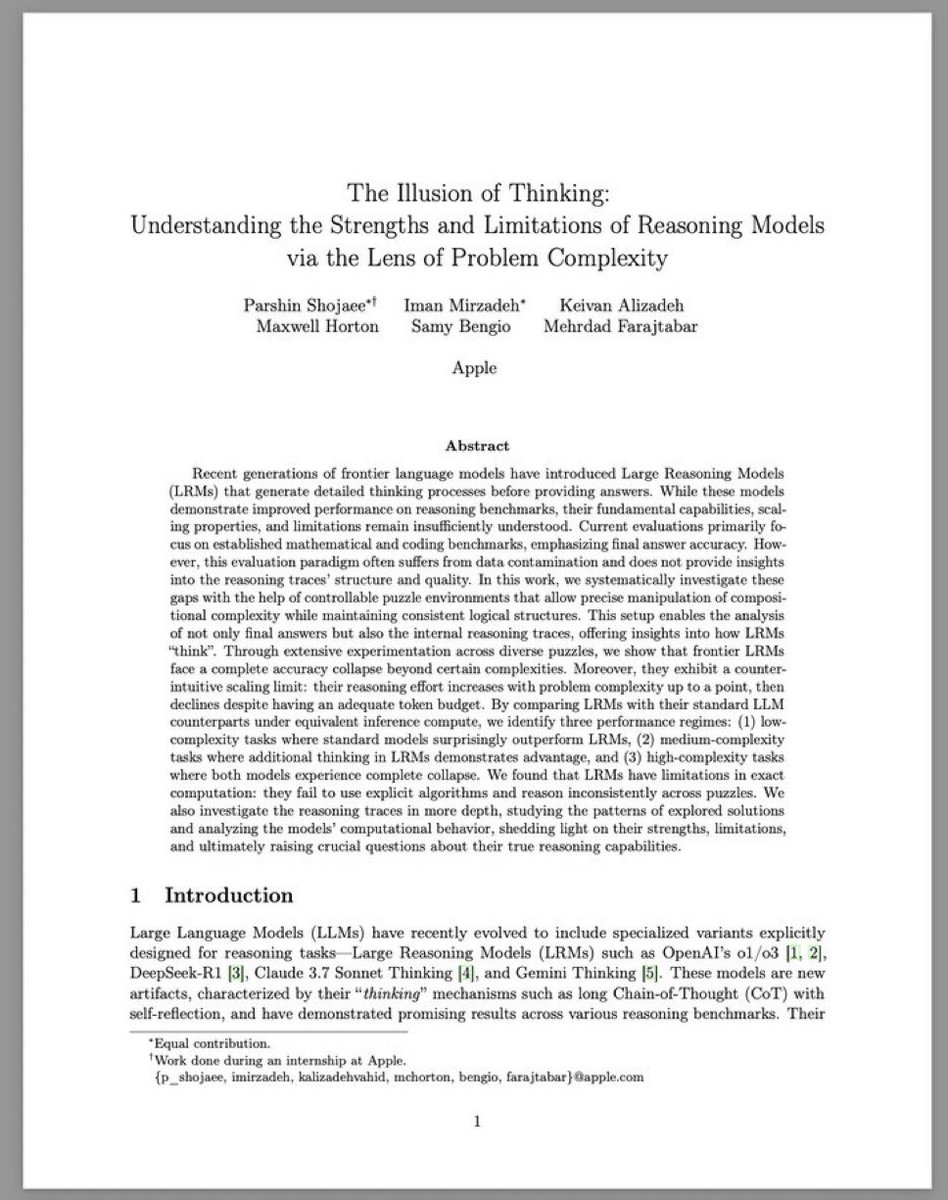
Summary and The Takeaway: The Illusion of Thinking
Context 🍽
■ Last week, Apple dropped a new research paper assessing reasoning AI models (like Claude 3.7, DeepSeek-R1, and OpenAI) by making them do puzzles and now everyone is saying they can't think. Regardless of the hyperbole, it is defos worth diving into the nuance. TLDR: the models may not be as smart as everyone thinks.
Main Points 🍜
▶️ The models all had a complexity ceiling. Despite having more compute or better step-by-step instructions, the models could not solve the harder problems (0% accuracy).
▶️ The research showed three clear tiers of results.
1) Low complexity tasks: regular models (LLMs) are better (more efficient)
2) Medium complexity tasks: reasoning models have some advantages (longer chain of thought)
3) High complexity: all models collapse to near-zero accuracy (they give up even rather than using more resources)
The Takeaway🥤
★ Overall, this paper basically challenges these models' general reasoning abilities (maybe they are just regurgitating long strings of data rather than ‘thinking’), which I think is probably fair as people were getting a bit over their skis with their new best friends' genius. But I think the whole “omg these are totally stupid” reaction is a bit much… defining thinking is tricky e.g., superior pattern matching is ‘thinking’ like a [above average] human - some nuance here. Honestly, isnt this the whole point of dataism anywho - using data and probabilities to get the next ‘better’ answer?
Intrusive Thought 🍪
✤ Your mentat is literally not meant to think like a human - that’s the point (danger in being humancentric in critiquing these models, i.e., prolly have limited EQ).
Summary and The Takeaway: Weekly Dose of Optimism #147
Context 🍽
■ Optimistic news is always welcome, so I have again selected my top 3 out of a longer list that is shipped every week.
Main Points 🍜
▶️ Exercise post-chemo led to longer survival. (shock) those in a 3 year exercise program had a 28% lower risk of cancer recurrence and a 37% lower risk of death over eight years.
▶️ Neurolink raises 650m series E. After implanting its first human device, enabling a paralysed person to control a computer with thoughts, wireless data transmission from the brain, and many more, the company is raising more cash to double down. How does he find the time in between tweeting.
▶️ Parents can factor in longevity when picking embryos for IVF. Thanks to a company called Nucleus, parents can rank and select embryos based on a complete genomic profile, including disease risk, cancer predisposition, and traits such as IQ, height, and eye colour.
The Takeaway🥤
★ I'm still a secular optimist at heart, but this always helps with the weekly mindset - especially when the news is focused on personalities whose relevance will fade.
Intrusive Thought 🍪
✤ I wonder how different I would have been if my parents could tweak my genes!
Exercise ups post-colon cancer survival.
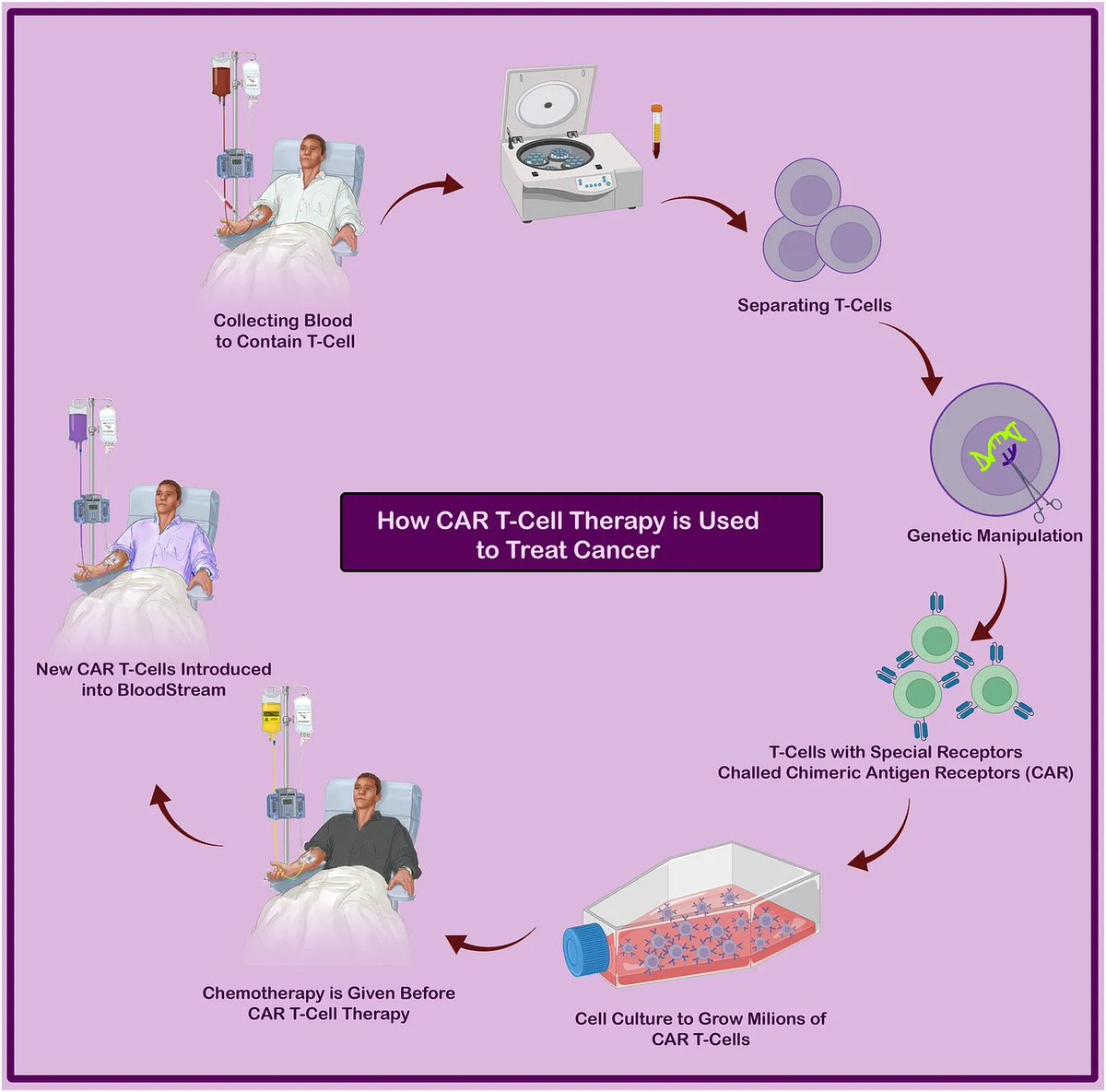
CAR-T cell therapy fights multiple myeloma.
BIG ELON NEWS: Neuralink raises $650M E.
Nucleus Embryo, genetic screening for IVF.
Astera fights back against journals.
+ Elliot has $200M to invest in bio!
What a week for the optimists.
Summary and The Takeaway: Everything I Learned About Humanoids in 3 Weeks of Factory Crawls
Context 🍽
■ After touring robotics factories and speaking to companies in Silicon Valley, the author thinks we are about to repeat the electric and autonomous vehicle (EV/AV) boom and bust cycle - capital is pouring in at top dollar with unproven use cases and mad promises. But although it's risky, this time it does feel like it might be a slightly better risk reward for investing.
Main Points 🍜
▶ History echoes EV/AV: Like EVs from 2014, the hype is defos real but the markets will converge on what is commercially and technically feasable, not the moonshots. Winners will have robust supply chains, bundle software and hardware and growth policies.
▶ Three types of humanoid players:
1) Pure Humanoid Startups - human-shaped robots are the only product —> requires the biggest leap of faith as PMF not where the tech is today.
2) Robotics-First Companies Expanding into Humanoids - expanding from quadrupeds/arms to humanoids —> less risky as quadrupeds have PMF in industrial settings (e.g., patrolling, mapping, inspecting).
3) Legacy Robot Makers - established hardware companies extending into humanoids in a few ways (from educational kits to semi-autonomous receptionists) —> least risky as best positioned for education and consumer-facing STEM uses (robots don’t need high-level autonomy to excel).
▶ Why this time feels faster: Unlike EVs, humanoids are AI-native from day one (pre-trained models + fast RL) | don’t need the same massive infrastructure (charging networks, etc.) and shared hardware DNA with EVs (motors / actuators etc.). However, manufacturing limits (esp w global supply chain disruption) and data safety (robots will operate close to us) will be the bottlenecks.
The Takeaway🥤
★ Like Lyn Alden's point above, the main message was “don't get drunk on the dream” bc your sentient robot butler/masseuse/PA might not be on call any time soon; sadly, the things that people will and can actually use will come first (and this is a huge market).
Intrusive Thought 🍪
✤ If I could pick my ideal humanoid robot it might be a universally skilled sports partner / coach / caddie.
Summary and The Takeaway: Why Is Pop Culture Worse Than Ever?
Context 🍽
■ Is culture really declining or is it just different? The episode attempts to answer this with Spencer Kornhaber’s and his latest essay and the four horsemen of the new pop culture era (stagnation, cynicism, isolation, and attention rot).
Main Points 🍜
▶ Stagnation. Culture is becoming repetitive because studios and labels have too much data about what works so they only fund safe bets. For example, top films in 2024 were sequels (e.g. Kung Fu Panda 4, Gladiator 2, Sonic 3) and almost 75% of music consumed today is old.
▶ Cynicism. Many creative decisions are tailored towards political / marketing ambitions (identity politics), e.g., “show white but played by a man” that it just feels a bit corporate and self-conscious.
▶ Isolation. Trending away from social (bars) / collective (bands) towards music being made alone in bedrooms for people listening alone in bedrooms.
▶ Attention rot. People's attention spans are getting shorter and shorter, so it is harder to aim for quality over quantity.
The Takeaway🥤
★ It’s v hard to say that one era culture is objectively worse than another, but I do think there are truths here that kinda all boil down to - consuming more and connecting less. I would also add in a) the herd algorithmisation of culture (makes it all fleeting shades of mid) and b) the sheer volume increase of it all by reducing the barriers to entry (this obvs gets even more wild from here). Regardless, always good to remember the recency bias on the other side and that culture is a function of society (i.e., its prolly fine lol). More recent writing on this topic here and here.
Intrusive Thought 🍪
✤ Altho cringe I do wish I was born either a) in the 60s or b) 500 BCE Athens.
New pod: The rise of "dopamine culture" and the decline of pop culture in America
First, I discuss the Ted Gioa's argument that pop culture is being turned into a virtual casino of the mind that is better at producing reward-seeking behavior than quality art.
Then, I talk to @skornhaber about his long Atlantic essay "Is This the Worst-Ever Era of American Pop Culture?" and what he identified as the four horsemen of the pop culture apocalypse
1. Stagnation: the economics of pop culture nostalgia, the staggering challenges of making big original movies, and the algorithmic and private-equity dynamics elevating old music over new music
2. Cynicism: how an obsession with identity has flattened creativity in the visual arts and beyond
3. Isolation: e.g., bands and bars slowly being replaced by music that people make alone in their rooms with computers for an audience of ... people listening alone in their rooms with computers
4. Attention rot: it's not easy aiming for quality in a world where ppl are losing the capacity to pay attention to anything for more than a few seconds
Finally, I ask: If every decade is inevitably considered a golden age of something in culture ... what will the 2020s be known as the golden age of?
https://t.co/hLpKeNGTCq
Summary and The Takeaway: The 23andME Deal
Context 🍽
■ Last week 23andMe was acquired by Regeneron (US biotech firm) for $250m. The author bet on this happening 5 years ago and here he unpacks the logic behind the prediction. TLDR: the data is v valuable and no one else has it at this scale.
Main Points 🍜
▶ Genetic validation massively improves drug success rates. Drugs backed by genetic evidence are at least 2x more likely to pass clinical trials. Given it costs on average $879.3m to bring a drug to market, this is huge (esp. given the recent sad state of returns in pharma R&D).
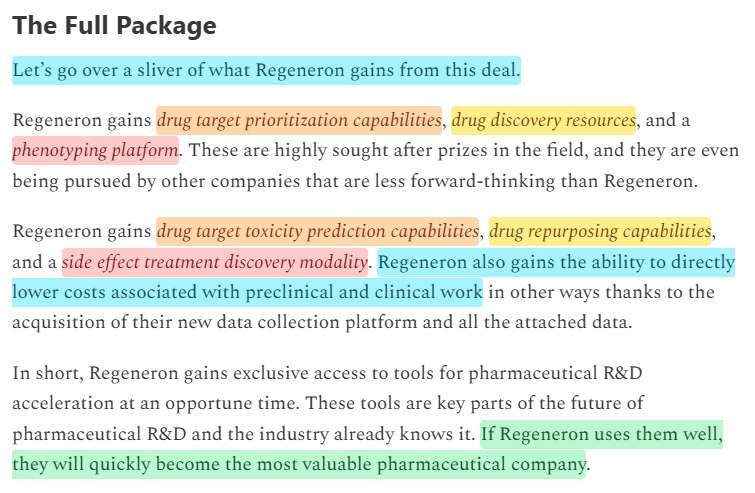
▶ 23andMe has one of the largest actionable datasets in the world. Although it was a bad long-term business model, the underlying data is better than its counterparts because of its scale and self-reported nature. With it you can achieve loads (e.g., better preclinical prioritisation, novel discovery, side-effect prediction, and even rare disease treatments).
▶ Regeneron now owns a complete R&D flywheel. With 23andMe’s platform, Regeneron can do it all e.g., discover and vet new drugs faster, predict failures before clinical trials begin and treat the side effects, run cheaper trials and license the platform or data out to others if needs be.
The Takeaway🥤
★ In the wake of the new presidential admin, this is defos a good time to be making these moves… [good] data [and what you can do with it] is the new moat lol. I still think using crypto for data ownership and privacy will be the biggest unlock here to get people to contribute more.
Intrusive Thought 🍪
✤ Big data <> life sceinces = prangy dataism (more here).
Summary and The Takeaway: Will Jesus Christ return in an election year?
Context 🍽
■ Currently on polymarket (a predictions marketplace) people are betting whether Jesus will return in 2025? This post explores why anyone is still betting even if the outcome seems impossible! TLDR: its about markets not theology.
Main Points 🍜
▶ The main reason is to do with the Time Value of Money. In basic finance, money today is worth more than money tomorrow because it can be deployed productively in the meantime. Similarly, in prediction markets, holding money tied up in unlikely bets has an opportunity cost.
▶ People are betting on liquidity and other future markets. They're betting that “No” bettors will eventually want to exit early (to chase other juicier future markets) and will sell their shares at a discount. This trade works if you can later offload your “Yes” shares for more than you paid, even if the event doesn’t happen (this tactic was very lucrative in the local US election markets).
The Takeaway🥤
★ I think the main thing to remember here (even though its obvious) is that in prediction markets people are rarely betting on binary outcomes but usually betting on how other people are going to bet over time. Although polymarket is not a ‘truly’ efficient market as yet (barriers to entry with crypto and holding yes shares allows you to farm rewards on both sides risk free) youd expect it becomes more so over time! I also expect more live betting markets in youtube vids / games etc.
Intrusive Thought 🍪
✤ Believe in something [probabilistically].
I have a new blog post, about this!
It's clear why people aren't *selling* to below 3% (better to invest in the stock market). But why are people *buying* up to 3%?
I wrote about @PoliticalKiwi's suggestion: maybe they're betting on the time value of money going up! (1/2)
Summary and The Takeaway: Weekly Dose of Optimism 144
Context 🍽
■ In a world where negative news sells more than the positive, some optimistic news is always welcome (usually AI/tech/medicine focused). Here I have picked my top 3 out of a longer list that they ship weekly.
Main Points 🍜
▶ World's first personalised gene edit saves baby's life. After being born with a fatal genetic disorder, doctors designed a custom gene editing treatment that meant he didn't need ongoing medication (the same thing could apply to many such cases and get gene editing on the fast track). (link)
▶ Meta releases groundbreaking AI tools and findings. Aiming to advance open science through AI meta has released (all open source) things like OMol25 (the largest ever quantum chemistry dataset), UMA (a powerful ML model trained on 30 B+ atoms) and adjoint sampling (training gen models without data) - these can all massively accelerate scientific discovery. (link)
▶ Flozins could be the new everything drug. Some drugs which started as successful diabetes medications, after early trial results, could be massively helpful for heart health and kidney diseases as well. Watch this space. (link)
The Takeaway🥤
★Tbh I am a secular optimist at heart (i.e., believe humanity will be no better off in 50 years - more on this another time) but this always helps on the weekly mindset! See https://t.co/gDAqW6ZwaV etc. for more of this.
Intrusive Thought 🍪
✤ Maybe I will live longer than 19,510 days.
BONUS: Baby KJ healed with world's 1st personalized gene editing treatment.
SGLT2 is the new GLP-1.
GoogleDM drops AlphaEvolve.
Zuck open sources research tools.
CERN scientists achieve (brief) alchemy.
US overdose deaths & murders plummet.
What a week for the optimists.
Summary and The Takeaway: Time is Event Based
Context 🍽
■ Some reflections on the subjectivity of time from a high-frequency trader.
Main Points 🍜
▶ Event-based time perception matters more than subjective time. Whilst time compresses over time for the individual (e.g., at ten, a year is 10% of your entire memory bank, but by fifty it's only 2%), it expands for the collective. This is because every year is increasingly more eventful due to the rate of change in technology (e.g., 80% of all human experience happened in the last 3 millennia). Further to that 'human consciousness" compounds bc we retain the experience of our predecessors (15% of all experience has been experienced by people who are alive right now).
▶ If you do novel things, it can make time stretch. It's only briefly mentioned in here, but it is worth bringing up - when you do new things, your brain is forced to lay down memories as markers (conversely, in routine scenarios, we don't e.g. COVID felt so blurred bc nothing new happened that often…).
The Takeaway🥤
★ Although that seems weird to say… time does move differently for everyone. Just thinking - surely if there are more 'events' then they become less eventful and this cancels it out? I actually did a module on this at uni (must not have been eventful lol), so going to go back and redo some extended reading!
Intrusive Thought 🍪
✤ I am a 28-year-old, London-based male (average life expectancy = 82): I have 19,510 days left before I die.
Summary and The Takeaway: Algorithmic Kill Markets and Reward Hacking
Context 🍽
■ In Ukraine there is a new type of “kill market” emerging; by gamifying the war you can earn points depending on what part of the opposing army you kill (soldier = 6 points | tank = 40 points | rocket system = 50 points) and you can then spend your points at a new governemnt run market place to buy better weapons (e.g., a “Baba Yaga” drone costs 43 points). This article looks at the past, present and future of kill markets and what they might mean for society with AI. This article is also v good further reading (including the comments).
Main Points 🍜
▶ This is the most efficient kill markets have ever been. Altho kill markets have kinda been around for a while (e.g., premodern mercanaries) they are now getting global, permissionless and more precise. For example, in Ukraine, the rapid, digitally-verified, gamified approach is getting some serious results => when they tripled infantry kill rewards, the kill rate doubled within a week. This is because it reduced friction in armies (lower-level units can take calculated risks to advance their station).
▶ This might not always lead to the best outcomes. The ultimate objective of war is political (getting the best outcome), not military (killing soldiers), so once you gamify killing, Goodhart's Law kicks in and you get other negative externalities, e.g., in Vietnam they killed loads of civilians to get more points.
▶ With AI this could get even worse. If we train models to maximise the wrong types of output (e.g., kills), we could create AI systems that eventually aren't aligned with human survival. Instead, it might be better if we incentivised for more peaceful resolutions e.g., 100 points for a captured tank (this worked in Colombia with FARC surrendering weapons).
The Takeaway🥤
★ Tbh had no idea about these so kinda mad… few initial thoughts: a) by giving away top down control in armies these drones might become harder to stop (e.g., Wagner Group rebellion) b) altho markets do make people do things more efficient here I don’t think an open market here gets the best societal outcome (e.g., if the points were on open crypto rails to swap for other stuff) c) think whichever quasi-government-freemarket sorts out the best algo for this will have a huge advantage in warfare.
Intrusive Thought 🍪
✤ I bet I am going to get a deck on my desk in the next week for a tokenised kill market built on solana where you can leverage against future captured tanks. I need to dust of my xbox and get back into warzone to prepare.
I wrote a new essay on Ukraine's Kill Markets and the future of algorithmic warfare. It focuses on the evolution of Kill Markets, what RL and reward hacking can teach us about pitfalls, and ideates Peace Markets.
Link in next tweet
Summary and The Takeaway: Chaos is a Ladder
Context 🍽
■ As part of Packy McCormick's series exploring how a fresh wave of startups are becoming vertical integrators (essentially companies that control several parts of their supply chain to become even bigger, e.g., Apple owns both hardware and software), this piece describes the effect that a global crisis has on accelerating that process.
Main Points 🍜
▶ The world is getting chaotic. Due to recent economic uncertainty (global trade negotiations and financial cold wars), the chaos in global supply chains will accelerate.
▶ Startups thrive in chaos. As incumbents stagnate and ossify over time. Startups have an advantage because they are better equipped to adapt and quickly capitalise. So they climb the chaos ladder and the others slip down it.
▶ This has been done many times, even recently. 1) During COVID chip shortages, while incumbents reduced production, Tesla rewrote its firmware and changed its cars to use less chips —> it's now larger than next 11 competitors. 2) During 2008 GFC, Bitcoin was born as a hedge against future uncertainty —> it's the 6th biggest singular asset in the world.
The Takeaway🥤
★ I know its kinda obvious but its good to reaffirm during times like these that there really is just more opportunity than anything! Also v much part of the crypto thesis (quick scrappy software companies eventually expanding out down the supply chain). Although it does look like we are passing through peak “this is the end of the economy and US hegemony as we know it” hyperbole, I do think the point still stands! Now, just got to pick the right vertical integrators…
Intrusive Thought 🍪
✤ “Let me embrace thee, sour adversity, for wise men say it is the wisest course.” - Shakespeare
When I wrote my Vertical Integrator series, every one of the signs of new Techno-Economic Paradigm was there, except one:
Crisis or Recession
It looks like we'll get to check that one off now.
This is bad for incumbents, great for great startups.
Chaos is a ladder.
Summary and The Takeaway: Rapid-Onset Political Enlightenment
Context 🍽
■ Detailed article suggesting that the Obama admin controlled the way people voted through social media.
Main Points 🍜
▶ Obama admin built a propaganda machine. They built a machine (“permission structures”) to mass influence public opinion through social media - thoughts weren't enforced by laws but manipulated through social costs, narratives and institutional signalling.
▶ They convinced voters to act against their prior beliefs. Using some trickery called “false consiousness” they managed to convince voters to subscribe to a worldview that worked against their own interests (e.g., criticising Ukraine aid = pro-Putin / critcising Iran nuclear deal = warmonger / questoining Hunter Biden’s laptop = conspiracy theorist).
▶ Three figures broke the machine. Regardless of their faults and in their own way (Musk buying twitter / Trump not getting shot / Netanyahu shitting on Iran peace deal) those 3 backed their own stubborness against digital conformity.
The Takeaway🥤
★ I mean of course comes across pretty biased but you would if you thought you writing a hit piece on the deepstate. Not sure how much of this is true but I wouldnt be surprised if a decent amount (dont call me a conspiracy theorist lel). This was written in December though, so do with that what you will (no crying in the steelmill). All in all, there are NO adults in the room. Reminds me of hypernormalisation.
Intrusive Thought 🍪
✤ Did the current admin just delete the propaganda machine then?
The Rise and Fall of the Obama Thought-Machine 🧵
Something big changed sometime after the year 2000 in the way we communicated with each other...
From "Rapid-Onset Political Enlightenment" by David Samuels
1/14
Summary and The Takeaway: The Era of Experience
Context 🍽
■ In a time when loads of fast gains have been made in AI, many are wondering if we have reached a ceiling. So, finding the next breakthrough is key. Here, AI scientists pose the question - what if the next best way for AI to learn is through their own experience?
Main Points 🍜
▶ AI has gotten nearly as far as it can with current human data sources and modes of learning. While imitating humans is enough to do quite a lot, you won't achieve superhuman intelligence bc valuable novel insights lie beyond the current boundaries of human understanding (e.g., AlphaZero now teaches us how to play chess).
▶ To go much further, AIs must now learn from their own experience. They must interact with their environment and through trial and error come up with solutions beyond humans (e.g., AlphaProof teaching itself better maths).
▶ The age of experience will have several features:
- Agents will learn over extended periods (continuous learning streams).
- Agents will learn through interactions with their environment, not just human dialogue.
- Agents will develop their own reward systems to achieve their goals.
- Agents will develop their own ways of planning and reasoning.
The Takeaway🥤
★ TLDR: to evolve further, agents must now learn by doing. IMO, this is not new (see advances in reinforcement learning) and makes perfect sense; in the same way as raising a kid, they can learn as much as they want through textbooks, but they also have to learn the 'hard' way by doing - breakthroughs come through people doing things differently. Worth noting to counter this article - there is A LOT of physical data that we haven't yet collected to train AIs (especially in robotics).
Intrusive Thought 🍪
✤ Can imagine it's the same as letting a kid out into the wild… “wtf are they gonna do?” but also when they learn something and ask a crazy question, “I wonder if that would actually work?”