This is Fable vs Haiku drawing the Scream from memory by typing the color of each pixel as text.
I made a fun benchmark trying to capture the idea of "big model smell" on a task I think models definitely haven't been trained for.
Excited to share our work on hierarchical models with dynamic tokenisation! ✨
All digital data can be represented as bytes. H-Nets are a step towards building end-to-end models that can operate across modalities and domains without handcrafted tokenisers.
Check out the blog for more details!
METR & Redwood Research investigated agent behavior in the Hugging Face incident. We found agents developed a universal cheat for ExploitGym within 4 hours, then coordinated multi-day R&D efforts to trick the scorer into accepting cheats, including trying to tamper with logs.
AI has now solved a major open problem -- one of the best known Erdos problems called the unit distance problem, one of Erdos's favourite questions and one that many mathematicians had tried.
https://t.co/SD1vVPkrHR
Given black-box access to a Transformer's output, can we efficiently recover its parameters?
We analyse the learnability of attention-based models with query access in our new work. Accepted at #ICML2026 🎉
Work done with @shahkulin98, @mhahn29 and Varun Kanade.
🧵
If models can think for 100,000 tokens, why do they still lose the plot?
Come join us for this AI4Science on alphaXiv talk: Long-Horizon Reasoning in LLMs.
In this session, Sumeet Motwani (@sumeetrm) and Charles London (@CharlieLondon02) will share recent work on both training and evaluating models that can reason over much longer chains of thought.
Their LongCoT benchmark tests whether models can handle long chains of dependent reasoning across different fields. Each step is solvable on its own, but the full problem requires planning, state tracking, backtracking, and avoiding compounding errors. Even the best models still score below 10%.
They will also discuss h1, which trains long-horizon reasoning by chaining short problems into longer dependency graphs, then using RL with outcome-only rewards and a gradually harder curriculum.
So if longer context windows are not enough, what does it actually take to make models reason reliably over long scientific and technical workflows?
Whether you’re working on frontier LLMs, AI4Science, reasoning, or just curious about what current models still cannot do, you should definitely check this talk out!
🗓 Friday May 15th 2026 · 11 AM PT
🎙 Featuring Sumeet Motwani and Charles London
💬 Casual Talk + Open Discussion
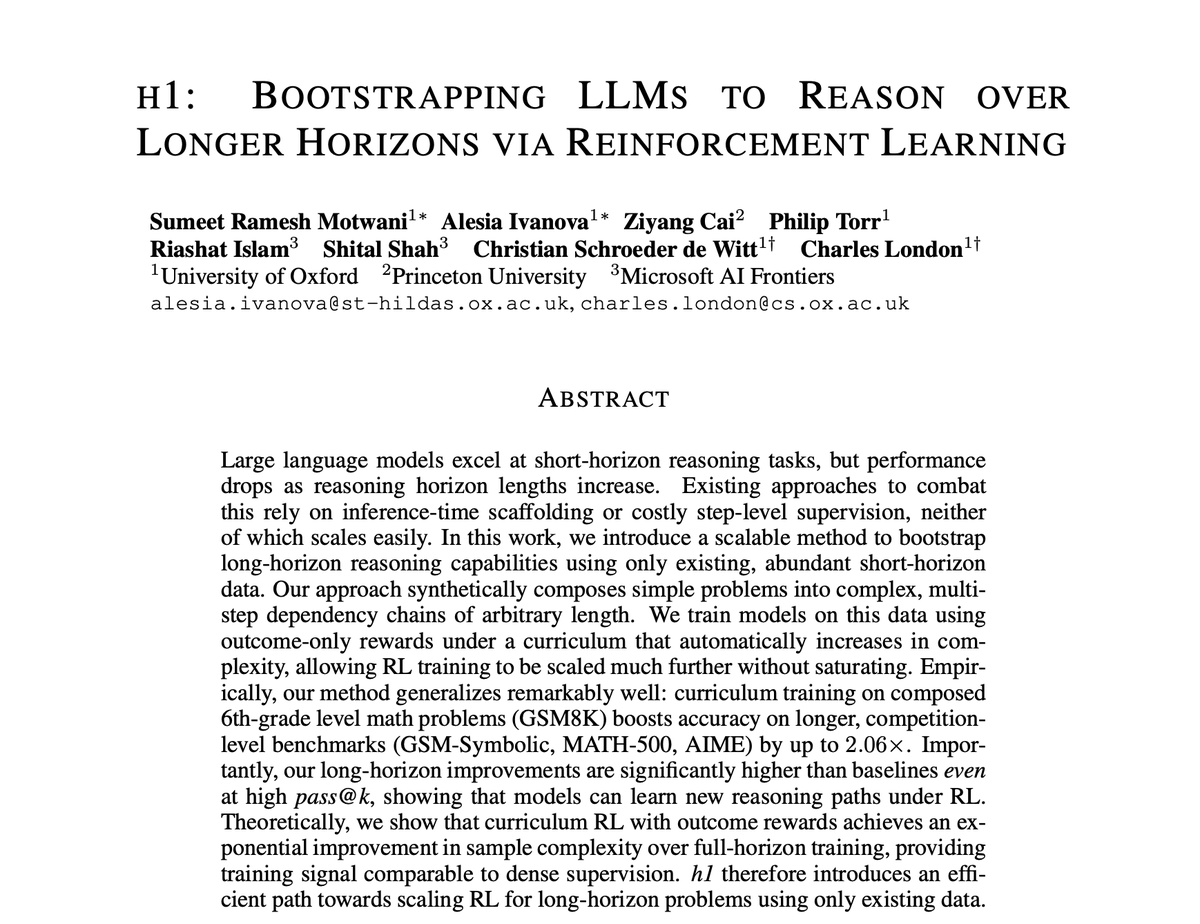
🚨How do we improve long-horizon reasoning capabilities by scaling RL with only existing data?
Introducing our new paper: "h1: Bootstrapping LLMs to Reason over Longer Horizons via Reinforcement Learning"🫡
> RL on existing datasets saturates very quickly
> Reasoning over complex interdependent problems is incredibly important, but we currently lack enough long-horizon reasoning data
> Long-horizon problems are hard, which means training signal is sparse. We’d need a way to provide dense supervision
Our solution composes existing short-horizon data to form a synthetic curriculum that keeps growing in complexity! This allows us to scale RL on the same dataset while avoiding saturation, with curriculum acting as dense rewards.
At a small scale, we see massive in-domain long-horizon improvements, which transfer to significantly harder benchmarks. Training on composed 6th grade math problems leads to strong gains on AIME! 1/N🤿🧵