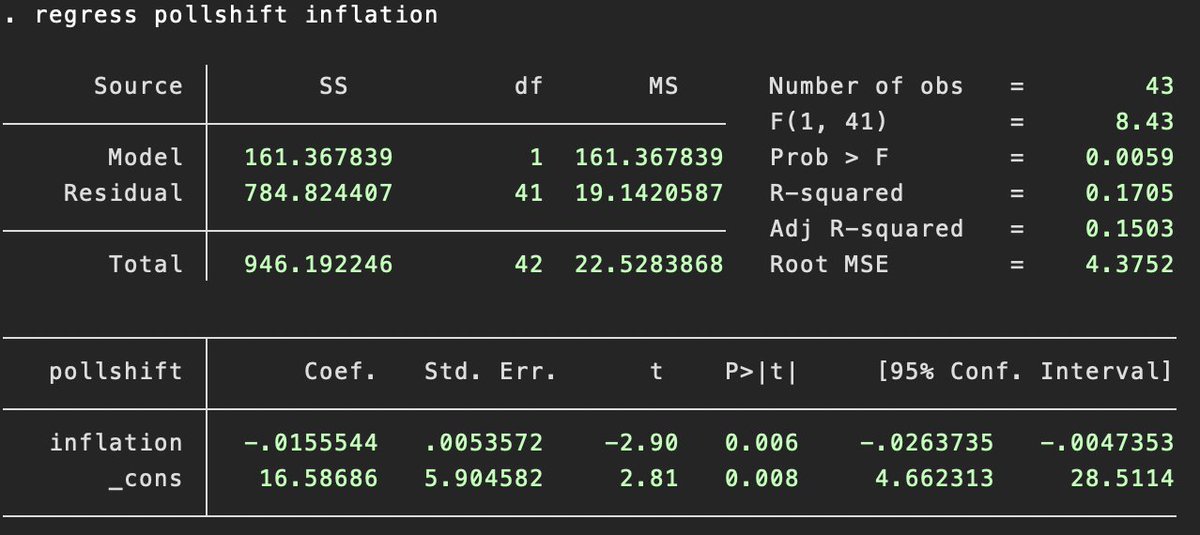
@nickgebbia The job market taught me so much useful stuff. For instance, when the overleaf download exceeds (100), it starts inserting random strings instead of numbers
There are some confounders here, but the inflation thing is actually statistically significant! Each additional $100 of inflation in a state since January 2021 predicts a further 1.6 swing against Harris in our polling average vs. the Biden-Trump margin in 2020.
@FrankSchilbach @CESifoNetwork@hmmlowe Thanks, Frank! and definitely have big shoes to fill @hmmlowe
(though if he’s so inimitable why do I keep finding myself following his path, as a fellow frank student -> ubc AP??)
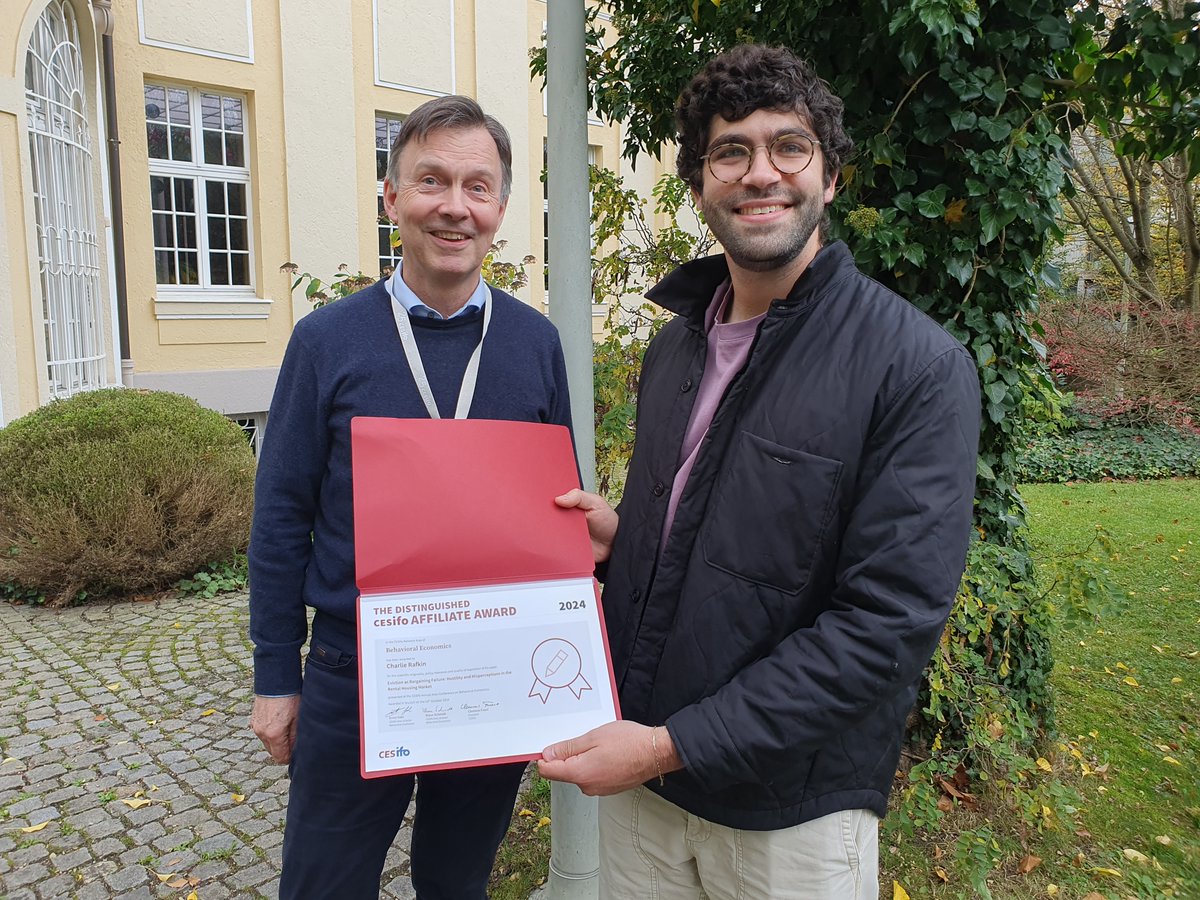
🏆 Congratulations to @CharlieRafkin from @UCBerkeley, winner of the #CESifo Affiliate Award 2024 in Behavioral Economics! 🎉 His paper ‘Eviction as Bargaining Failure: Hostility and Misperceptions in the Rental Housing Market’ stood out for its impactful insights. 👏
@dylanmatt@joshcmorrison Have you done the Revolutions podcast season on the French Revolution? Really really good if you want to fill in the background
Very happy to share that I will start as an assistant professor at @ubcVSE in Jan 2026, after postdoc visits at Berkeley and Stanford!
So grateful for my time at @MITEcon, and for my fantastic advisors, mentors, coauthors, and classmates.
We're happy to announce three new hires, marking the end of a very successful recruiting year. Join us in welcoming Ying Gao, Charlie Rafkin (@CharlieRafkin), and Miguel Ortiz (@mortiz217 ) to Vancouver, and to UBC! Article: https://t.co/uOw7rrs91E
Great Vox article on the Case Deaton research, including a very thoughtful discussion of our paper (@paulnovosad@CharlieRafkin and me) on how to think about outcomes like mortality by education group when the underlying educational distribution is changing over time
@salonium One flag is that the indirect effect on dementia is larger than the direct effect on shingles (at least in pp). My guess (based on v little tbf!) is that biologically plausible “passthrough” could be no larger than 1 in 5, but the study is not powered to detect effects that small
@salonium@paulgp@paulnovosad@thesamasher yeah, i love this paper and their analogy to comparing alaska vs. the US
but - we ultimately conclude the opposite way, ie there are in fact real (and huge) increases in mortality for the bottom 10%
Sharing some simple Javascript code embeds that can improve Qualtrics surveys for econ/social science research
(+ if you have similar hacks, I'd love to see them!)
https://t.co/XXcrf9Fkur