Some professional news: after nearly twelve years at Vox, I'm going to be joining @open_phil, working with @mattsclancy and @jddwor on the Abundance and Growth Fund
personally i am not really impressed when a computer is good at math — since a computer is math . i am a lot more intrigued by things like , for example , a rat being an exceptional cook — since that’s not really expected
@wilhelmscreamin I truly love the (prob apocryphal) story that Americanos are called that because when we invaded Italy in 1943-44, the Italians kept serving us espressos and we were like “TOO SMALL, ADD WATER”
It would be helpful if Ant, OAI, GDM, and other major industry players threw their weight behind a California bill and a federal bill enacting these recommendations
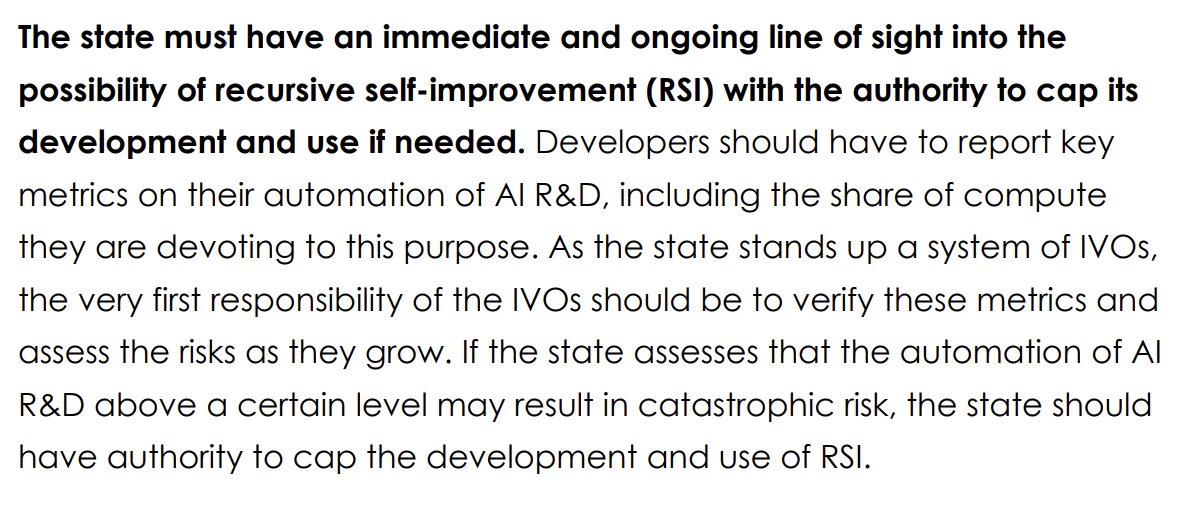
There is a lot of great stuff in this new report from the California government on AI policy.
Particularly valuable to have mechanisms where the government can modulate the speed of development, especially for recursive self-improvement.
https://t.co/4RGV60JqYN
this article is once again effective altruism-pilling me.
one of the options recommended for new billionaires is repairing 100+ basketball courts in NYC. To put it in perspective, you could spend the same amount of money and save 3,000+ kids from dying of preventable disease! Those kids will otherwise never play basketball, even on a shitty court.
i kinda feel conflicted about this because i don't believe that the *only morally justifiable thing* for people to do is spend all their disposable income on e.g. anti-malaria initiatives. Or at least, i don't have an objective moral framework that allows me to say that. But man, if you're a private donor who can spend your money anywhere you want, I just don't think you can say with a straight face that repairing basketball courts is better than saving 3,000 lives. There's just no way that's true w/ any common sense moral framework
writing this post made me feel a bit guilty about my own personal tradeoff of spending on things that make me feel nice vs. things that do material good for others, so i'm going to make a big donation today. I'm really grateful for GiveWell + other organizations that make it easy for me give to people in need!!
The recommendations from Governor Newsom's recently convened expert panel - Professor Alondra Nelson (Princeton), Jason Goldman, Professor Robert Reich (Stanford), and Professor Gillian Hadfield (Johns Hopkins) - were just released and are a clarion call for urgent action to address risks to public safety from advanced AI systems.
Some of the most notable recommendations:
• Emergency shutdown authority
• Minimum safety standards for AI developers
• Mandatory third party oversight
• Authority to cap the amount of compute used for RSI
The next weeks and months will determine whether these recommendations are words on paper, or whether the Governor and legislature can work together to accomplish something historic to protect CA and lead the country on guardrails to prevent catastrophic risks from runaway AI development.
We’re releasing a concrete proposal for how a near term AI slowdown could work. It involves:
1. AI companies declaring how they are using their compute and letting third party auditors verify those disclosures. We call this Verified Compute Allocation Disclosures (VCAD).
2. Compute Reallocation towards serving customers and safety, away from capabilities R&D.
(2) slows AI capabilities , while (1) makes the slowdown credible.
AI companies currently seem to be going for ‘safety case pacing’. But: (i) there’s no consensus on what a valid safety case looks like so there’s no way to consistently audit for compliance, and (ii) if the R&D doesn’t get paused, temporarily delaying a training run for safety doesn’t meaningfully slow the overall trajectory of capabilities progress. It would be great if we had a viable safety case regime, but we need much more time to get it working.
Compute reallocation is a good pacing proposal because it is relatively specific, can be verified, and would lead to a more durable slowdown.