Well this is exciting!
The Department of Psychological & Brain Sciences at @JohnsHopkins invites applications for a full-time tenured or tenure-track faculty member in Cognitive Psychology, in any area and at any rank!
Application + more info: https://t.co/bVEdhelZPk
A forgotten signal in psychology: the time between pressing and releasing a key.
A PNAS study shows that response duration, not just reaction time, tracks confidence.
Hesitation after initiating a response reveals uncertainty, offering a simple, no-cost measure of metacognition hidden in everyday behavioral data.
@JacksonKernion@ZeffMax literally had this in mind with my tweet!! i also find strongdarts to be the best fitting pant i’ve ever owned and fear the slenderness of the cut has them on the chopping block
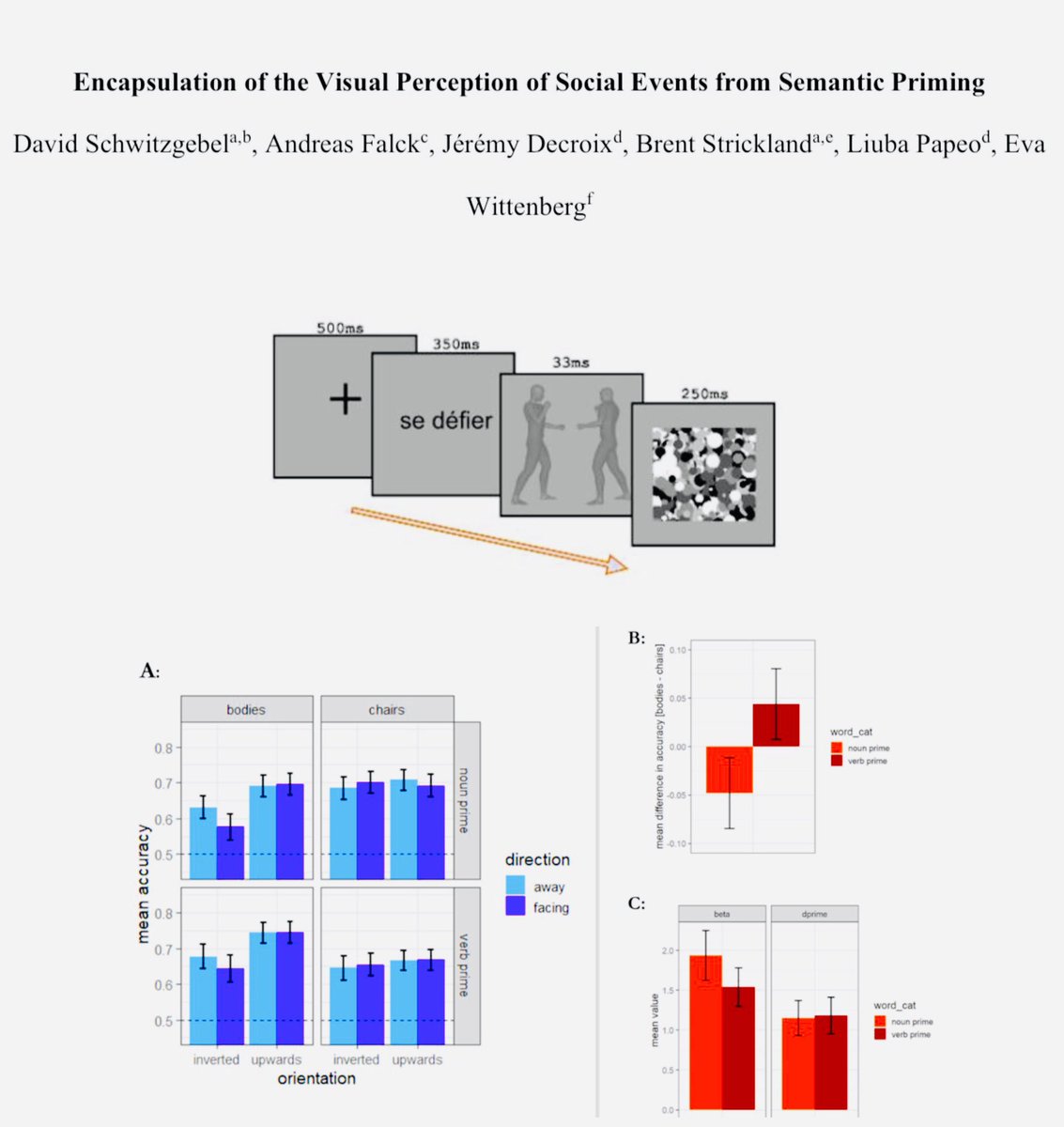
10 years ago we identified a stage in social-event processing in which perception recognizes that two social agents are connected. A new study now shows that this stage is fully encapsulated from language and semantics.
Soon to appear in @APA JEP:HPP
https://t.co/VbB5WEjmv2
Introducing “Pretend Battleship”: you’re told where the ships are but then must play like you never got that info. Could you do it? And what would that reveal about your understanding of your own mind? A joy to be part of this creative project led by @mazormatan, w/ @ibphillips
Curious @sapinker what you make of Pearson's work (mentioned in @NautilusMag)? Pupils constrict when imagining bright stimuli—but only in normal populations, not in aphantasics! https://t.co/n2oOF89Tyq. Such a creative entry into this issue, wowed me when I first learned of it.
Everything I've recently read about "aphantasia" is consistent with Martha's & my hypothesis that their deficit is not in their imagery but in their folk theory about everyone else's imagery (though I'm prepared to be proven wrong). (The existence of fMRI differences is uninformative: all individual psychological differences consist of differences somewhere in the brain, including differences in personality.)
More anecdotally, many visual aphantasics are happy to report vivid auditory imagery (e.g., "playing a song in your head"), suggesting they have at least some understanding of the qualitative differences between real-deal perception and what imagery is supposed to be like.