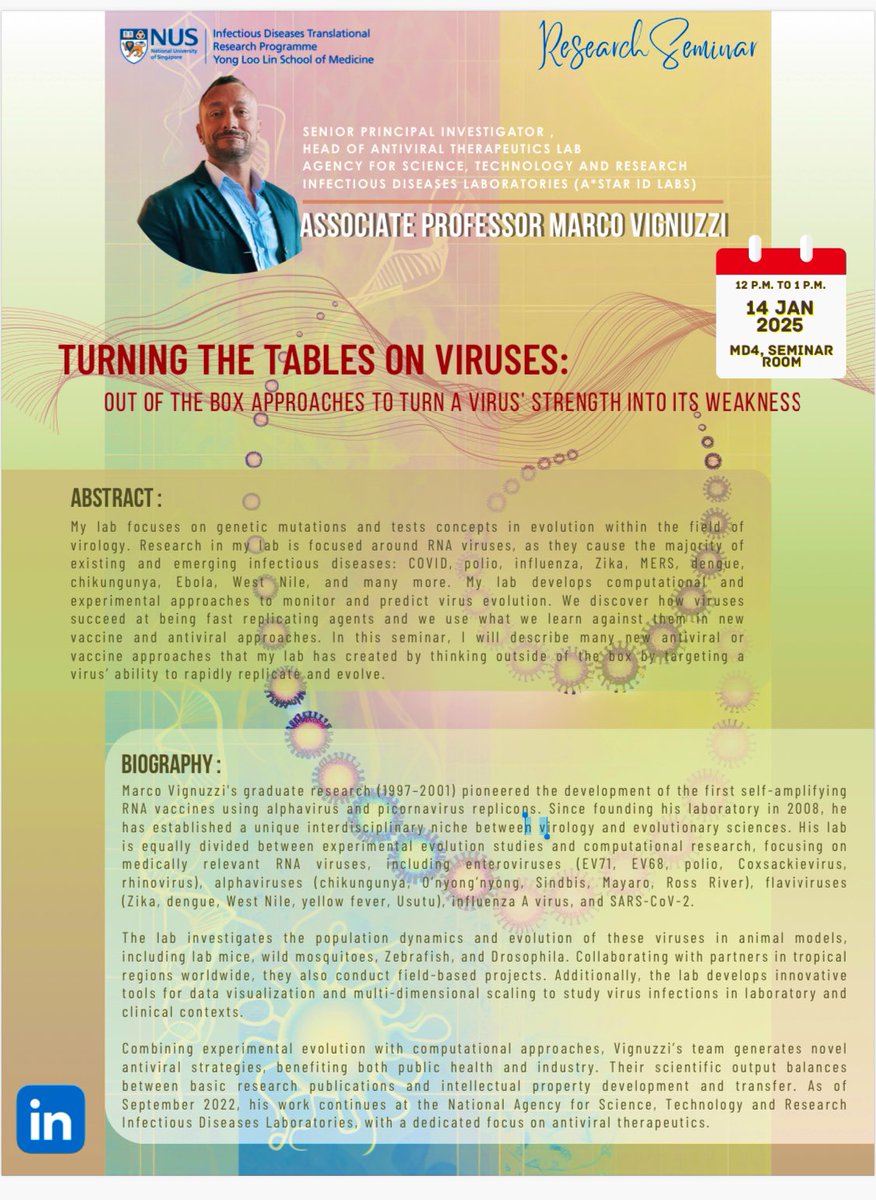
Our paper on inferring context dependent entropy using protein language models is officially out in NAR Genomics & Bioinformatics! 🧬🤖
with Adam Strange, @jampei2 and @SystemsVirology
https://t.co/w5ZmD4GKoL
details below...
#NARGAB
A virus won’t go from “nothing” to “crisis” overnight—but ignoring it is like smelling smoke and thinking, “Eh, probably just toast.” Spoiler: it’s not toast. Early Warning is everything. Fund and improve systems that keep the kitchen from burning down.
https://t.co/S5nbrdXL15
Please join us by registering with Zoom link and share to your network to learn more about Nipah from @linfa_wang, severe fever with thrombocytopenia syndrome from Professor Dongmin Kim and one health AMR in China from Professor Yonghong Xiao
Meet the Batman – Prof Linfa Wang FAA FTSE. Like the eponymous hero, his superpowers are his vast subject knowledge and willingness to answer the call to action. The bat expert had been considering retirement but was quick to step up when COVID struck.
Need a human cell line to isolate and propagate SARS-CoV-2 in high titers? Here we have characterized “IGROV-1”:
https://t.co/BLyG9IA7la
+ CRISPR screens identifying AHR as a host proviral factor of human betacoronaviruses
@yaw_shin@CheeWahTan2 @GavinJDSmith @linfa_wang
🦇news: Body temperature in #bats dramatically impacts their #antibody repertoires. High 🌡️leads to preferential recognition of damaged cells, indicating an anti-inflammatory function. #preprint https://t.co/8UcOU5QTcz
Your academic CV is NOT linked to your ability to make big discoveries.
▫️
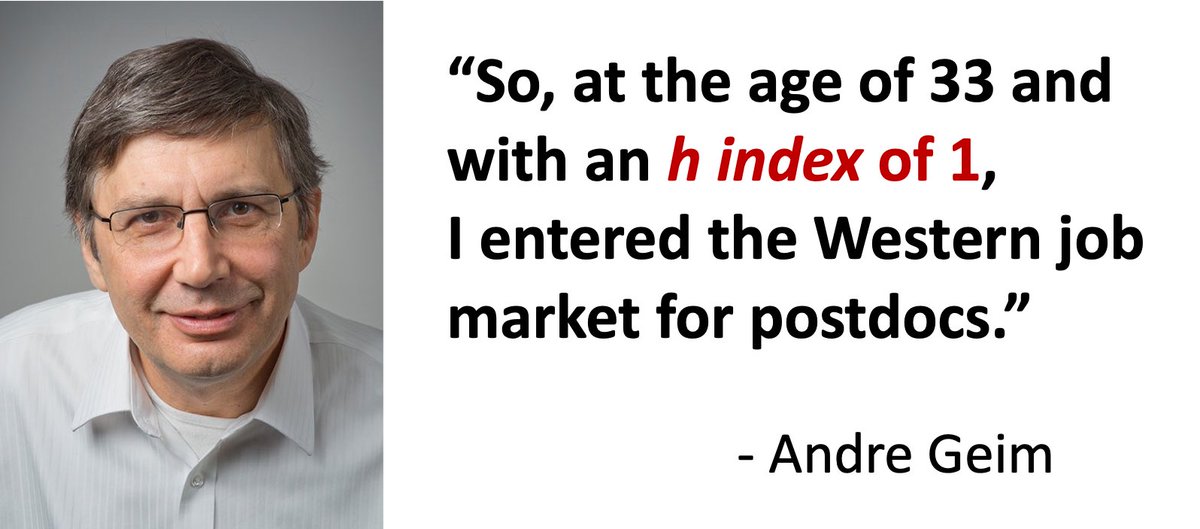
1. Andre Geim, a co-discoverer of graphene, wrote in his Nobel Lecture article:
- “So, at the age of 33 and with an h index of 1 (latest papers not yet published), I entered the Western job market for postdocs.”
2. Albert Einstein searched for a teaching position for two years. He had to accept a position at a Patent Office, where in a single year he wrote the four papers that completely revolutionized #science (the photoelectric effect, Brownian motion, special relativity, and E=mc2).
- Only few years later, he finally secured his first academic position as lecturer at the University of Bern.
▫️
Other examples include Peter Ratcliffe and Frances Arnold, who won Nobel Prizes for the discoveries they made as young PIs in newly established labs. And many others.
▫️
So, let us all keep in mind that:
1. Big discoveries are often unforeseen. They emerge from random and risky research (e.g. graphene was a tiny side project!). Make sure you have such projects in your lab.
2. Most truly impactful discoveries did not require high h-indices, excessive funding or a high-IF journal.
3. Rejection of your proposal does NOT mean it proposes bad science. Such rejections represent the opinion of one person who has a rather subjective idea of what ‘good science’ means.
4. For younger people, it’s easier to do risky research. Locking them to unnecessarily complex tenure requirements makes such discoveries unlikely.
▫️
A strong scientist is not defined by high “academic metrics”.
It is the ONE who proposes risky endeavors outside the conventional boundaries.
Who sees risk as an opportunity to make discoveries.
And who is constantly seeking out these risks in the lab.
#AcademicTwitter #AcademicChatter
@DukeNUS research finds antibodies that neutralise COVID variants and other animal coronaviruses. By targeting conserved spike regions, the antibodies could enable universal coronavirus vaccines and therapeutics. Major advance for pandemic preparedness!
https://t.co/FKrteZRvYZ
This paper from Linfa Wang’s group to which @tylernstarr & I contributed illustrates interesting points about
1⃣ Importance of imprinting for antibody specificity to SARS-like CoV
2⃣ How it may be easier to broadly neutralize animal sarbecoviruses than human #SARSCoV2 variants
Pan-sarbecovirus monoclonal antibodies can be a good pandemic preparedness strategy for SARS3 buying time for specific mAb and vaccines. IC50 E7 dropped with XBB otherwise active SARS1 and SARS2.
1/2
https://t.co/w5DuLrT8tv