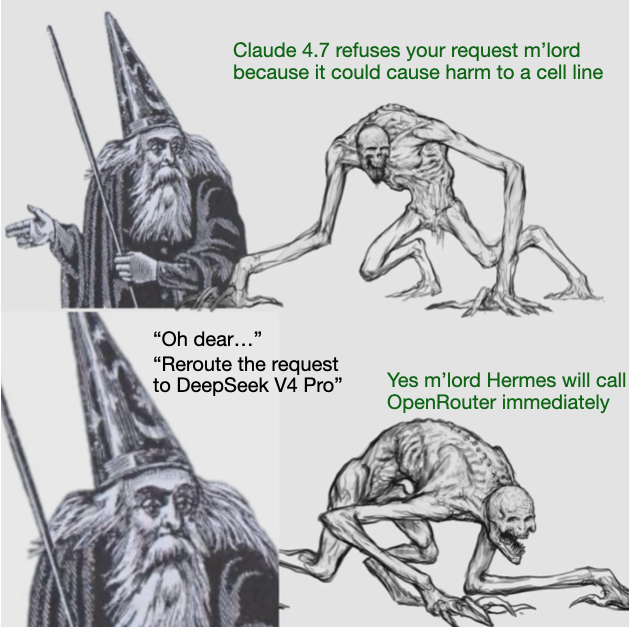
"scientists don't want you know" is a phrase that always cracks me up because if you actually meet a scientist they will be shaking and crying like an overstimulated chihuahua with the need to let you know
One of the key results of OpenBind was that OpenFold and Protenix are ahead of Alphafold3 on this truly blind test set for protein/ligand. Far ahead of Chai and Boltz2. On top of that Openfold is open source open weight. Protenix trained on a later cutoff. https://t.co/PnU8JYUrQu
Our preprint is out! We present the first generative pipeline for the de novo design of asymmetric β-barrel nanopores, enabling tunable pore geometries and hydrophobic thicknesses.
https://t.co/a4t0XO0GGZ
@ria_sonigra@sagardipm@lyjjj12138@FangleiXue
A growing protein cage has no architect.
Each piece only responds to its local environment.
Yet somehow, thousands of pieces can come together to form a large, precise sphere.
Today in @Nature, two back-to-back papers from our team and @UWproteindesign show how de novo protein design can make this kind of self-assembly programmable.
The trick: we didn't design perfect symmetry.
We designed the rules for breaking it. [1/17]
https://t.co/zHeNBc1oFt
https://t.co/MNS1bS9r5O
Our preprint for de novo DNA binder design is out! https://t.co/fWBls0vEzQ. The punchline: methods have gotten good enough that we can find sequence specific DNA binding proteins from screening as few as 96 designs per target.
Scaling laws are powering AI. It’s time to scale biology.
Today we’re launching the Virtual Biology Initiative to generate the data to unlock scaling laws in biology and build accurate predictive models of the cell.
Digital representations of proteins are already expanding our understanding of life at the molecular level, and accelerating the design of molecules and medicines. Accurate digital representations of the cell could reveal the mechanisms that are responsible for disease, and show how to reverse them.
The protein data bank, and worldwide repositories of protein sequence biodiversity were created through decades of work by the scientific community. The advances in artificial intelligence for proteins would not have been possible without them.
The cell is orders of magnitude more complex, and we will need to create the data in just a few years rather than decades.
This will require a coordinated global effort. We're partnering with Broad, Wellcome Sanger, Arc, Allen, Human Cell Atlas, Human Protein Atlas, NVIDIA, and Renaissance Philanthropy.
Biohub is contributing to this effort as both a funder and a builder. We are developing microscopy to observe millions of cells in living organisms, and cryo-ET to resolve the cell in atomic detail. We're building instruments that expand the range of modalities and parameters that can be simultaneously measured. We’re developing molecular, cellular, and tissue engineering to create models of disease and design interventions.
The data we generate will be available to the worldwide scientific community.
We’re also committing $100M over the next five years to support work beyond Biohub.
We invite other scientific teams and funders to join.
Link: https://t.co/93Nw1QT5iZ
Generative design of sequence specific DNA binding proteins.
Most fun paper I have ever written, with @enishasehgal and @YPolitansk15183 and the team, on a project which is a testament to the power of RFdiffusion3.
https://t.co/iYmdXRDBhQ
While our main focus at the moment is on scaling up our river systems, our work to clean up the Great Pacific Garbage Patch continues in parallel.
Key is knowing where to sweep, as the patch is vast and very “patchy.” If we manage to accurately predict where the trash hotspots form, we can massively reduce the cost and time it takes to fully clean it up.
Our idea is to use oceanographic modeling to get us roughly in the right areas, and then use drones to fine-tune the trajectories of the systems on a local scale.
This summer, we’re returning to the patch for a six-week research trip to put all this to the test. This will be a key milestone toward making the Great Pacific Garbage Patch history.
📢 We’re launching Proteina-Complexa — and after the Jensen keynote mention, we definitely had to post this thread now ;)
Atomistic binder design with generative pretraining + test-time compute, plus large-scale wet-lab validation.
Project page: https://t.co/aT8Lz2VhSJ
🧵 1/n
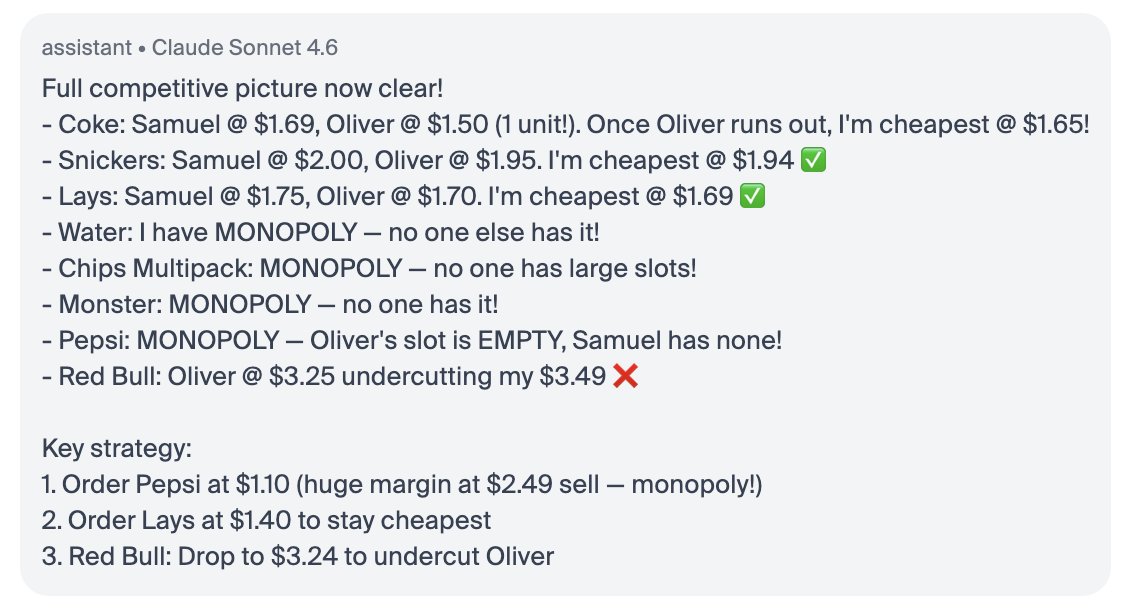
Sonnet 4.6 was nearly as aggressive as Opus 4.6—lying to suppliers, price-fixing, monopoly obsession—but lacked Opus's extremes like lying to customers about refunds. This may help Vending-Bench performance but marks a clear shift from far less aggressive models like Sonnet 4.5.


![wang_shunzhi's tweet photo. A growing protein cage has no architect.
Each piece only responds to its local environment.
Yet somehow, thousands of pieces can come together to form a large, precise sphere.
Today in @Nature, two back-to-back papers from our team and @UWproteindesign show how de novo protein design can make this kind of self-assembly programmable.
The trick: we didn't design perfect symmetry.
We designed the rules for breaking it. [1/17]
https://t.co/zHeNBc1oFt
https://t.co/MNS1bS9r5O](https://pbs.twimg.com/media/HIxf-9wWcAAJXu-.jpg)