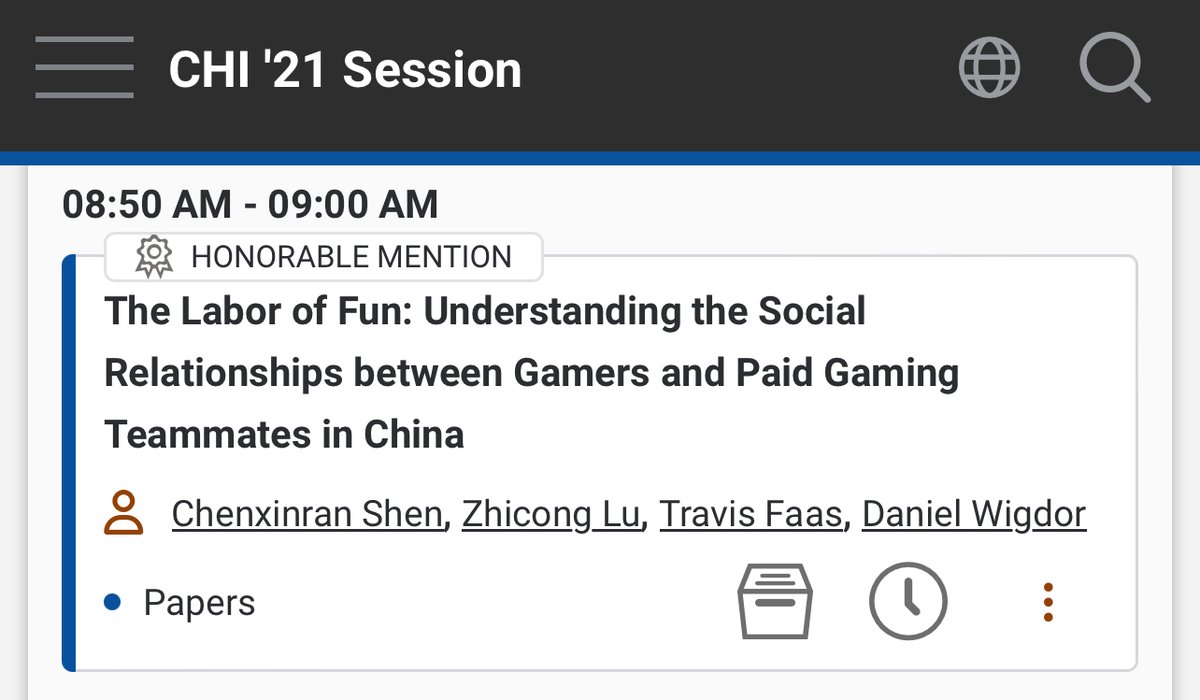
Thrilled to receive my 2nd Honorable Mention paper at #CHI2024! Both awarded papers investigate how voice can influence interpersonal communication, one within the context of online dating and the other in a paid game teammate online community. Thanks to my collaborators!
🎓 PhD Recruitment | Texas A&M CS
I am seeking 1–2 PhD students for Fall 2026 in Human–AI Interaction, with a focus on AI for education.
✅ Motivated and responsible
✅ CS background
✅ Full-stack development or LLM fine-tuning experience is a plus
📅 Deadline: Dec 15, 2025
I’m hiring students who are interested in multimodal generative AI / UI agent-related topics.
My current vision is that we should have human-in-the-loop controllable UI generation models that adapt UIs to the diverse needs of designers and users + enhance human creativity.
Excited to present our #CHI2025 paper “HaloTouch: Using IR Multi-Path Interference to Support Touch Interactions with General Surfaces” at Yokohama tomorrow. The video is available on YouTube as well: https://t.co/YE5YILighC
Thrilled to share that our paper "To Rely or Not to Rely? Evaluating Interventions for Appropriate Reliance on Large Language Models" received an Honorable Mention at #CHI2025! 🔥
preprint >> https://t.co/719x04beT7
video >> https://t.co/jjv5Ozktfn
My work from last summer in Finland with amazing scholars from @AaltoUniversity and @LMU_Muenchen has been published on Augmented Humans (AHs) International Conference
⭐How will humans collaborate with their "augmented" counterparts in the future? https://t.co/ihtIVrXOUU
📢 Looking for current research on #HCI + #AI? Here's a collection of 200+ #CHI2025 preprints, collected via arXiv and your suggestions: https://t.co/SZnY8RrDir
New meta-analysis (2024) finds human-AI collaboration is task-dependent: performance increases for creative & open-ended tasks (like content creation), but performance drops for decision-making tasks; human-AI collaboration seems to work best when humans already outperform AI
Your brain's next 5 seconds, predicted by AI
Transformer predicts brain activity patterns 5 seconds into future using just 21 seconds of fMRI data
Achieves 0.997 correlation using modified time-series Transformer architecture
-----
🧠 Original Problem:
Predicting future brain states from fMRI data remains challenging, especially for patients who can't undergo long scanning sessions. Current methods require extensive scan times and lack accuracy in short-term predictions.
-----
🔬 Solution in this Paper:
→ The paper introduces a modified time series Transformer with 4 encoder and 4 decoder layers, each containing 8 attention heads
→ The model takes a 30-timepoint window covering 379 brain regions as input and predicts the next brain state
→ Training uses Human Connectome Project data from 1003 healthy adults, with preprocessing including spatial smoothing and bandpass filtering
→ Unlike traditional approaches, this model omits look-ahead masking, simplifying prediction for single future timepoints
-----
🎯 Key Insights:
→ Temporal dependencies in brain states can be effectively captured using self-attention mechanisms
→ Short input sequences (21.6s) suffice for accurate predictions
→ Error accumulation follows a Markov chain pattern in longer predictions
→ The model preserves functional connectivity patterns matching known brain organization
-----
📊 Results:
→ Single timepoint prediction achieves MSE of 0.0013
→ Accurate predictions up to 5.04 seconds with correlation >0.85
→ First 7 predicted timepoints maintain high accuracy
→ Outperforms BrainLM with 20-timepoint MSE of 0.26 vs 0.568
1/3 Today, an anecdote shared by an invited speaker at #NeurIPS2024 left many Chinese scholars, myself included, feeling uncomfortable. As a community, I believe we should take a moment to reflect on why such remarks in public discourse can be offensive and harmful.
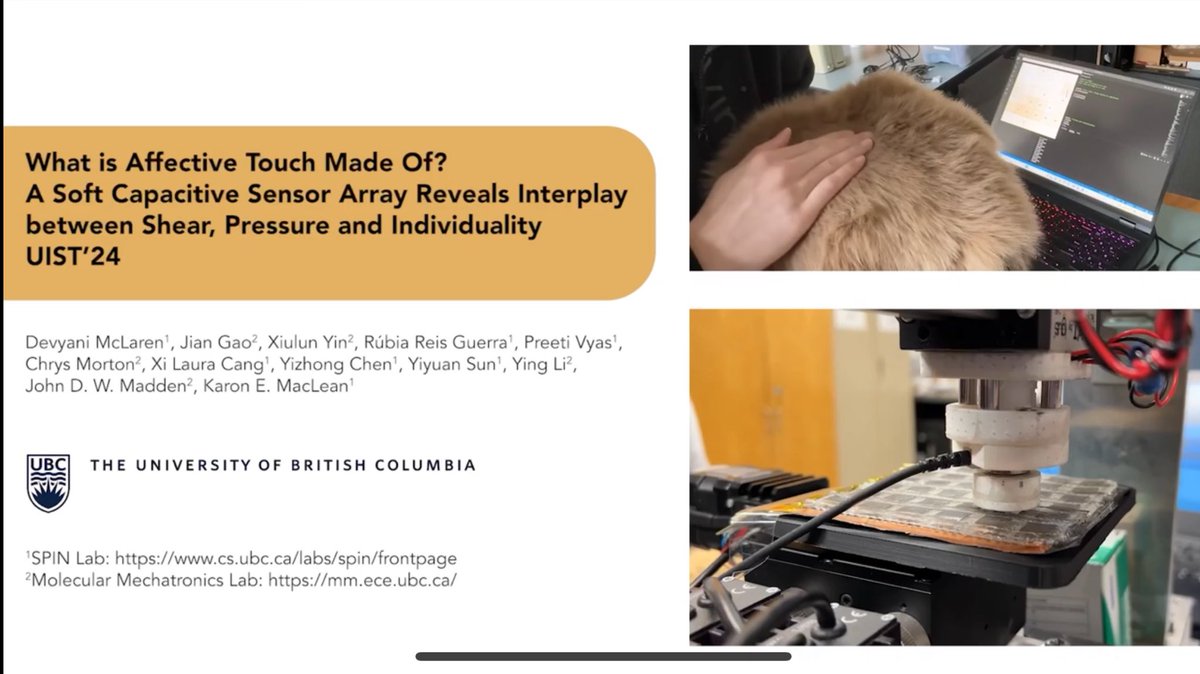
Check out our work on ShearSense at #UIST2024 We demonstrate interplay between shear, pressure, and individuality evaluating affective touch on a soft capacitive sensor.
Not at UIST this year but my amazing colleagues are. Go say hi to
@dev_mclaren@jsonx99 ✨#affectivehaptics