Poet | Journalist (Space, Science, Data & More) & Columnist with @timesofindia | @APCSS Fellow | Expert Consultant On 2 (award winning) Space Films For @wbd
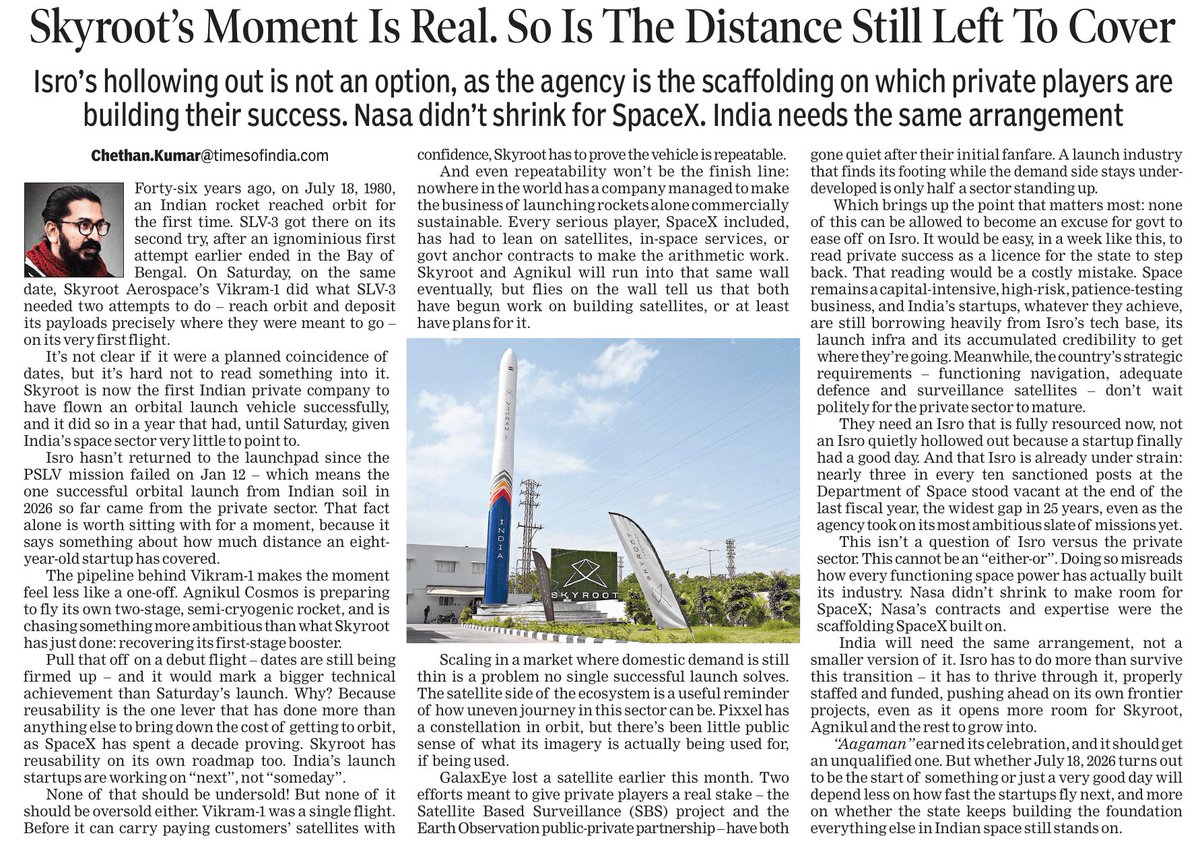
#Space#India@SkyrootA earned its celebration & deserves an unqualified one.
#Vikram1 matters, @AgnikulCosmos will take it higher with #Agnibaan.
It may be tempting to treat space policy as a relay where the baton has now passed! But hollowing out @isro isn't an option!
#Space#Update
Space regulator & promoter @INSPACeIND has invited Indian-owned non-govt entities (NGEs) to bid for rights to use three satellite network filings at the orbital location 93.5°E. 1/n
The filings cover Ka, Ku and Q/V bands and can be used to build high-throughput satellites for services such as broadband and broadcasting. They are existing filings under India’s administration, at the coordination or registration stage with ITU. 2/n
Winners can build on them rather than start fresh filings. They are offered in seven packages, from single bands to all three, with base prices ranging from Rs 27 lakh for Q/V to Rs 1.04 crore for all three. 3/n
Only NGEs under Indian ownership and control that want to own and operate satellites or hosted payloads can apply. Bids, due by 5 pm on Dec 21, must be sent by post or by hand, with a copy of the technical bid emailed. 4/n
Each applicant submits a technical bid, covering experience, infra & financial capacity, a separate sealed price bid & a security clearance proforma, along with a Rs 1L EMD. Highest price bid at or above the base price wins each package; ties go to higher technical score. 5/n
As per IN-SPACe, satellites involving the Ka band must deliver a combined throughput of at least 25 Gbps; others need at least 10 Gbps or 12 transponders of 36 MHz each. 7/n
The winner must pay 25% within seven working days and the balance within four weeks. The deposit is refunded to unsuccessful bidders but forfeited if the winner fails to accept the offer or pay. IN-SPACe can “reject any application on national-security grounds”. 6/n
They must cover Indian territory, including islands, carry at least 20% indigenous content and be deployed within five years of IN-SPACe’s advisory note. The award does not confer spectrum rights or authorisation. 8/n
Winners must obtain the advisory note, approach the Department of Telecommunications' Wireless Planning and Coordination Wing, complete frequency coordination with other networks, and seek a separate IN-SPACe authorisation to operate. 9/n
The offer carries risks. The Ka-band filing is valid only until Feb 26, 2028, and the announcement cautions that additional measures may be needed to bring it into use in time; the Q/V filing is valid until 2031 and the Ku filing is already notified. 10/n
Filings are offered on an “as is where is” basis, with no guarantee of interference-free access or of the orbital slot itself, and payments are non-refundable. 11/n
Rights of use last up to 20 years from bringing the network into use, cannot be transferred, and can be cancelled for inadequate progress, with possible blacklisting. n/n
Rights of use last up to 20 years from bringing the network into use, cannot be transferred, and can be cancelled for inadequate progress, with possible blacklisting. n/n
#Space#Update
Space regulator & promoter @INSPACeIND has invited Indian-owned non-govt entities (NGEs) to bid for rights to use three satellite network filings at the orbital location 93.5°E. 1/n
Filings are offered on an “as is where is” basis, with no guarantee of interference-free access or of the orbital slot itself, and payments are non-refundable. 11/n