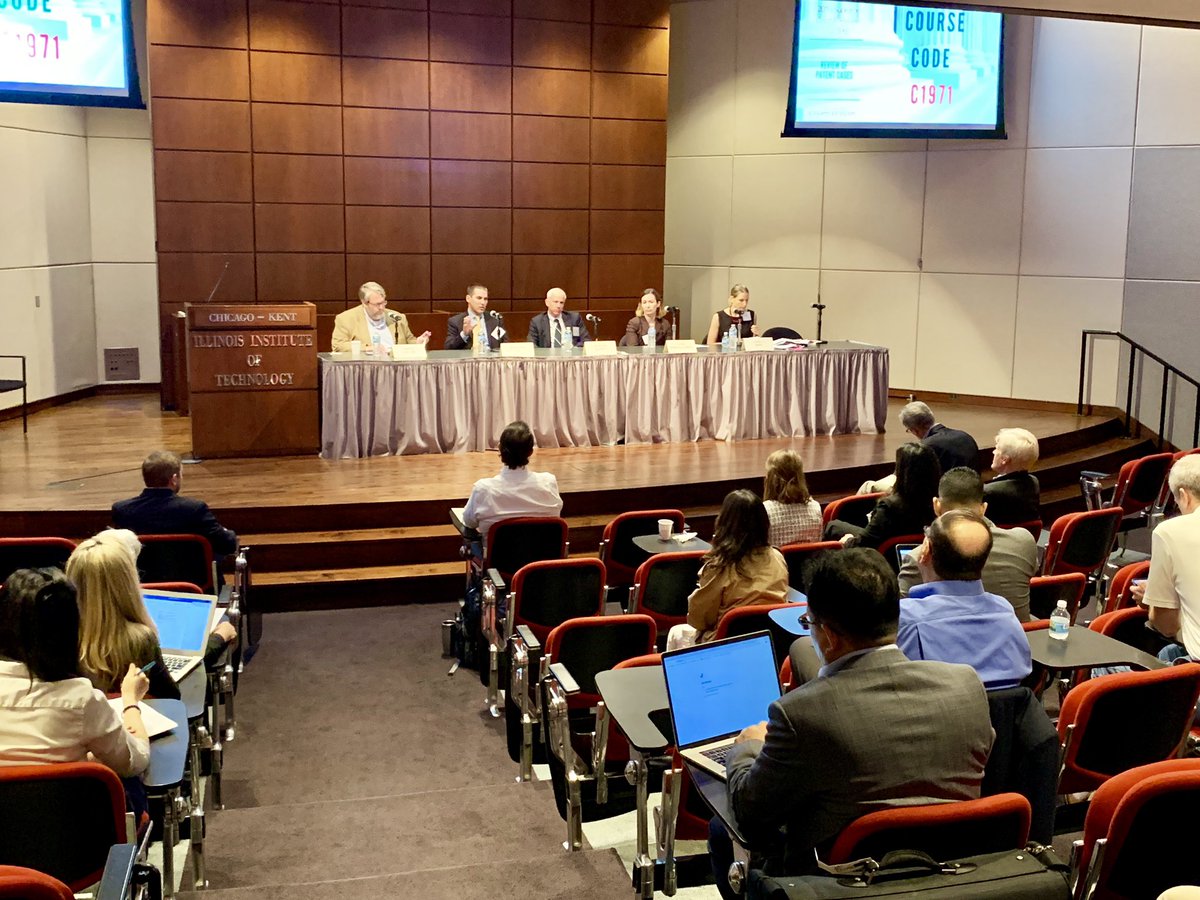
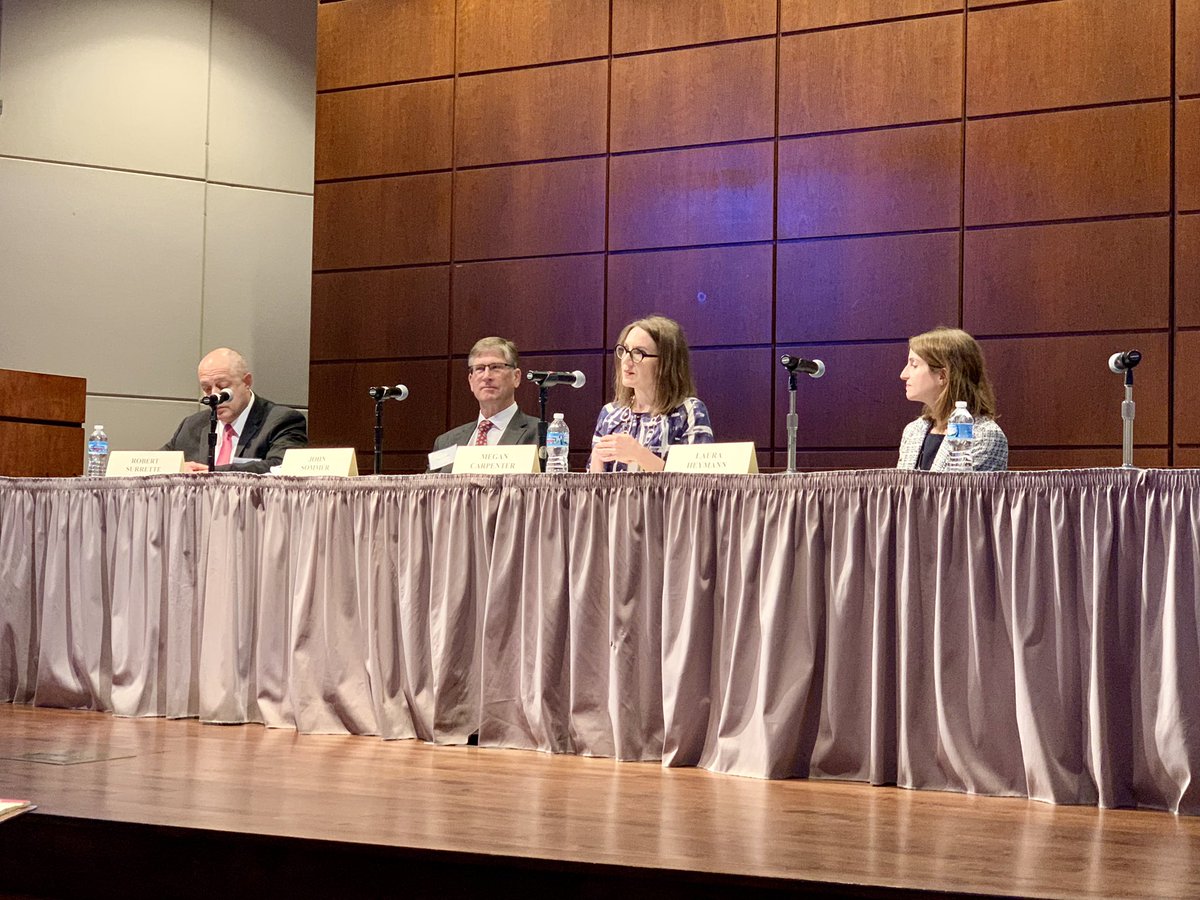
Why does the Supreme Court hear more patent cases than copyright cases? Because patent law issues, if not resolved, may lock up innovation, thereby slowing the US economy, whereas problems in copyright law will likely not stop the creation of expression-Donald Verrilli #SCIPR2019
The stakes for copyright owners on the outcome of the pending Supreme Court case Allen v. Cooper are high because if the Court finds no abrogation of sovereign immunity, states, their institutions and universities may infringe copyrights and not be sued-Donald Verrilli #SCIPR2019
The Supreme Court may be more comfortable taking a "hands off" approach to copyright law by not taking on many cases because multiple circuit courts hear copyright issues, as opposed to patent law cases, which are only heard by one appellate court-Donald Verrilli #SCIPR2019
Our next panel will discuss the analytics of the IP cases before the Supreme Court in the past term and preview the upcoming IP cases before the Court #SCIPR2019
One of the biggest problems left by Return Mail Inc. v. USPS will be how to treat government contractors who are assigned government patents. Will they be treated as the government, therefore not as a person, and unable to institute AIA proceedings? -Camilla Hrdy #SCIPR2019
Further, there would be conflicts for the government to ask one of its other branches, the Patent Office, to find a patent the government is contesting invalid -Richard Rainey #SCIPR2019
In the end, Return Mail Inc. v. USPS involved a simple application of a definition statute to another part of the code, that "person" under the Dictionary Act does not include the government, so a person in Title 35 does not include the government. -Richard Rainey #SCIPR2019
I'm speaking today at @ChicagoKentLaw's 10th SCOTUS IP Review. I'll be talking about Georgia v. PublicResource and about the shrinking role of #SCOTUS in developing #copyright law. #scipr
Had Congress meant to change the meaning of the on sale bar to exclude secret sales, Congress would have done more to clearly change the meaning of the phrase than add "or otherwise available to the public" to 35 USC 102 - Prof. Camilla Hrdy #SCIPR2019
some marks were rejected because the market for the goods bearing that mark may be considered scandalous (eg adult entertainment), and some marks were rejected because the use of a mark in a particular market made them scandalous - Prof. Megan Carpenter #SCIPR2019 2/2
One problem with the ban on scandalous trademark registration was that the reasoning of some rejections ran contrary to the reasoning in other rejections. Some scandalous words were always rejected while some were registered, 1/2
Professor Laura Heymann disagreed with several of the Justices, that there is a universal list of which words would be considered "scandalous or immoral" by society #SCIPR2019
Prof Jessica Silbey noted that, when discussing the impact of Rimini Street Inc, one policy reason to limit fee awards to attorney's fees in copyright cases is that the expenses taken on by the other side are not always predictable; a good reason to follow the American fee rule
Discussing Fourth Estate Corp. v. Wall-Street. com, Professor Robert Brauneis discussed how the purpose of copyright registration isn't just to get claims on the record, but also to obtain copyright office expert opinion on the copyrightability of a work for litigation #SCIPR2019
Welcome to #SCIPR2019! We will be starting our first panel soon, with a discussion of the copyright cases at the Supreme Court during the previous term