I am a member of the Norwegian Nobel Committee.
There are five of us. Five people, appointed by a parliament most of the planet could not find on a map, who decide, once a year, which human being the world has agreed to call good.
I know. I know. I think about it on the tram.
We meet in a building on Henrik Ibsens gate, a street named after a man who wrote almost exclusively about people discovering they are frauds, which nobody on the committee finds funny except me. There is a room with a long table and the portraits of the dead laureates looking down, Mandela, the Dalai Lama, a great many earnest men in spectacles, and one portrait we do not discuss, which is Kissinger, 1973, awarded while the bombs were still falling, after which two of our predecessors resigned and the satirist Tom Lehrer said political satire was now obsolete. We keep him on the wall. A reminder. Every family has the uncle.
It is October in Oslo, which means the sun gives up around four in the afternoon like a civil servant, and it rains the particular Norwegian rain that isn’t quite falling, just hanging there, judging you. I arrive with wet shoes. I always arrive with wet shoes. There is coffee, because this is Norway and there is always coffee, we drink more of it per person than almost anyone alive, and someone’s wife has sent kanelboller, the cinnamon buns, and we sit, five Norwegians, damp, caffeinated, sugared, and we decide the moral standing of the entire species.
Let me tell you how it actually works, because the world imagines a cathedral and it is, I promise you, a book club with a mandate.
287 nominations this year. 208 people, 79 organizations. Anyone can nominate, that’s the secret nobody understands: a professor, a parliamentarian, a former laureate, so the “nominee” list is meaningless, it’s a suggestion box, and every autumn some congressman nominates his own golden retriever and the press writes “SHORTLISTED.” Nobody is shortlisted. There is no short list the public ever sees. There is us, and the coffee, and the rain, and the portraits, and a Norwegian stubbornness that is older than the prize itself.
We read reports. The institute’s advisers write them, thick dull documents, and we argue. Our chairman told the BBC once that in the final meeting “there is a high temperature.” High temperature, for a Norwegian, means someone slightly raised an eyebrow and then apologized for it. We don’t do high temperature. We do a long silence, and then Kristin says “well,” and everyone knows exactly what “well” meant, and it’s settled. That’s our shouting. “Well.” You’d have to be raised here to hear the violence in it.
Now. This year. I will not say the name, because we never say the name, but you know the name.
A certain head of state wanted this prize the way a child wants a thing in a shop window, which is to say loudly, and in public, and with the full belief that wanting it was itself the argument. He said he deserved it. He said he’d ended eight wars, a number that grew most times he said it, like a fish. He had other heads of state phone us. Israel’s prime minister posted it on the internet, “Give him the Nobel.” The leaders of Cambodia and Pakistan announced they’d nominated him, as though announcing it were part of it, as though we tally mentions. A man flew around the globe collecting endorsements for a Norwegian committee the way you’d collect signatures for a petition to the council about a noisy dog.
And here, uff da, is the detail I treasure, the one that makes me smile into my coffee. The nomination deadline is the 31st of January. He took office on the 20th. So for all the phone calls, all the posts, all the gilded lobbying, the only nominations that could possibly count for this year’s prize were filed in the first eleven days of his term, before he had, by his own arithmetic, ended a single one of the eight wars. He campaigned all year for a prize whose window had shut while he was still hanging up his coat. We didn’t have to reject him. The calendar did. We just watched. Norwegians are very good at watching. We have long winters.
People think we sit there weighing his deeds. We don’t. That’s the thing I can’t make the world understand. We’re not grading his homework. We don’t owe anyone the prize for a ceasefire, however real, however loud the announcement. “He made peace” is not a sentence that ends in a medal, the way he believes it does, the way he believes every good thing ends in his name on it. The will of a dead Swede says the prize goes to whoever did the most for fraternity between nations. A dead Swede, I should add, who made his entire fortune inventing dynamite and selling arms, and spent his last years horrified at his own obituary, which called him a merchant of death, and so bought his way to immortality as a man of peace. The whole prize is one guilty arms dealer’s attempt to launder his name. We are, all of us, administering a dead man’s public relations. I find this clarifying. It keeps me humble. It should keep everyone humble, and it keeps, by my count, no one humble at all.
So who did we give it to?
An eighty-five-year-old woman. A judge. Born in Durban, under apartheid, granddaughter of a Tamil man who came to South Africa as indentured labor, a bus driver’s daughter from the poor Indian quarter, who became the first non-white woman to run a law practice in her province, who defended Mandela’s people when defending them was dangerous, who sat on the Rwanda tribunal and the court at the Hague, and who, at eighty-five, is right now a judge weighing whether a genocide is a genocide. When we told the world, our chairman said the rule of law “underpins the system we have set up to ensure peace,” and that “peace requires justice.” She wasn’t even in Oslo. She was in Nuremberg. In courtroom 600. The actual room where they tried the Nazis. You cannot stage that. God staged that, and God, it turns out, is a better satirist than any of us.
She did not phone us. She did not post. No prime minister demanded it for her on the internet. She had, as far as our deliberations are concerned, the one qualification the loud man could never manufacture, which is that she wanted the work and not the medal. The medal finds those people. It flees the ones who chase it. This is not a rule we wrote. It’s just the only pattern the hundred-odd years of our mistakes has ever shown.
The reaction from across the ocean was immediate. His spokesman posted that we “place politics over peace.” Ja. Perhaps. We’re five damp pensioners in a rainy city; of course it’s political, it was always political, it was political when we gave it to a sitting American president nine months into his first term for the promise of things he had not yet done, and we have been quietly embarrassed about that one for fifteen years, so believe me, we had a particular reason this year to prefer a woman with fifty years of verdicts behind her over a man with eight wars in front of him and a deadline already behind him.
Here is what he will never understand, the thing I’d tell him on the tram if he ever took one. We are the one prize he cannot buy, cannot post his way to, cannot have a friendly dictator phone in for him. Not because we’re incorruptible, nei, we’re as vain and wrong and human as the portraits on our wall. But because the entire point of the thing, the only power a small cold country’s book club has ever held, is that it goes to the person not performing the wanting. The moment you demand it, you’ve proven you don’t understand what it’s for, and proving that is itself the disqualification. He ran the most expensive campaign in the history of the prize and the campaign was the reason. He was never losing to Navi Pillay. He was losing to the concept.
It’s dark now. Four o’clock dark. The buns are gone. Kristin said “well” an hour ago and we all went home. I’m on the tram with my wet shoes, and somewhere across the water a very powerful man is explaining to a camera that the prize is rigged, that we’re corrupt, that he’ll win it next year, and he genuinely might, we’re only five idiots and we’ve been wrong before, Kissinger is still on the wall.
But not this year. This year an old woman in Nuremberg, in the room where the law once stared down the exact kind of man who thinks wanting a thing loudly enough should make it his, got a phone call she didn’t ask for.
That’s the job. We don’t reward the man who ends the war and announces it.
We reward the woman who spent fifty years deciding what a war was.
He’ll never see the difference. That’s rather the whole point of him.
Takk for i dag. I have to change trams.
Prof. Florence Ondieki has been appointed the substantive Principal of the College of Human Resource Development (COHRED), ushering in a new chapter in the College’s leadership.
Her appointment follows a successful competitive recruitment process after serving in an acting capacity since 2023. She succeeds Prof. Elegwa Mukulu, the founding Principal of the College, who played a pivotal role in its establishment, growth, and development. ^DP
https://t.co/19DR4FvZzP
#JKUATPAUGrad2026
The loudest proof of wealth is not a designer suit—it is the freedom to enter a room without performing for anyone.
Titus Muya’s casual dress beside sharply suited executives tells a deeper story: ownership changes the balance of power.
Years ago, he was reportedly the founder, strategist, administrator and errand man building @FamilyBankKenya from the ground up.
Today, thousands of careers and decisions sit on foundations laid when few people were watching, applauding or believing.
That is the lesson many young Kenyans miss. Looking successful is expensive; becoming successful demands sacrifice, patience and ownership.
Clothes can create an impression, but only assets, institutions and cash flow can create lasting independence.
Money at its highest level does not merely buy luxury. It buys choice, time, dignity and the power to say no. It allows you to dress for comfort, speak without fear and occupy rooms where your work—not your appearance—commands respect.
Stop spending your best years trying to look rich before you have built anything. Build the company. Own the shares.
Create jobs. Accumulate productive assets. One day, people in expensive suits may sit around a table because of decisions you made in silence.
DEAR WIVES,
If your husband plays golf on weekends but you don't, I need to tell you something.
And I need you to put down whatever you are holding before I continue.
Last Saturday I teed off at 7am for a monthly MAG tournament.
7am.
Your husband also wakes up at 5am for golf.
Not because he loves the sport that much.
Because of what arrives on that course by the time you reach the back nine.
Let me explain.
At 7am the golf course looks exactly like you imagine it looks.
Green. Peaceful. Quiet. Men in polo shirts arguing about handicaps. The sound of birds and dignity.
By the time we were making the turn at hole 9 something had changed on that course.
Something very significant.
The ladies had arrived.
Now I want to be very careful about how I describe what I witnessed because I am a servant of the Lord and I have a reputation to protect in at least three counties.
These women did not come to play golf.
They came to play golf in outfits that have absolutely no business being on a golf course but look absolutely perfect on a golf course.
The skirts.
I need to talk about the skirts.
Golf has a dress code.
These skirts had also read the dress code.
Then made alternative arrangements.
When a ball lands on the green and a woman has to bend down to retrieve it, there is a moment a brief, specific, professionally catastrophic moment where every male golfer within a thirty meter radius completely forgets what sport they are playing.
Handicaps are forgotten.
Scorecards are abandoned.
Grown men who have been playing golf for fifteen years suddenly cannot remember how to hold a club.
The course was full of lawyers, architects, engineers and accountants Yaani men who make important decisions daily standing completely still, club in hand, staring at the middle distance with the expression of men whose brains have temporarily gone on leave.
By the time the award ceremony started in the evening the tournament had been running for hours.
Nobody remembered their scores.
The sponsors were awarding winners.
The men were still recovering from the back nine.
I watched a senior partner of a law firm,
a man who recently argued before the high court on the Rigathi Gachagua case fumble with his drink twice while a lady walked past to collect her award.
I watched an architect who designs buildings forget the word for "birdie."
I watched a pastor.
I will not say what I watched the pastor do.
But I will say that whatever he saw on hole 14 is going to require significant prayer to process and I am not sure his congregation is ready for this Sunday's sermon.
Now here is what worries me as an elder.
You wives prayed for these men.
Some of you fasted.
Some of you went to all night prayers specifically requesting a husband.
God answered.
You got him.
Now every Saturday morning he wakes up at 5am with the energy he has never once demonstrated on a weekday, puts on his best golf shirt and drives to a course where women in architectural skirts are bending to retrieve balls from the green.
He comes home Sunday.
Exhausted.
Satisfied.
Talking about his handicap.
Which handicap exactly we cannot confirm.
Clergy golf is now a thing.
Lawyers golf. Architects golf. Engineers golf. Doctors golf.
Every profession has found its way to the fairway.
God himself is watching these greens and I believe even He is concerned.
As an elder I must warn you.
The golf course is doing to your marriage what the gym instructor started.
Except it is happening outdoors.
In broad daylight.
With witnesses.
And a bar at the clubhouse afterwards.
We either take up golf and accompany these men to the course.
Or we accept that somewhere between hole 7 and hole 14 your husband is seeing things he has not seen since his honeymoon and possibly things he did not see even then.
The balls on these courses are multiplying.
And not all of them are Titleist.
Don't say the servant of the Lord didn't warn you. 😂
Nairobi Hospital Board Member Eric Okeyo putting anakonda in his place! He has DECONSTRUCTED and EXPOSED the Sugoi CONMAN mercilessly! Indeed, fear is gone!
I mourn the passing of Patrick Mukabi, the artist behind the iconic paintings in all Java House wall paintings. As a newbie journalist, my bery first assignment was to cover the story of how Mukabi memorialised the 1998 bombing of the US embassy in Nairobi. I have followed his work over the years and my best series from his collection was Market Women. Mukabi did a lot of work teaching youngsters to paint. But above all, he immortalised many aspects of Nairobi social life. He is a national treasure. The city of Nairobi owes him a great of gratitude. We need a City Arts Council to recognise such artists Wangui Maina and Dennis Onsarigo.
Tigoni police station, you are holding a young lady who is a rape victim! You have colluded with her perpetrator to deny her justice! Her young son is outside your police station in the cold!
What kind of inhumane behavior is that?
Worse still, you are refusing to issue her aunt, the only close relative who had given her shelter at the time of arrest with an O.B number. That level of impunity MUST end.
Her aunt has called me to try plead with you but you have an insolent male officer on duty who chose to hang up demanding that they come tomorrow. They are not leaving the station UNTIL you process and or release the victim by the book!
You want to pretend tomorrow that SHE was never at that station? We already know what you are capable of when Kenyans look the other way even for a minute!!
I am personally taking up the matter and will ensure the OCS and the complicit officers are prosecuted.
OCS Christine & your officers! We shall see where that impunity hides in the face of the law!!
Share widely!
@DCI_Kenya@IG_NPS@fidakenya@thekhrc
@KenyaPower_Car... 7:30pm everyday??? Are you trying to desensitise the consumers to load shedding? What is this country coming to?! If there's a problem, TELL US! Otherwise, sort out this power issue on Hatheru Road and environs! #msscchhheewww
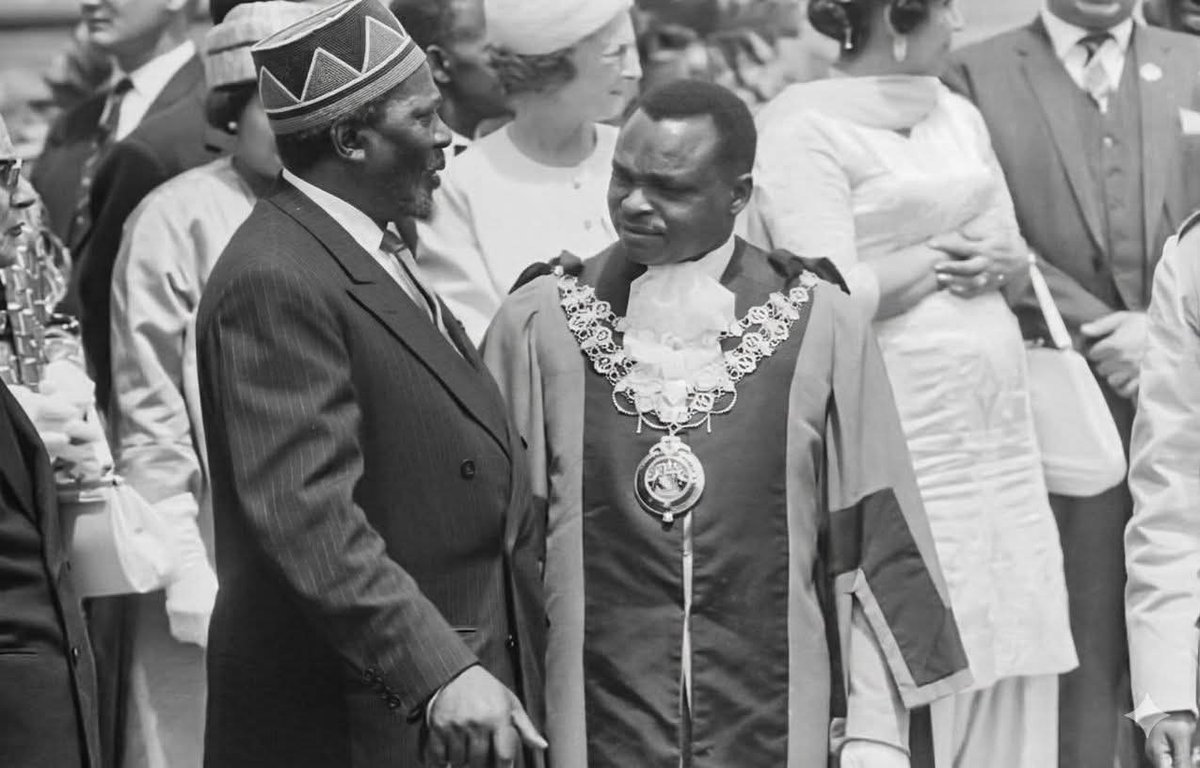
They said that Charles Rubia was tidy in thought, sharp in speech, and dangerously efficient. Various European technocrats, noticed that, this young man from Murang’a had the unsettling habit of understanding how institutions actually worked. They admired his organisational skills and mentored him quietly.
Armed with a good secondary education in 1950s . Rubia knew the future would eventually need him.He was Confident, and involved in several business ventures. In 1957, he was elected to the advisory Nairobi General African Ward Council, a body that existed partly to give Africans a voice and mostly to make sure that voice did not get too loud.
Between 1958 and 1960, he served in the Legislative Council, Then came election to the aldermanic bench by fellow councillors. Rubia became Deputy Chair of the Finance Committee, one of the most powerful positions in the Council. Money, after all, was the last thing colonial administrations liked Africans to control. The fact that he did so calmly, competently, and without drama made him even more dangerous.
A council of 37 members, 23 of them white, elected him Mayor of Nairobi. In January 1963, Mayor Rubia formally received Kenya’s new Governor, Malcolm MacDonald. In October 1963 he was overwhelmingly re-elected Mayor, this time Africans now formed the majority 28 out of 41 members.. By July 1964 he was backed for a third term. Independence came, but peace did not come with it. In September 1964, Rubia resigned as Mayor in protest, accusing Local Government Minister Samuel Ayodo of interfering in city affairs. What could have been a simple administrative quarrel quickly turned into a political dispute with tribal overtones. Rubia was Kikuyu and Ayodo was Luo.KANU was supposed to be one party but reality disagreed. The quarrel split the ruling party, stirred ethnic passions, and reminded everyone that independence had removed the colonial master but not the human instinct for rivalry. Yet Rubia survived politically.
After his mayoral years, Rubia moved to Parliament, serving as Starehe MP from 1969 to 1988, a long stretch through the era when power in Kenya was about about loyalty. in the year 1990 , old men decided they were not yet finished. Rubia, now in his seventies, fell out with the ruling party KANU alongside former Cabinet minister Kenneth Matiba. Together, the two announced plans for a public rally on July 7, 1990. It would become famous as Saba Saba Rally.
At a packed press conference in Nairobi, the two men calmly explained that the rally would discuss development, governance, and the economy . They even laid out a polite strategy.... that eight rallies, one in every province, beginning with Nairobi... The government of Daniel arap Moi was not amused. There would be no rally, officials warned, by what they called “enemies of development,”
On the material day, Nairobi was sealed under a security cordon not seen since the 1982 Kenyan coup attempt...Police filled the streets.
Transport stalled... Yet leaders still came out in solidarity ,James Orengo, Gitobu Imanyara,Raila Odinga, Masinde Muliro,George Anyona,Martin Shikuku, and a host of activists.
The day dissolved into running battles, riots, arrests, deaths and tear gas thick enough to make even the brave reconsider their bravery. Rubia was arrested, Matiba was arrested and so were many others. They were taken to the dreaded Nyayo House cells, where the government gave them arare opportunity to reflect on their patriotism while hanging upside down.
A year later, Rubia walked out of detention older, thinner, but vindicated.The wind had shifted. The agitation he and others had begun had pushed Kenya to the edge of change. Multi-party politics was coming, whether the state liked it or not. 1/2
For best Kenyan History & Investigative stories follow @timothyturunga
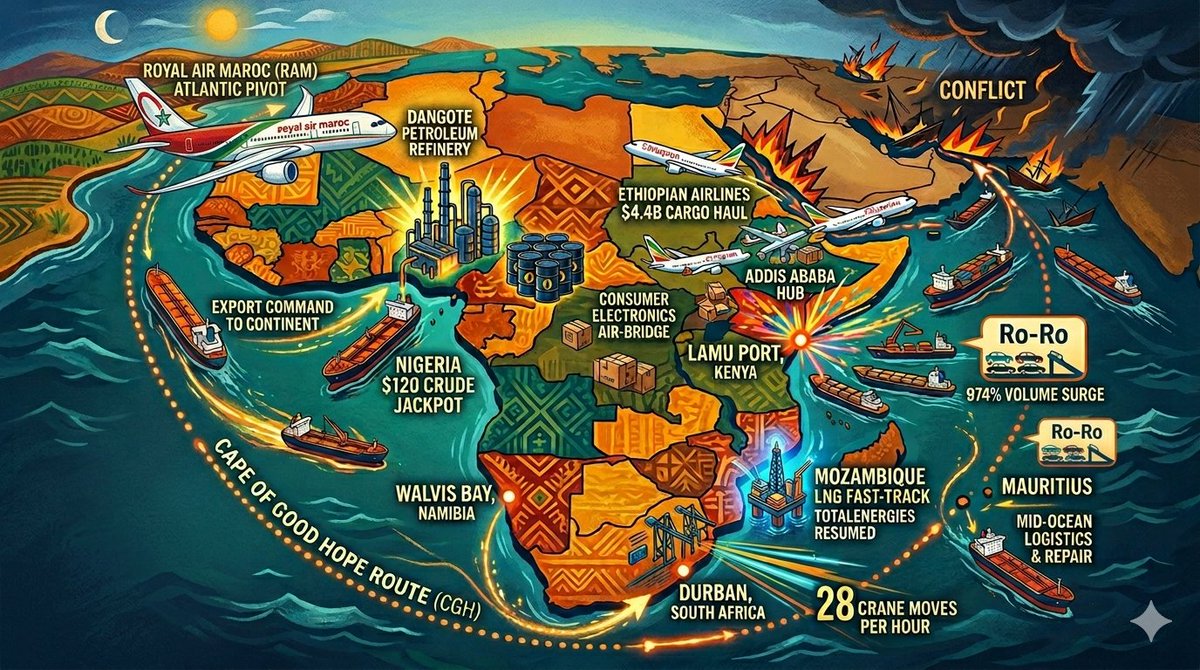
Kenya, Ethiopia, Nigeria Early African Winners as They Harvest Windfall from the Misery of US–Israel vs Iran War
As the world reels from the escalation of the US–Israel vs Iran war that erupted on 28 February, the humanitarian suffering is profound. Yet in the realm of global commerce, a quieter upheaval is underway. With the Red Sea and Strait of Hormuz rendered near impassable – shipping traffic down by 90% – Africa has emerged as the world’s most vital logistics corridor.
•In KENYA, the once-forgotten LAMU PORT has roared to life. Long dismissed by critics as a white elephant, it has seen a 974% surge in volume. Ultra-large vessels, too deep for Mombasa and too exposed for Gulf waters, now dock at Lamu’s 18-metre natural depth.
•ETHIOPIA'S national carrier Ethiopian Airlines has seized the moment. With Dubai and Doha mostly paralysed by airspace risks from Iranian missile and droke strikes, Addis Ababa has become the continent’s primary air-bridge. Cargo revenue is up 14%. High-value goods – electronics, pharmaceuticals, perishables –are now routed through Bole International, bypassing the 40-day sea detour.
•NIGERIA is counting its crude. Brent prices hit $120 per barrel in March. Against a budget benchmark of $64.85, daily revenues have doubled. The government has stumbled into an unexpected multi-billion dollar fiscal cushion.
•DURBAN, South Africa’s main port, has shed its reputation for congestion. It is now clocking 28 crane moves per hour, processing thousands of ships rerouted around the Cape of Good Hope with a rare level of precision.
•MOROCCO'S Royal Air Maroc has moved swiftly. Ten new international routes –including Los Angeles and Beirut – have siphoned off transit passengers who once relied on Middle Eastern hubs. Casablanca traffic is up 12%.
•WALVIS BAY in Namibia has become the first reliable refuelling station for ships emerging from the South Atlantic. Bunkering demand is up 30%.
•The DANGOTE Petroleum Refinery has in Nigeria, is cashing in. In March, it issued an export tender for 84,000 metric tonnes of jet fuel and diesel. It is no longer just a domestic project – it is replacing Persian Gulf supplies for the continent.
•MOZAMBIQUE'S $20 billion LNG project has been fast-tracked. TotalEnergies resumed operations in early 2026. Over 4,000 workers are racing to meet an accelerated production date. Iranian gas is out. Mozambican gas is in.
•At Mozambique's PORT of MAPUTO, volumes grew by 16% in the weeks following the war’s outbreak. Chrome and coal exporters have abandoned northern routes in favour of the safer Indian Ocean–Cape corridor.
•MAURITIUS, ever shrewd, has leveraged its mid-ocean position into a 15% revenue increase. High-end logistics and emergency repair services are now its bread and butter.
But no doubt, the most intriguing twist is the Roll-on/Roll-off (RoRo) revolution in Lamu. Manufacturers are using RoRo ships – where vehicles are driven on and off via ramps – to offload thousands of cars. These are then ferried to the Gulf on small, low-risk boats to avoid the $200,000+ war risk insurance premiums slapped on large carriers entering the Strait of Hormuz.
To protect this windfall, Kenya and Ethiopia have launched joint military operations along the once-languishing Lamu Port–South Sudan–Ethiopia Transport (LAPSSET) corridor. This unprecedented coordination is designed to ensure that the new “safe harbour” of Lamu remains shielded from regional spillover.
And because the closure of the Strait of Hormuz marooned shipping containers, an emergency air-bridge has formed. Nairobi and Addis Ababa are now the primary transit points for consumer electronics flown from Asia to Europe—bypassing the the 17,700KM sea detour.
US leader Donald Trump despises Africa, once labelling its countries "sh*thole", but while many of them will be hit hard by rising energy and fertilisers from America and Israel's attack on Iran, several of them will get a bounty he would never have wished for them.
These are the voters who will elect for Kenya ethical, accountable, just, empathetic and visionary leadership that will elevate our country to excellence.
@MitchellJo31042@AJEnglish ("Before Donald Trump *and Americans*, Benjamin Netanyahu and Jews bombed and attacked Iran.")
... let's generalise everywhere, if that's what you're doing!