@realDaveFeldman Hyperimmune state for any number of reasons that is not resolving. It is still possible to achieve the TAG & HDL-C criteria while under those conditions.
@AjOsborne1 Return of capital is absolutely, no questions asked, the distribution of capital basis in the security / investment. In absolutely no way is that a return on your investment $.
@realDaveFeldman Well, ChatGPT tried its best to get the correct answers of:
Non-HDL-C <= 30mg/dL
HDL-C not very low or very high
TAGs <= 50mg/dL but up to 80mg/dL is probably acceptable
Clearly lipidology & cardiology are not spamming the web with the correct answers enough.
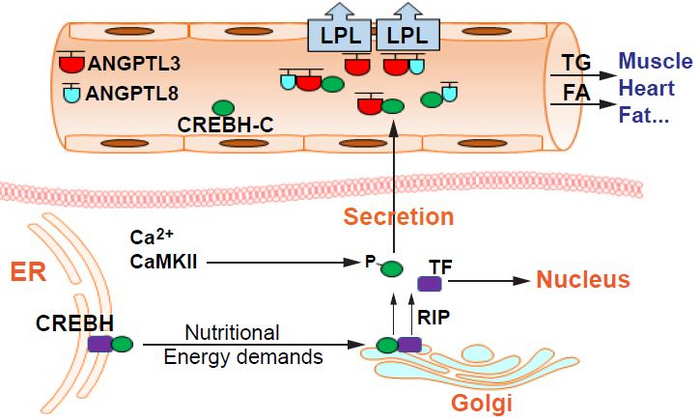
@LowCarbEyeDoc @realDaveFeldman If you want to learn more then you will want to start with ANGPTL3/4/8. Beyond that, cells and tissues have their own mechanisms to control LPL expression & activity, & free fatty acid transporters.
@LowCarbEyeDoc @realDaveFeldman You may be making an incorrect assumption. Increasing apoB-p secretion does not necessarily result in higher apoB-p concentration.
A few things:
1. FFA release from adipocytes is available to fuel cells / tissues.
2. apoB-TAGs are secreted in a high CHO state as well.
@LowCarbEyeDoc @realDaveFeldman It is entirely physiologically manageable to increase apoB-TAG secretion while the concentration of apoB-p is reduced. Or vice versa.
@LowCarbEyeDoc @realDaveFeldman The net effect is that the pressure to make cholesterol available is greater to extremely greater than the pressure to eliminate cholesterol through some pathway.
Whether there is a need or not, apoB-TAG secretion is simply not a meaningful driver to the net apoB-p concentration.
@realDaveFeldman @LowCarbEyeDoc Here's where we fundamentally disagree:
I attribute the effect of LEM to be 1-5% at most of the driving force behind the change in apoB-p in circulation. It may actually be negative on the basis apoB-TAG secretion is situationally lower.
@realDaveFeldman @LowCarbEyeDoc Dave, I was only even referring to apoB100 with the variable TAGs. They are secreted as low TAG LDLs all the way to very TAG rich VLDLs. I have brought this variable aspect up, and how it could have lower apoB-TAG with far greater apoB-p situationally before.
@realDaveFeldman @LowCarbEyeDoc To make this clear: When I say it is not relevant, I do not mean that no influence exists whatsoever. I am saying it does not have a meaningful influence in total. Ergo, not relevant.
@realDaveFeldman @LowCarbEyeDoc The regulation of the 2 are not tethered together at all.
Never mind the fact that a secreted apoB-p has a variable amount of TAGs in it.
They are simply not tethered together.
No matter how many apoB-p are secreted, regulatory factors can remove them from circulation.
@realDaveFeldman @LowCarbEyeDoc I have seen so much data that would indicate it to be lower, but there are competing forces and contexts.
Which again, just comes back to my primary position. It is not even relevant. This is in barely any way the driver of what LEM is aiming to explain.
@realDaveFeldman @LowCarbEyeDoc My position is that the central promise of LEM is not relevant. It has barely any explanatory value.
I cannot say with certainty whether apoB-TAG secretion is higher, the same, or lower because the context matters tremendously for that specific detail.
@realDaveFeldman @LowCarbEyeDoc Beyond physiological curiosity, and interest in the hypothesis, please inform me how & why people care about that detail at all.
There's very real basis to care about the apoB-p or non-HDL-C.
ApoB-TAG secretion in absolute terms? I am interested to be informed.