New paper w/@jieunkim1211 in World Politics: do societal actors matter in authoritarian legal systems? We argue lawyers in China act as "rightful challengers" — leveraging intra-state tensions to advance their clients' interests. https://t.co/HFgufNbsL1
"China has been very clear that they are not happy with the last arms package for Taiwan and the potential large package on the docket. Xi will probably ask Trump to delay, or whittle down, the next package," says @patricia_m_kim to the @FT.
https://t.co/9ljIXdkmTG
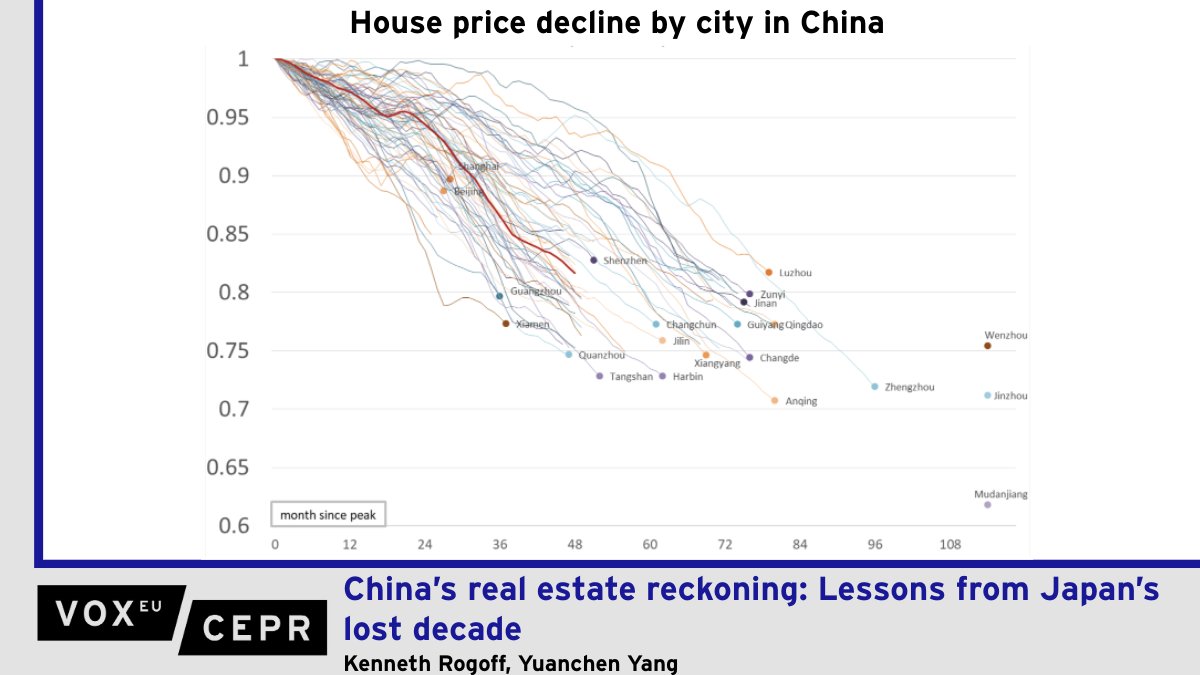
China’s real estate reckoning: Lessons from Japan’s lost decade
Kenneth Rogoff @krogoff@Harvard@HarvardEcon, Yuanchen Yang @IMFNews
https://t.co/xrQYU52Ox1
Offshoring intermediate inputs to China dramatically reduced R&D by Canadian firms, as lower costs of existing products weakened incentives to develop new products, from Wulong Gu, Alla Lileeva, and Daniel Trefler https://t.co/E1i09HNTKC
1/ Today, we are launching Sharpening the Edge: Positioning the United States for Strategic Competition with China — a cross-program @BrookingsInst initiative offering bold, actionable policy recommendations. https://t.co/CjBfAGCjWl
Two Nobel laureates joined other leading scholars at a recent @HarrisPolicy event to debate 1,000 years of history and its lessons for economic growth today.
Learn more: https://t.co/ekj6Zoq4vG
Chinese global ownership grows rapidly, targets innovative firms, raises target R&D but not patents or profits, and shifted innovation gains back to China, from Jennie Bai, Luc Laeven, Yaojun Ke, and Hong Ru https://t.co/lWHaPyV0uk
Our next talk is next week: Monday, 27 April 2026.
👉Nancy Qian👈 (Northwestern, Kellogg) will present "The Economic Determinants of Taiwanese Sentiments towards Reunification with Mainland China". This is joint work with Yu-Chi Hsieh, Marco Tabellini and Yifan Zhang
Reasons for treason by Chinese generals during World War II include being passed over for promotions and knowing good officers who had already defected to the Japanese, from Xinyu Fan, Gary Richardson, Zhihao Xu, and Sicheng Zhao https://t.co/GmxrCCwJiV
Demographics and financial development play a larger role than industrial or trade policies in China's current account imbalances, from @machang_china and Shang-Jin Wei https://t.co/cxLb8chiAw
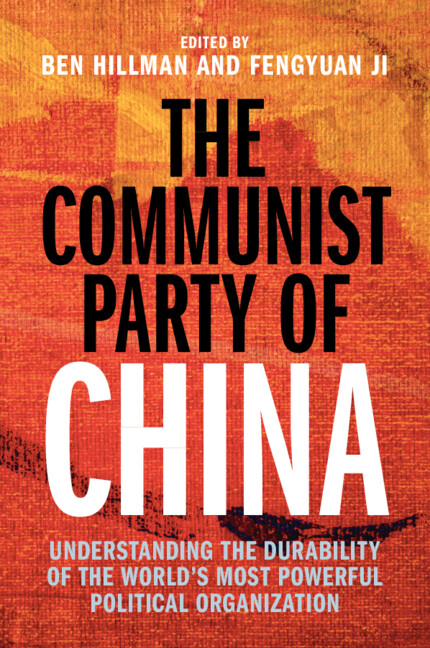
The Communist Party of China by Ben Hillman and Fengyuan Ji
An interdisciplinary collection exploring the ideology and mechanisms behind the Communist Party of China's grip on political power.
📚 https://t.co/2v1Va8E37u
US and China are converging in AI patenting, but differ in who innovates and where; AI patents are more valuable, and China relies more on US knowledge, from @HanmingF, Xian Gu, Hanyin Yan, and Wu Zhu https://t.co/zrwU7lEXd3
Studying China’s cash-based home renovation program finds that cash resettlement—by converting illiquid shanty houses into cash—facilitated household location upgrading and raised house prices in more expensive locations, from Zhiguo He, Zehao Liu, Xinle Pang, Yang Su, and Kunru Zou https://t.co/RBLLLZeRwa
Examining China's transformation from pharmaceutical free rider to global innovator over the past decade, driven by National Reimbursement Drug List reform, knowledge creation, and talent flow, from Panle Jia Barwick, Hongyuan Xia, and Tianli Xia https://t.co/YzEhwyLa9w
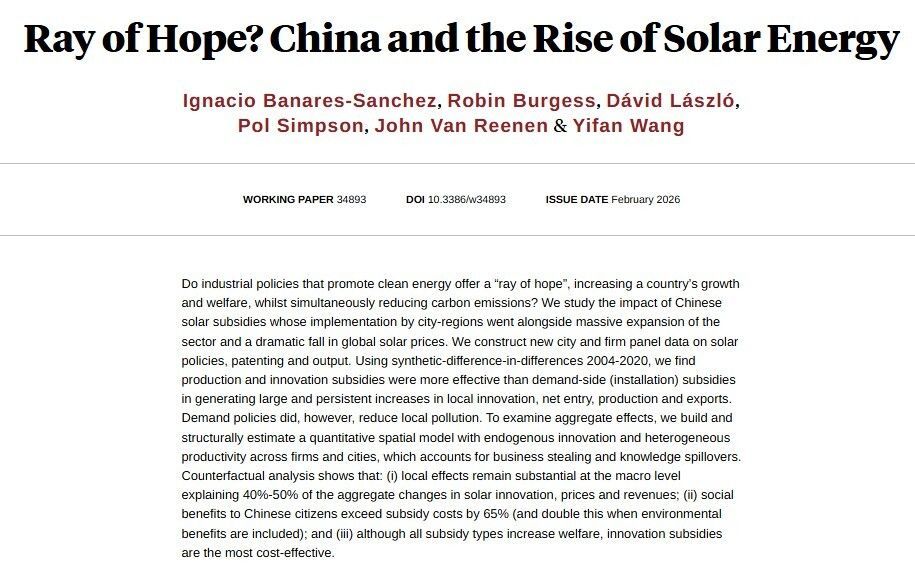
Chinese local industrial policy subsidies were responsible for 40 to 50 percent of the fall in prices, and the growth in innovation and output since 2006 in the Chinese solar industry, from Ignacio Banares-Sanchez, Robin Burgess, Dávid László, Pol Simpson, @johnvanreenen, and Yifan Wang https://t.co/FLZHEZTjqF
Academic friends: Did I recently see a paper re-analyzing the China shock paper and showing the results mostly went away when you corrected some error or assumption? (Or am I hallucinating?) Pointers appreciated.
My recent open-access article provides a new perspective to understand politics and propaganda in today's China. “Propaganda State 2.0” in China | The China Quarterly | Cambridge Core - https://t.co/DbCnmdeJAs