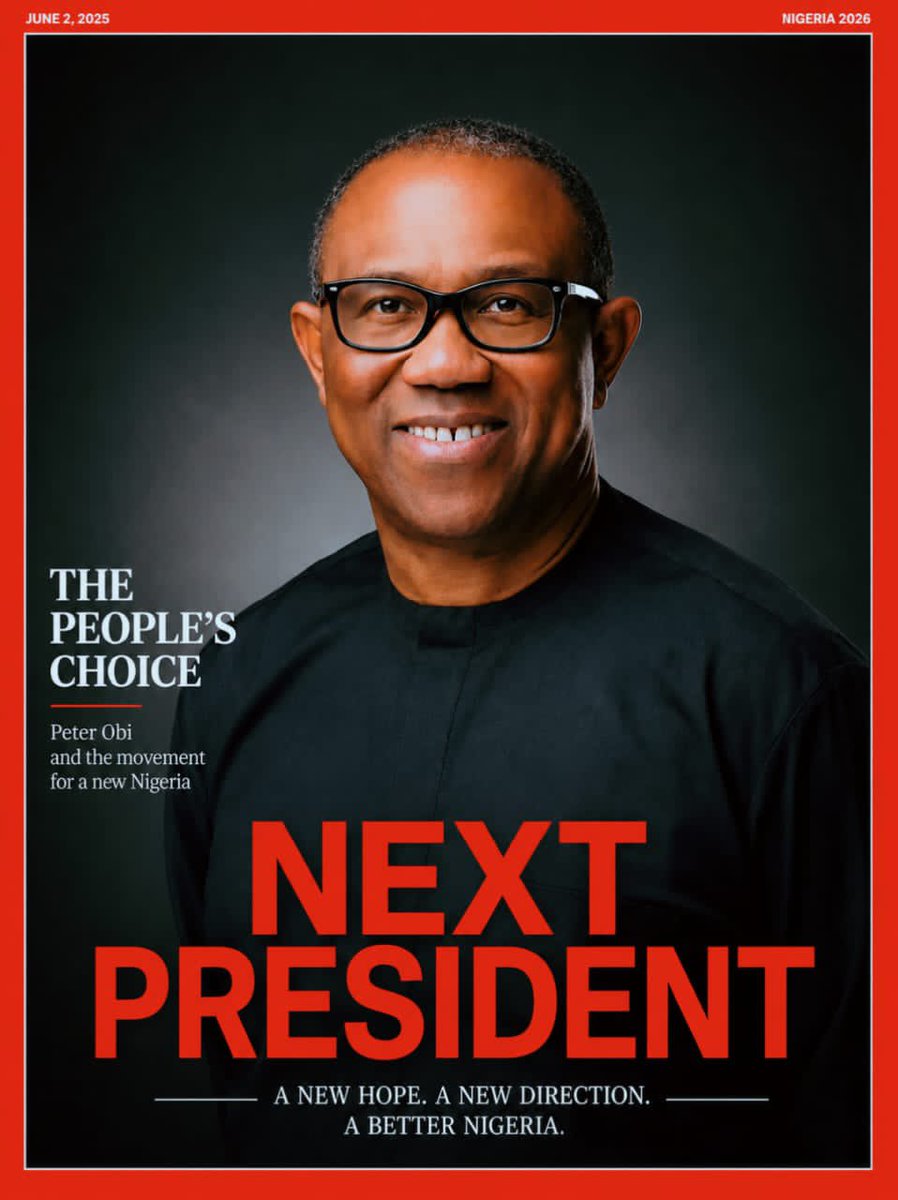
Yesterday, I spoke with ARISE News on the Anambra debt question and other issues affecting our nation.
In the interview, I clarified the facts surrounding the multilateral development funds accessed by Anambra State, the financial position I left behind in 2014, and the urgent need to focus on the hardships confronting Nigerians rather than on political distractions. I am Sharing this interview to correct factual details, clear all doubts, and put the issues in their proper perspective.
A new Nigeria where leaders are proud of their past is POssible. -PO
https://t.co/kvURszM91q
Osun: While celebrating, let us also remember those who paid the ultimate price for democracy
Once again, I congratulate Governor Ademola Adeleke and the good people of Osun State on the outcome of the election and, more importantly, on safeguarding the democratic process. The people have spoken through the ballot, reaffirming the fundamental principle that power belongs to the people.
As we celebrate this success, let's not forget those who made the supreme sacrifice for our democracy during the Osun election. Our thoughts and prayers are with the families of those who lost their lives under different circumstances during the electoral period. I believe these families deserve our collective compassion, solidarity, and support. I therefore hope that the families of those who lost their loved ones will be identified and reached through visits, condolences, and appropriate compensation, irrespective of the political side to which they belonged.
Elections should be about the people, their choices, and their aspirations — not about the loss of precious lives. No political victory is worth the blood of a Nigerian.
My prayer is that our democracy will continue to mature to a point where elections no longer come at the cost of human lives, and where political differences can always be settled through issue-based campaigns and the rule of law.
May God comfort all the families who have lost loved ones and grant the departed eternal rest.
With the right conduct of elections, a New Nigeria is POssible. -PO
@nwachinonyere@Iyoaiye_@PeterObi Who told you that the paid attack dog is ignorant ? ,it's because he's not affected or any of his relatives or friends he would have known better. Hypocrite !
“Professors are aiding illiterates to rig elections, lawmakers have removed forgery as an offense in electoral matters, and SANs are defending forgery, our religious leaders are now praying for criminal politicians, our judges are singing 'On your mandate we stand'”
- Peter Obi
By Making Excuses for Unverified Certificates, We Are Planting Poison in the Soul of Our Society
A nation that tolerates unverified academic credentials at any level of leadership, regardless of who is involved, risks destroying the very standards upon which a society is built. The issue is not about an individual. It is about standards, accountability, and the values we choose to pass on to the next generation.
We cannot continue to excuse blurred, missing, questionable, or unverified credentials simply because they belong to someone we support. The process through which people attain positions of responsibility matters greatly. How we get into leadership is as important as what we do with leadership.
If we normalise the abandonment of basic verification today, tomorrow we may have professors who never attended a university, doctors who never studied medicine, and judges who never studied law.
That is the dangerous precedent we must never allow. Nigeria cannot sacrifice its future on the altar of today's transactional politics. We must build a society where truth is not partisan, standards are not negotiable, and accountability applies equally to everyone.
History will judge us not only by those we defended, but by the principles we were willing to defend. We must choose truth over convenience, standards over sentiments, and the future over political expediency.
A New Nigeria is possible, but only if we are willing to do the right thing, even when it is inconvenient. -PO
As a member of the team that accompanied His Excellency @PeterObi to the Abuja airport on Saturday, July 4, I can state categorically that he does not have a police officer as his driver in Abuja. Therefore, if airport CCTV captured a police officer entering the driver’s seat of a vehicle, that vehicle could not have been Mr. Obi’s.
It is also important to note that Mr. Obi travels through as many as ten Nigerian airports every week. Over time, there have been several acts of hostility directed at him and members of his team by airport personnel across different locations.
Based on the account shared by the Honorable Minister, it is clear that the incident Mr. Obi referenced during his interview with @Chude did not occur on the date or at the airport cited by the Minister. They are plainly two different incidents.
Grand Corruption: Nigeria’s Greatest Threat.
The recent report from the IMF consultation further raises concerns about the scale of grand corruption under the Tinubu government. The IMF now reveals that about N8.83 trillion in expenditure undertaken in 2025 is not reflected in the budget. This expenditure is not budgeted and is therefore not under legislative oversight or administrative scrutiny. This is horrible.
N8.83 trillion is as follows:
1.About 2% of our GDP.
2.Over 35% of Nigeria’s 2025 N23.96 trillion capital project budget. In fact, the amount is more than the actual released capital funding for 2025.
https://t.co/Hta3LViCB8 is more than the entire combined budget for education (N3.52 trillion) and health (N2.38 trillion).
If such an amount is properly used and accounted for, it could transform Nigeria’s public health and education sectors. It could create hundreds of cottage industries that can provide jobs for thousands of graduates and build a solid foundation for economic development. But we cannot account for it. This is not an isolated incident.
This is a pattern of grand corruption that has become part of this administration.
We have a lot to worry about regarding the state of corruption under President Tinubu. The sort of corruption that is ingrained in total disregard of elementary rules of public finance management poses a grave danger to national security and the stability of the Nigerian state. The capture of the Nigerian state and the plunder of its resources are actions that undermine the basis of state stability and deepen poverty and state failure.
This recent revelation proves that the APC government is grossly corrupt, incompetent, and insensitive. With the growing poverty and the urgent need for significant upgrades to social and physical infrastructure, a responsible and responsive government would ensure that N8.83 trillion is prudently utilised to address these gaps. But not the Tinubu administration.
A few days ago, I called on President Tinubu to resign from office for incompetence, lack of capacity, lack of compassion, and failure to improve on his campaign promises. Some people thought perhaps the call was excessive. But with the daily revelations of pervasive corruption in this administration and its total lack of commitment to the welfare and security of Nigerian citizens, the only reasonable action is for President Tinubu to resign from office. The collapse of elementary forms of due process under Tinubu and the increased evidence of rampant looting of Nigerian public finances reinforce the need for greater accountability. It is now time for Nigerian citizens to rise within the law and hold this administration to account.
A New Nigeria is POssible. -PO
Accountable Borrowing: The South Africa Example.
I have consistently maintained that borrowing, in itself, is not a bad thing. Every nation borrows. The critical issue is not the act of borrowing, but what the borrowed funds are used for and whether citizens can clearly see and measure the impact of such borrowing in their daily lives.
There is a lot to learn in the open and transparent manner in which South Africa handled its recently secured a $1 billion loan from the New Development Bank, with a clearly defined purpose. Publicly announcing the targeted purpose of the loan for all to know and monitor, upgrading water supply systems, modernising sanitation infrastructure, improving electricity distribution, and strengthening waste management services across eight major metropolitan cities, including Johannesburg, Cape Town, and Durban.
This is indeed what accountable borrowing should look like; the purpose is clear, the projects are identifiable, and the expected benefits to citizens are measurable. Such investments directly improve living conditions, enhance productivity, and stimulate economic growth.
In Nigeria, however, the opposite is the case: public debt has risen dramatically under the current administration, and its deployment is shrouded in secrecy from the people who will indeed pay back the loan. Today, our total public debt has increased from about ₦87 trillion in 2023 to nearly ₦200 trillion.
Yet, despite this unprecedented accumulation of debt, Nigerians are often left without a clear and detailed account of how these borrowings are being deployed to improve critical sectors such as education, healthcare, power, security, and infrastructure.
Borrowing must never become an end in itself. Every loan obtained in the name of the Nigerian people must be tied to specific, productive investments capable of generating economic value, creating jobs, reducing poverty, and improving the welfare of citizens.
Good governance demands transparency and accountability. The government must be able to clearly explain what was borrowed, where it was invested, and what measurable outcomes have been achieved. The ordinary Nigerian should be able to see and feel the benefits of every debt incurred on their behalf.
At a time when millions of Nigerians are struggling with rising costs of living, unemployment, insecurity, and declining purchasing power, fiscal discipline and prudent management of public resources are no longer optional; they are imperative.
Every borrowing decision should answer one simple question: How does this improve the life of the ordinary Nigerian? If that question cannot be convincingly answered, then we risk merely transferring today's burdens to future generations.
A New Nigeria is POssible. - PO
BRICS bank approves $1 billion lifeline for South Africa’s struggling cities | Business Insider Africa https://t.co/VN0C0Xo8zp
What June 12 Should Mean to Us Nigerians
Today, we observe a day that should mean a great deal to us as a people who cherish democratic principles. Every year on June 12, the conversation inevitably turns to a critical assessment of the state of our nation. It serves as an annual benchmark for asking important questions: Are our elections today as transparent as they were in 1993? Is the social contract being honoured? Are the institutions of governance truly serving the people?
Ultimately, June 12 is a powerful blend of reflection and aspiration. It honours a fractured past while serving as a constant and foundational reminder of the immense power inherent in the collective democratic will of the Nigerian people.
For us in Nigeria, June 12 is not merely a date on the calendar; it is the emotional and structural bedrock of our modern democratic identity. Officially recognised as Democracy Day, June 12 carries deep historical, political, and social significance, representing both a monumental tragedy and the ultimate triumph of the collective will of the people.
To understand what June 12 means to Nigeria, one must examine its history, its evolution, and its enduring symbolism.
A new era of true democracy is POssible. -PO
As the World Cup Begins Without Nigeria
As the World Cup begins today across three nations, I identify with our teeming football followers and urge them not to be despondent that Nigeria is not participating, despite the abundant talent in our land.
Our failure to participate on the global stage is not due to a deficit of talent; it is a direct consequence of a deficit in leadership, planning, and institutional support.
The task of building a better Nigeria rests primarily on the shoulders of the younger generation. Do not watch the World Cup with despair; rather, see it as a reminder of where Nigeria ought to be. We must move our country from being a nation of mere consumers of global entertainment to a nation of proud producers and competitors.
A new Nigeria is POssible. -PO
Despite Three Years of Tinubu's Food Emergency, Nigeria hungriest ranking index declined to among the worst nations globally.
In celebrating his supposed successful three years in office, President Bola Ahmed Tinubu listed some achievements in the agricultural sector, firstly, his declaration of emergency on food security in July 2023, followed by the acquisition of 2,000 tractors and 9,000 farming implements, stated as Nigeria's largest agricultural mechanisation programme.
Yet the outcome of this has been the opposite. Nigeria's hunger index has worsened significantly. Nigeria's hunger index ranking was 103rd out of 123 countries surveyed in 2022/2023, and this figure had since worsened to 115th out of 123 countries surveyed in 2025/2026. Consequently, Nigeria is now classified among the world's most hungry or food-insecure nations in the world, with the World Bank forecasting that 33 million Nigerians could experience severe hunger.
In fact, Nigeria has the highest number of hungry people in the world.
I have always maintained that Nigeria have no reason to be seen among the hungriest nations in the world when we have fast, uncultivated land in the north, which is our greatest asset today.
We must transparently invest in Agricultural production, which will guarantee food security, but create huge employment.
A new Nigeria is POssible. -PO