💪 Ever wondered how a nerve signal makes your muscles contract?
Discover the fascinating journey from nerve impulse → Ca²⁺ release → actin–myosin interaction → sarcomere shortening, explained through accurate 3D scientific visualization! 🧬⚡
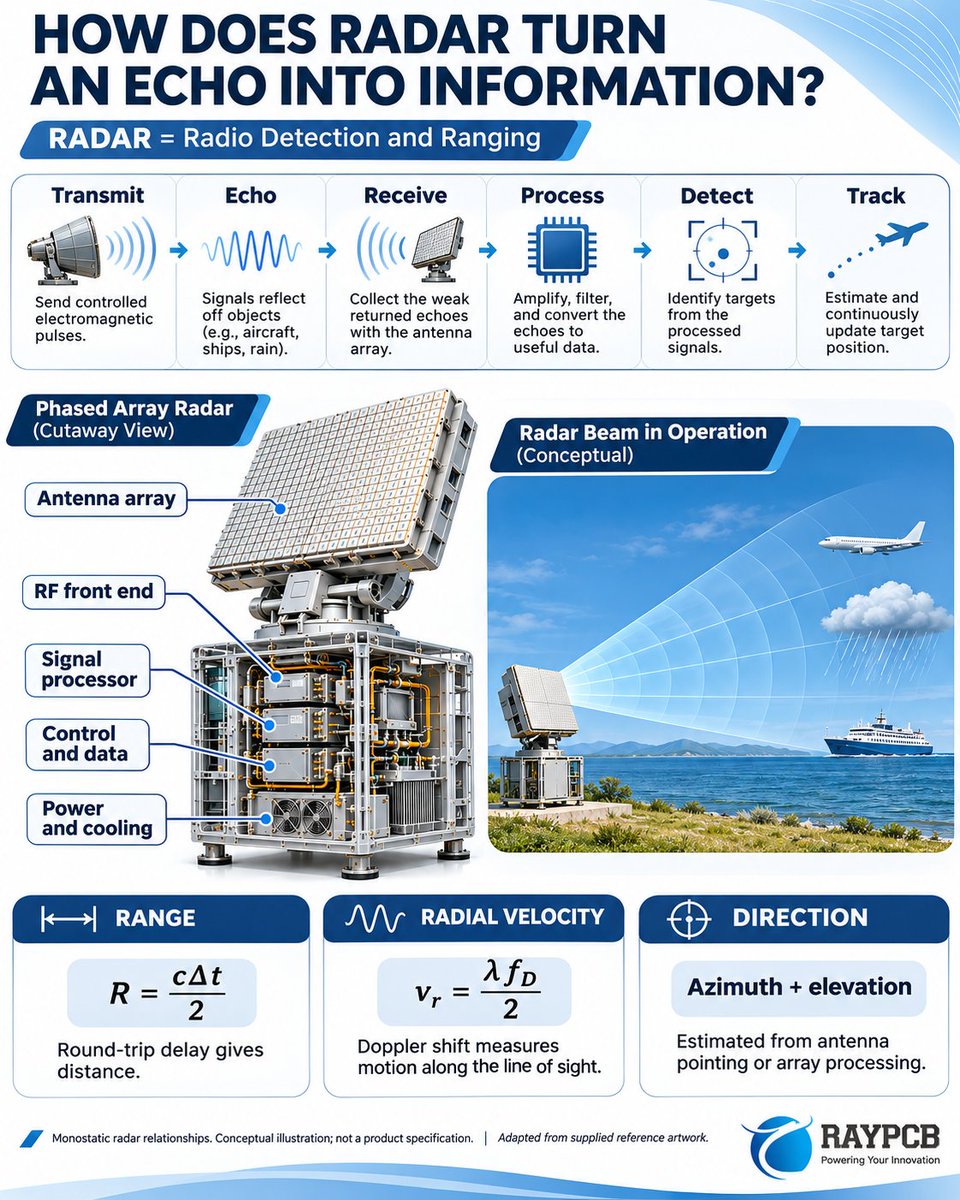
How does radar turn a faint echo into distance, speed and direction?
RADAR stands for Radio Detection and Ranging. It uses electromagnetic waves to detect objects and estimate where they are—and how they are moving.
The basic idea resembles an echo: transmit a signal, receive the energy scattered back by a target, then extract useful information from that return.
Three measurements explain much of what happens next:
1. RANGE: How long did the signal take to return?
For a monostatic pulsed radar:
R = c × Δt / 2
The factor of two accounts for the outward and return journeys. A 1-microsecond round-trip delay corresponds to approximately 150 metres.
2. RADIAL VELOCITY: How has the echo changed?
Doppler processing measures motion toward or away from the radar. It does not directly reveal the target's full velocity vector. A fast-moving target can have little radial velocity if its motion is across the line of sight.
3. DIRECTION: Where did the echo come from?
Antenna pointing and array processing estimate azimuth and elevation. Combine these angles with range to locate a target in 3D. Height estimation also depends on geometry and propagation assumptions.
Inside a phased-array radar, antenna elements, transmit/receive electronics, beam control and signal processing work together. Power integrity, thermal management and mechanical alignment support that performance.
One common misconception: radar is not immune to weather. It operates day and night and can work in conditions that challenge optical sensors, but rain attenuation, clutter and atmospheric propagation still matter. The impact depends on frequency and system design.
The three diagrams show the signal journey, an illustrative exploded architecture and the integrated system. They are conceptual explanations, not specifications for a particular radar.
Which part would you like to explore next: beam steering, Doppler processing, or the RF PCB behind the array?
#RayPCB #Radar #RadarSystems #RFEngineering #PhasedArray #AntennaDesign #RFPCB #PCBMANUFACTURING #PCBA