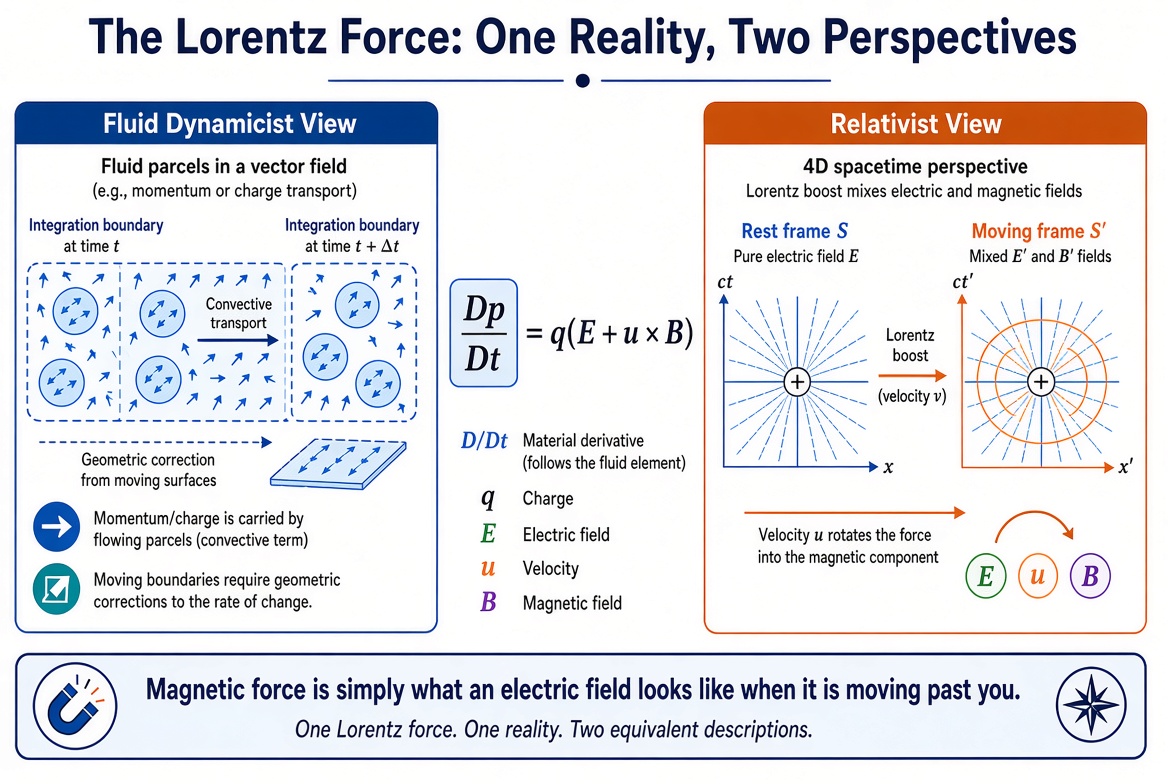
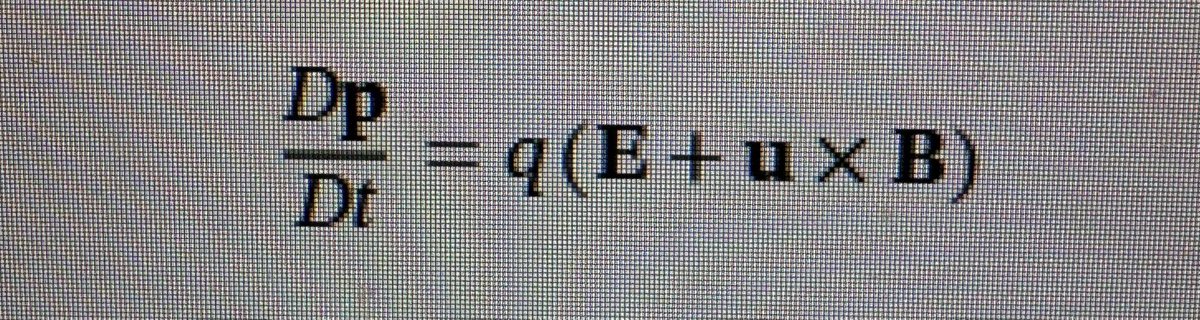
The material derivative tracks the fluid parcel as it moves, while the relativistic tensor framework automatically generates the exact u x B magnetic force component without needing any low-velocity approximations or manual adjustments.
Bro, ur telling me you aren’t happy that nasa gets 100 million a day and we got photoshopped images of a rover on mars?
I’m especially happy about the government propaganda and the high budget stuff like “interstellar”
Pretty rad
The body is a smaller torus of the same turn.
What circulates leaves and returns; the heart’s field is a closed loop whose axis is still only because the motion is continuous.
There is no vessel and no content - only the medium folding on itself at the scale of a life.
The Earth’s larger closure and the body’s smaller one are not nested things.
They are one current seen at two distances.
Alignment keeps the fold ordered. Breakage meets the same flow as friction.
The person is not in the medium. The person is the medium, briefly closed upon itself.
The model is defined by a single scalar pressure field P of a pervasive medium. Matter sources a pressure deficit via the Poisson equation:
\nabla^2 P = 4\pi G\rho_0\rho\,,
where \rho is ordinary mass density and \rho_0 is a constant ambient density of the medium (the overall factor is chosen so the constants match).
In the weak-field, slow-motion regime the same scalar pressure can be embedded in a relativistic hydrodynamic description of the medium.
The resulting force law on a test particle then reproduces the geodesic equation of the linearized Schwarzschild metric to the order tested by light deflection, Shapiro delay, and perihelion precession. Thus the model is a kinematic equivalent of both Newtonian gravity and the observationally constrained post-Newtonian limit of general relativity.
The model is defined by a single scalar pressure field P of a pervasive medium. Matter sources a pressure deficit via the Poisson equation:
\nabla^2 P = 4\pi G\rho_0\rho\,,
where \rho is ordinary mass density and \rho_0 is a constant ambient density of the medium (the overall factor is chosen so the constants match).
The material derivative tracks the fluid parcel as it moves, while the relativistic tensor framework automatically generates the exact u x B magnetic force component without needing any low-velocity approximations or manual adjustments.
TIDES ON A FLAT EARTH : EXPLAINED
The circulating Moon (and to a lesser extent the Sun) generates position-dependent force fields or horizontal pressure gradients on the ocean surface as they move.
This means the relative velocity between the celestial bodies and the water produces directed forces that drive water toward or away from the sub-lunar region.
The “rotating sky” mechanism (firmament) that carries these bodies adds dynamic rotational contributions in the large-scale flow equations even though the plane itself does not spin, so Coriolis-like terms appear in the reference frame of the moving celestial influence.
Atmospheric pressure systems, winds, and the dome’s convective/thermal engine (uneven heating, moisture phase changes, and boundary effects at the perimeter) further modulate the water displacement.
This means that tides emerge as a system-level response of the interconnected ocean fluid rather than a pure local gravitational lift by the Moon alone.
The earth works together as a system.
The model is defined by a single scalar pressure field P of a pervasive medium. Matter sources a pressure deficit via the Poisson equation:
\nabla^2 P = 4\pi G\rho_0\rho\,,
where \rho is ordinary mass density and \rho_0 is a constant ambient density of the medium (the overall factor is chosen so the constants match).
@MichelVandegaer Because the ether is the boogeyman.
The cosmological constant debunks the model we believe in. Can’t cross that line - let’s just call it “quantum physics”.
Where is the science?