@sandeeproy1 A family of 4 lives abroad. The permanent address home in India is locked. One applies for 5th renewal of Passport in Sweden. They send for Police verification in Gurgaon. What does one do? Stupid rules by Stupid bureaucrats. Does family member travel back to India first?
How a NRI who has no or to little ties to India can provide Indian address for police verification while renewing the passport? The parents don't live at the permanent address in India or they live abroad. No connections with relatives.
@passportsevamea
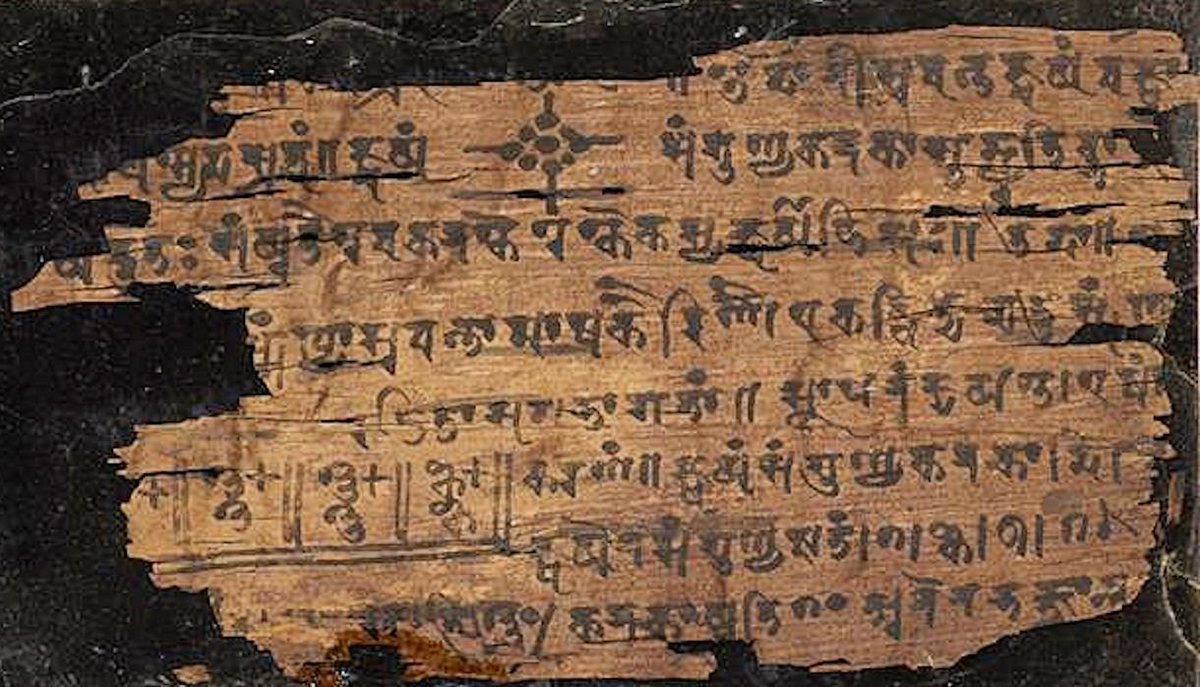
A farmer digging in a ruined place near Peshawar in 1881 found 70 fragile leaves of birch bark. They carried mathematics that still surprises us.
One leaf holds a rule for the square root of a non square number. Subtract the nearest square. Divide the remainder by twice that root. Apply one correction. That is all.
How good is it?
The manuscript itself computes the square root of 339009. Its answer is correct to 11 decimal places.
In another problem it checks its own answer using a fraction whose numerator has 23 digits. No decimals. No calculator. Just digits in a row, and dots for zeroes.
The bark reached Oxford's Bodleian Library in 1902, and the rule sat there, admired but shelved. Then in 1976, M.N. Channabasappa, a mathematics prof. at Karnataka Regional Engineering College, Surathkal, re-deciphered the sutra and turned the rule into an iteration.
In 1979 he reported that, iterated, the Bakhshali rule reaches the square root of 41 to ten decimal places 38% faster than Newton's method.
A rule from a birch bark, beating Newton at his own game.
In 2012, David Bailey and Jonathan Borwein proved why. One Bakhshali step is secretly 2 Newton steps rolled into one, so every step multiplies the correct digits by about 4.
They wrote that the Western tradition knew no square root method this powerful until well after the Enlightenment.
How old is the bark?
Oxford's 2017 carbon dating says its leaves come from at least 3 different periods, the oldest from the 3rd or 4th century. The rule itself cannot be dated. It may be older than the bark it sits on.
We do not know the scribe's name. We do know the professor's. Why is it not in our maths textbooks?
Sources: Indian Journal of History of Science, Ganita Bharati, American Mathematical Monthly, MacTutor, Bodleian Libraries
Photo: A folio of the Bakhshali manuscript on birch bark. The dots are its zeroes. Credit: National Geographic / Bodleian Libraries
One of these fast bowlers will have a “niggle” before the next test and Siraj will come in for next test.
So he will come back in as an “injury replacement” than as a definite starter in the XI.
That way some people’s ego remains intact.
#NZvIND
@vikrantgupta73 They knew they weren’t going to get any wickets. Asked for draw to make the bowlers look less ridiculous. Probably on orders from the deep thinker who sits with his sidekick and pretends to be Dronacharya