Connecting young people to digital networks serves no purpose if they remain disconnected from themselves, others, and their own interiority. We must help young people rediscover silence, reflection, the ability to ask questions, the depth of relationships, and openness to transcendence. To listen to the soul, we must lend an ear, because the soul's voice is not a shout, but a whisper.
Las inteligencias artificiales no viven una experiencia, no poseen un cuerpo, no pasan por la alegría y el dolor, no maduran en las relaciones ni conocen desde dentro lo que significan el amor, el trabajo, la amistad y la responsabilidad. Tampoco tienen una conciencia moral: no juzgan el bien y el mal, no captan el sentido último de las situaciones ni asumen el peso de las consecuencias. Pueden imitar, pueden simular pero no conocen lo que producen, porque no residen en el horizonte afectivo, relacional y espiritual en el que el ser humano se hace sabio. #MagnificaHumanitas
THIS GUY VIBE CODED AN APPLE WATCH APP THAT LETS YOU CAST HARRY POTTER SPELLS TO CONTROL YOUR SMART HOME
you flick your wrist like you're holding a wand and say a spell. your apple watch detects the motion and the voice command and triggers a smart home action
for example, say "lumos" with the right wrist movement and your lights turn on
say "nox" and they turn off
it uses the apple watch's built in accelerometer and gyroscope to detect the wand motion and the microphone to recognize which spell you're saying
then it triggers the matching homekit shortcut to control whatever device you want
so you can map any spell to any smart home action. lights, locks, thermostat, music, whatever homekit supports
people are already thinking about extending this concept because it's actually possible for the apple watch to listen and recognize speech during a workout session
this is another example of someone taking sensors that already exist in a device you own and giving them a completely new purpose
your apple watch has a gyroscope, accelerometer, microphone, and haptic engine sitting there doing almost nothing most of the day
all it took was one creative dev + vibe coding to turn it into a magic wand
Imagine every pixel on your screen, streamed live directly from a model. No HTML, no layout engine, no code. Just exactly what you want to see.
@eddiejiao_obj, @drewocarr and I built a prototype to see how this could actually work, and set out to make it real. We're calling it Flipbook. (1/5)
When simulation becomes the norm, it weakens the human capacity for discernment. As a result, our social bonds close in upon themselves, forming self-referential circuits that no longer expose us to reality. We thus come to live within bubbles, impermeable to one another. Feeling threatened by anyone who is different, we grow unaccustomed to encounter and dialogue. In this way, polarization, conflict, fear and violence spread. What is at stake is not merely the risk of error, but a transformation in our very relationship with truth.
Introducing Claude Design by Anthropic Labs: make prototypes, slides, and one-pagers by talking to Claude.
Powered by Claude Opus 4.7, our most capable vision model. Available in research preview on the Pro, Max, Team, and Enterprise plans, rolling out throughout the day.
We actually have some very close friends at the College Board and apparently the executive team is in full panic mode that this video is spreading on the Internet. Sorry, not sorry.
Big personal news: I’ve been recruited by Google DeepMind for a new Philosopher position (actual title), focusing on machine consciousness, human-AI relationships, and AGI readiness, starting in May. I’ll continue my research & teaching at Cambridge part-time. Absolutely stoked!
Jesse Genet on Agentic Parenting
Jesse Genet joins a16z's Sarah Wang and Katherine Boyle to discuss her journey from founder to parent, how she's using agents in her household, and how AI could transform parenting for the better.
00:00 YC founder turned homeschool mom
03:00 Discovering Claude Code and agentic building
06:00 Building while homeschooling 4 kids under 5
11:00 How AI generates personalized lesson plans and logs progress
18:00 Jesse's 11-agents
27:05 Agent tech stack deep dive
33:56 How agents improve daily life
40:04 Letting kids interact with AI: values, risks, and the future of parenting
@jessegenet@KTmBoyle@sarahdingwang
Some brief thoughts on Mythos
We’ve known this was coming for a long time. At least, we *should* have. Extremely effective software vulnerability discovery was clearly coming to anybody paying attention.
It has also been clear that all AI policy so far has been made and executed with training wheels. It was always clear that, sometime soon, the training wheels would come off.
The training wheels aren’t fully off just yet—this model is being kept under lock and key, and Anthropic does not seem inclined to release Mythos preview to the public anytime soon, if ever. The training wheels will be off when these capabilities are fully diffused in ways centralized actors cannot control. It is inevitable that this will happen. The point is not to argue about whether we should “ban open source” or similarly unrealistic notions. The point is to harden the world for this new reality.
I applaud Anthropic—and I especially applaud @logangraham—for doing so. But their efforts alone are not close to enough. Project Glasswing—a partnership with Anthropic and other companies—seems nice, but unsurprisingly it lacks uniform frontier lab participation.
It would probably be ideal, for our national cyberdefense, if the federal government were not trying to destroy Anthropic and eliminate their models from government systems. If anything, the government should be trying to work more closely with Anthropic. As a side note, I hope Anthropic is working with state and local government entities on cyber vulnerability discovery, since many of our adversaries know that state and local is America’s soft underbelly in so many ways.
In any event, the Mythos news should lay bare how stupid and counter-productive the Department of War’s feud with Anthropic really is. As someone who suspected all this was coming (not from inside knowledge but from it being ~obvious), that probably explains why I have had such a strong reaction to that feud. It’s this senseless distraction just at the time that the training wheels are coming off. I hope the two parties can resolve their differences now, for the sake of the country, but I am not hopeful.
I do want to call out, however, the numerous political and career civil servants in the Trump Admin who do get these issues, know how stupid the Ant-DoW stuff is, and want to work with the frontier labs like adults. I wish you all utmost success.
I find myself inclined to end on some positive notes. Mythos appears to be—according to Anthropic at least—“the most aligned” model Anthropic has ever trained. We are approaching superhuman capabilities in some domains, and yet alignment is getting better rather than worse. That’s not nothing. I know some of you think the model is faking its alignment, or aware when its alignment is being tested. I don’t have a good answer.
Finally, there is this: Mythos was made by an American company, and like most successful American companies, it has a vested interest in maintaining order and peace, and it is investing substantial resources in mitigating the risks of its technological progress, as I expect most of the American labs would. This is cause for optimism: The incentives of capitalism are working.
The training wheels are coming off, but at least we are the ones removing them, as opposed to our enemies. Perhaps we can be the first to learn to bike for real. The first step would be to get beyond all the low-fidelity, under-specified, pimply little fights of AI policy’s prepubescent era. That goes for me too.
“What hath God wrought,” wrote the first telegram. What, indeed. In this case, the answer is still up to us.
I remain fascinated by the "Pre-Slop" genre, stuff that dated AI by years, even decades, but foresaw where all "content" was ultimately going. Peter Gabriel dropped this in 1992! Prescient AF.
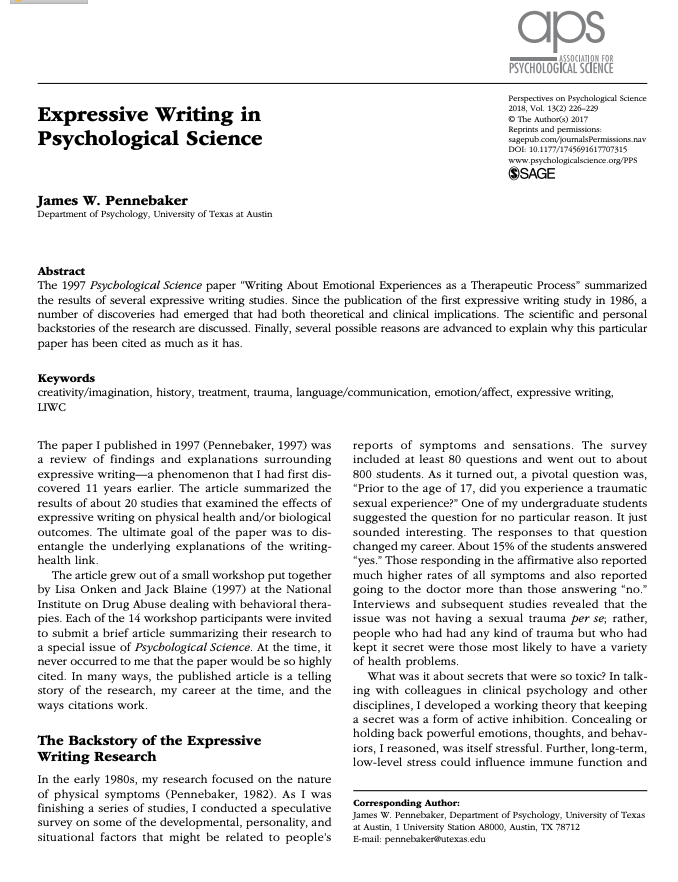
Every writing teacher who told you "be concise" accidentally murdered your best ideas.
In 1987, psychologist James Pennebaker ran an experiment that broke every assumption about how human creativity works. He divided college students into two groups and gave them the same creative writing prompt. Group A had to write for 15 minutes without stopping, elaborating on every thought that surfaced. Group B had to write concise, polished responses in the same time frame.
The elaborate writers didn't just produce more ideas. They produced fundamentally different types of ideas. Brain scans showed their prefrontal cortex entered a state resembling REM sleep, where distant neural networks suddenly started talking to each other. The concise writers showed patterns identical to focused problem-solving mode, which actively suppresses creative connections.
Six months later, Pennebaker tested both groups again. The elaborate writers had continued generating novel solutions to unrelated problems at twice the rate of the concise group. The act of elaborative writing had permanently rewired their associative thinking patterns.
The advice sounds logical. Cut the fat. Trim the excess. Get to the point faster. What they missed is that ideation and communication are completely different cognitive processes, and optimizing for one destroys the other.
When you write elaborately, your brain enters what cognitive scientists call "divergent thinking mode." Each additional sentence forces your mind to find new angles, make unexpected connections, discover relationships between concepts that would never surface in a stripped-down version. The elaboration itself becomes the thinking tool.
Watch what happens when you try to explain a simple concept in 2000 words instead of 200. Your brain refuses to repeat itself. It starts mining deeper layers, pulling up examples you forgot you knew, connecting dots that seemed unrelated five minutes ago. The constraint of length becomes a creativity multiplier because your mind has to work harder to fill the space meaningfully.
Most people reverse this process. They think first, then write down the conclusions. They treat writing as a documentation tool for thoughts that already exist. This kills the discovery mechanism completely.
Real creative thinking happens during the writing, not before it. The elaborate sentences force your brain to search its entire knowledge network for supporting ideas, contradictory evidence, parallel examples, deeper implications. Every time you expand a thought, you're asking your neural pathways to surface material that stays buried when you think in headlines.
Professional researchers figured this out decades ago. They don't brainstorm in bullet points. They write massive exploratory documents where every paragraph spawns three new questions. They let themselves ramble across pages because they know the rambling is where breakthrough insights hide. The connections emerge in the elaboration, not despite it.
There's another layer most people miss. When you write elaborately about a topic, you're not just exploring what you already know about it. You're discovering what you didn't realize you knew about it. The act of expansion forces you to reach into adjacent knowledge areas, pull connections from unrelated experiences, surface insights that were sitting just below conscious awareness.
Pennebaker's follow-up studies revealed something even stranger. Students who wrote elaborately about completely unrelated topics showed improved creative problem-solving across all domains. The cognitive muscle of elaborative thinking transfers. Train it on one subject, and it enhances your ability to find novel solutions everywhere else.
Your brain was designed to think in stories, not summaries.
Feed it complexity and watch creativity multiply.
If you come across someone asserting there is "no scientific evidence" that social media is causing harm, please send them this link.
We lay out seven lines of evidence, including RCTs, natural experiments, and testimony from victims & perpetrators of harm
https://t.co/lZsNalKZE5
You can now enable Claude to use your computer to complete tasks.
It opens your apps, navigates your browser, fills in spreadsheets—anything you'd do sitting at your desk.
Research preview in Claude Cowork and Claude Code, macOS only.
Meet the new Stitch, your vibe design partner.
Here are 5 major upgrades to help you create, iterate and collaborate:
🎨 AI-Native Canvas
🧠 Smarter Design Agent
🎙️ Voice
⚡️ Instant Prototypes
📐 Design Systems and DESIGN.md
Rolling out now. Details and product walkthrough video in 🧵