https://t.co/VaG4tuTsfX
1/4
Calling an unreleased trailer with zero release date a "Western AAA killer" is pure engagement farming, @Furo. What we’re actually seeing isn't industry disruption—it’s the classic vertical-slice playbook designed to inflate social metrics, secure subsidies, and court investors before a single core gameplay loop is optimized.
2/4
Mashing Elden Ring, Final Fantasy, and Arthurian legend together isn't revolutionary design; it's an algorithmic composite of proven foreign IPs. That "10+ unique summonable knights" mechanic is a textbook framework for shallow move-lists, cloned character rigs, and inevitable live-service monetization.
3/4
Flashy cinematic combos and motion blur exist to hide the absence of real combat fundamentals: zero visible collision detection, non-existent hit-stop feedback, and static AI. A post-apocalyptic London is one of the most generic assets in modern engines—dramatic lighting doing the heavy lifting for unrendered gameplay.
4/4
Borrowing public-domain Western folklore allows foreign studios to farm international hype while dodging domestic regulatory hurdles. Scripted sizzle reels engineered for short-form engagement algorithms aren't shipping products. Don't confuse pre-rendered smoke and mirrors with an actual, playable game.
https://t.co/qHT1UDIdVU someone isn't a "real gamer" because they buy digital instead of physical is pure nonsense. Format and platform preferences don't define passion—playing great games and supporting developers does.
Inventing arbitrary purity tests isn't genuine critique, and it certainly isn't "defending gaming culture." It’s a manufactured outrage business model designed to farm clicks, monetize drama, and generate ad revenue off everyday players. Real gamers care about the games; everyone sees right through the grift.
@krimson Games don’t exist in a vacuum. Claiming state control and corporate oversight have "nothing to do with quality" ignores how the industry actually works.
* Censorship Kills Innovation: When state censors dictate narrative themes, art assets, and mechanics, artistic vision takes a backseat to political compliance.
* Data & Kernel Access: Chinese national intelligence laws legally compel domestic tech firms to share data with state apparatuses. Handing kernel-level access to state-aligned entities is an objective security risk.
* Market Distortion: Protectionist policies lock foreign competitors out of the domestic market while state-subsidized conglomerates buy up Western studios and export aggressive, gacha-heavy monetization.
* Soft Power Pipeline: Commercial hits aren't just entertainment—they fund state-linked tech ecosystems and act as tools for cultural normalization.
Scrutinizing who funds the engine, who enforces the censorship, and where user data travels isn't being "disconnected"—it's basic consumer awareness.
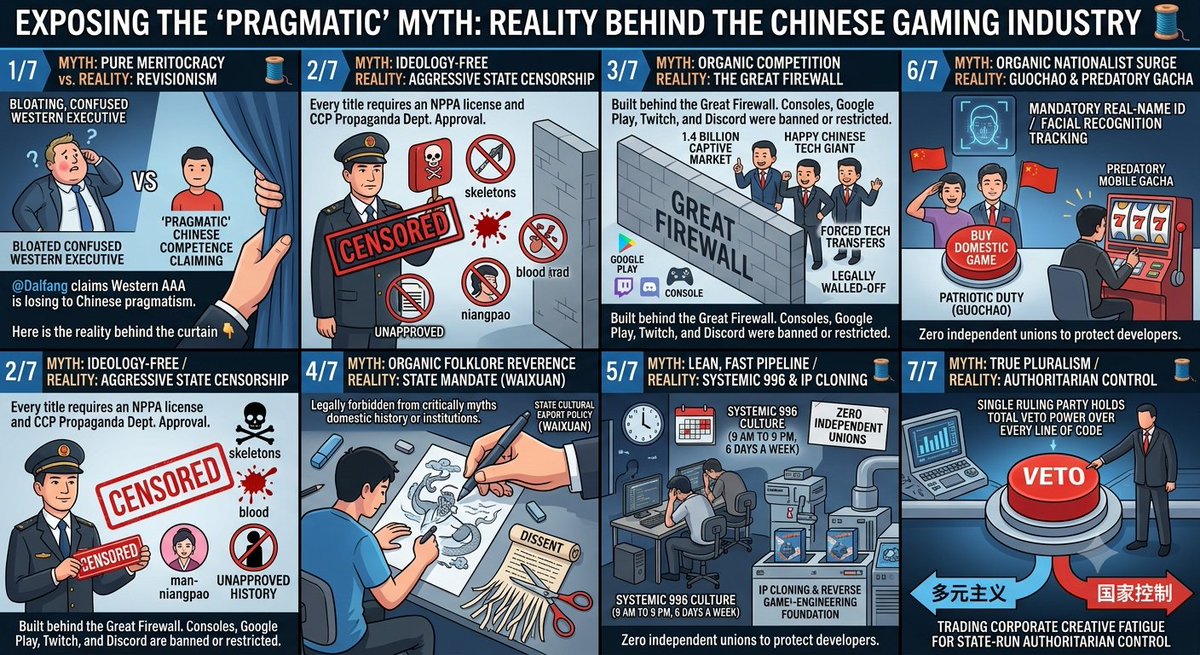
1/7 🧵
.@Dalfang’s video claims Western AAA is losing to Chinese "pragmatism" and "ideology-free competence."
Western AAA has massive bloat and design issues, but framing the Chinese gaming industry as a pure meritocracy is complete revisionism.
Here is the reality behind the curtain 👇
2/7
The Myth of "Ideology-Free" Development
Chinese studios aren't free from ideology—they operate under the world's most aggressive state censorship.
Every single title requires an NPPA license and approval from the CCP’s Central Propaganda Department. Skeletons, blood, religious themes, unapproved history, and even "effeminate men" (niangpao) face strict regulatory bans.
3/7
The "Organic Competition" Fallacy
Chinese tech giants didn’t outcompete Western rivals in an open market.
They were built behind the Great Firewall. Consoles, Google Play, Twitch, and Discord were banned or restricted, giving domestic conglomerates a legally walled-off, captive market of 1.4 billion users alongside forced tech transfers.
4/7
Mandated "Reverence" vs. Real Creative Freedom
Praising studios for "revering" folklore misses the point: state cultural export policy (waixuan) mandates it.
Developers don't just choose traditional myths out of humility—they are legally forbidden from critically deconstructing domestic history or institutions. Dissent means instant revocation of your studio's license.
5/7
The "Lean, Fast" Pipeline is Systemic 996
The speed and low costs being romanticized rely heavily on brutal 996 crunch culture (9 AM to 9 PM, 6 days a week) with zero independent unions to protect developers, built atop decades of state-shielded IP cloning and reverse-engineering.
6/7
Nationalist Mobilization & Predatory Monetization
Massive domestic sales surges are heavily driven by state-backed Guochao (national pride) campaigns that frame buying domestic games as a patriotic duty.
Underneath a few showcase single-player games sits the real business model: predatory mobile gacha paired with mandatory real-name ID and facial recognition tracking.
7/7
Authoritarian Control Is Not "True Pluralism"
Swapping Western corporate design flaws for an ecosystem where a single ruling party holds total veto power over every line of code isn't "diversity" or a win for players.
It’s just trading corporate creative fatigue for state-run authoritarian control.
https://t.co/pZVZkrkPI3
1/7 🧵
.@Dalfang’s video claims Western AAA is losing to Chinese "pragmatism" and "ideology-free competence."
Western AAA has massive bloat and design issues, but framing the Chinese gaming industry as a pure meritocracy is complete revisionism.
Here is the reality behind the curtain 👇
2/7
The Myth of "Ideology-Free" Development
Chinese studios aren't free from ideology—they operate under the world's most aggressive state censorship.
Every single title requires an NPPA license and approval from the CCP’s Central Propaganda Department. Skeletons, blood, religious themes, unapproved history, and even "effeminate men" (niangpao) face strict regulatory bans.
3/7
The "Organic Competition" Fallacy
Chinese tech giants didn’t outcompete Western rivals in an open market.
They were built behind the Great Firewall. Consoles, Google Play, Twitch, and Discord were banned or restricted, giving domestic conglomerates a legally walled-off, captive market of 1.4 billion users alongside forced tech transfers.
4/7
Mandated "Reverence" vs. Real Creative Freedom
Praising studios for "revering" folklore misses the point: state cultural export policy (waixuan) mandates it.
Developers don't just choose traditional myths out of humility—they are legally forbidden from critically deconstructing domestic history or institutions. Dissent means instant revocation of your studio's license.
5/7
The "Lean, Fast" Pipeline is Systemic 996
The speed and low costs being romanticized rely heavily on brutal 996 crunch culture (9 AM to 9 PM, 6 days a week) with zero independent unions to protect developers, built atop decades of state-shielded IP cloning and reverse-engineering.
6/7
Nationalist Mobilization & Predatory Monetization
Massive domestic sales surges are heavily driven by state-backed Guochao (national pride) campaigns that frame buying domestic games as a patriotic duty.
Underneath a few showcase single-player games sits the real business model: predatory mobile gacha paired with mandatory real-name ID and facial recognition tracking.
7/7
Authoritarian Control Is Not "True Pluralism"
Swapping Western corporate design flaws for an ecosystem where a single ruling party holds total veto power over every line of code isn't "diversity" or a win for players.
It’s just trading corporate creative fatigue for state-run authoritarian control.
Raising a glass doesn’t fix a broken premise.
Replying with a toast when confronted with actual economic data and technical realities is just a thought-terminating cliché. It signals tribal solidarity, but it doesn't explain how publicly traded corporations answering to Wall Street shareholders are "communist," nor does it excuse the predatory monetization and broken launches happening outside the West.
Cheers to the echo chamber, but consumers who actually care about frametimes, code quality, and consumer rights look at data—not catchphrases.
Calling publicly traded AAA publishers "communist" makes zero sense—their entire playbook is late-stage shareholder capitalism and quarterly EBITDA chasing.
Blind regional tribalism just gives other studios a pass on bad optimization and predatory monetization. Judge the code, frametimes, and mechanics, not the geography.
Calling Western AAA studios "communist" is economically illiterate. EA, Ubisoft, and Activision don't answer to public collectives; they answer to Wall Street institutional investors, EBITDA targets, and quarterly shareholder calls. Corporate PR trend-chasing isn't "communism"—it’s risk-averse late-stage capitalism designed to protect market cap.
Beyond the category error, lumping an entire hemisphere together is pure fallacy. Treating mega-corps the same as studios like Larian, CDPR, Warhorse, or thousands of standalone indies ignores the teams actually delivering deep mechanics, zero DRM, and consumer-first releases.
Regional tribalism ruins consumer standards. A game isn't good because of where it was coded, and giving any developer a blank check just because they aren't "Western AAA" is how you end up accepting predatory monetization, broken optimization, and live-service bloat under a different flag.
Judge the software on frametimes, physics, mechanical depth, and fair pricing—not culture-war buzzwords.
Calling Western AAA studios "communist" is economically illiterate. EA, Ubisoft, and Activision don't answer to public collectives; they answer to Wall Street institutional investors, EBITDA targets, and quarterly shareholder calls. Corporate PR trend-chasing isn't "communism"—it’s risk-averse late-stage capitalism designed to protect market cap.
Beyond the category error, lumping an entire hemisphere together is pure fallacy. Treating mega-corps the same as studios like Larian, CDPR, Warhorse, or thousands of standalone indies ignores the teams actually delivering deep mechanics, zero DRM, and consumer-first releases.
Regional tribalism ruins consumer standards. A game isn't good because of where it was coded, and giving any developer a blank check just because they aren't "Western AAA" is how you end up accepting predatory monetization, broken optimization, and live-service bloat under a different flag.
Judge the software on frametimes, physics, mechanical depth, and fair pricing—not culture-war buzzwords.
https://t.co/LWoG0I782O
1/5
Comparing multi-year lifetime views on an old reveal to a secondary platform re-upload ignores how media consumption works. Audience traffic is fragmented across massive co-streams, aggregate outlets (IGN, GameSpot), and short-form clips. Measuring total franchise interest off a single platform mirror is fundamentally flawed data analysis.
2/5
Dismissing multiplatform expansion overlooks basic Total Addressable Market (TAM) math. Timed exclusivity was the primary ceiling for launch momentum. Expanding across PC, PlayStation, Xbox, and next-gen platforms immediately opens the franchise to tens of millions of players who never bought a PS5.
3/5
Fixating on isolated physical tracking (like 30k retail units) completely misreads modern software economics. Over 75% of modern AAA sales are digital. Platform expansions provide steady, high-margin, long-tail revenue with zero manufacturing or retail overhead.
4/5
Trilogy finales consistently drive back-catalog monetization. Bundled "Twin Packs" and complete collections allow latecomers to onboard affordably, converting new players directly into buyers for the final installment. The player base doesn't vanish—it aggregates across the ecosystem over time.
5/5
Cherry-picking the lowest-performing trailer mirrors while ignoring cross-platform reach, digital share, and bundle dynamics is classic doom-bait commentary. The commercial data reflects an expanding, multi-ecosystem release strategy, not a franchise losing momentum.