Programmable cell aggregation by a synthetic biosilicification approach
"synthetic multicellular systems via programmable cell aggregation within 15 min.
Bio-bricks were created by mixing engineered cells displaying the R5 peptide with sand." https://t.co/FzBXyWjLdZ
The genomes of Orobanche hederae, Orobanche gracilis, and Orobanche minor are now available on NCBI GenBank and BLAST. Congratulations to all involved.
@CharlesMelnyk@PNASNews Congratulations Charles 👏!
Glad to be among the first to hear about these new Pj haustorial strategies during Toulouse's PLANTCOM network meeting! best of luck for the coming projects.
The conjugation-associated linear-BAC iterative assembling (CALBIA) method for cloning 2.1-Mb human chromosomal DNAs in bacteria
https://t.co/kTdH5nZSRF
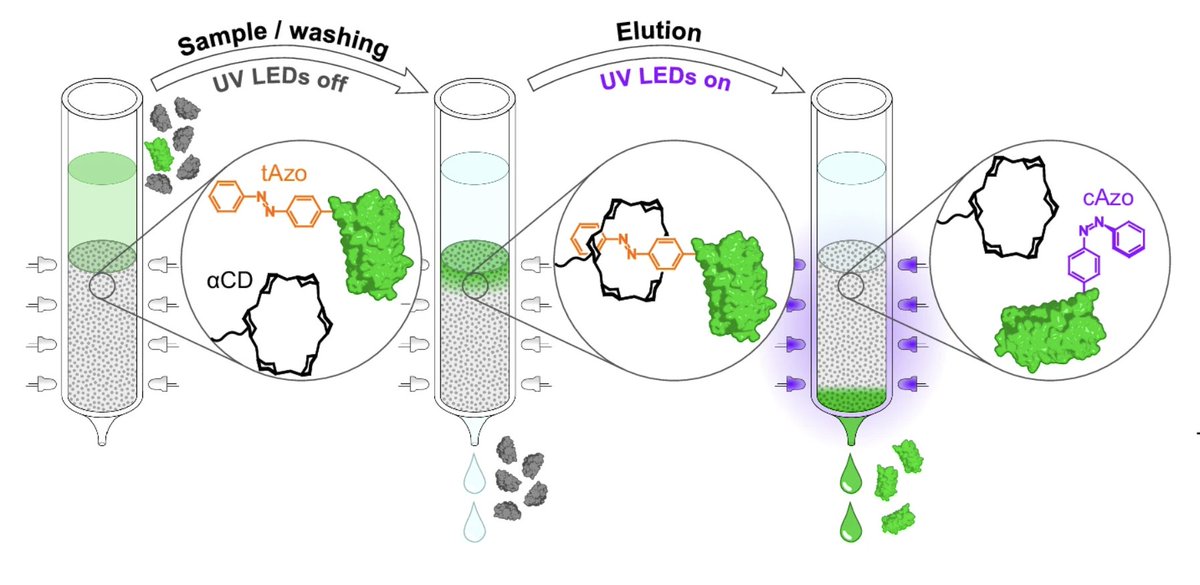
Protein purification with light via a genetically encoded azobenzene side chain
"the UV light-switchable cis/trans-isomerization of the ncAA Pap enables one-step protein purification" https://t.co/ADmkVh19gt
"First IPPS Online Seminar in 2025 by Prof. Jim Westwood on January 8th, 2025" by IPPS Admin
Preview: We are excited to announce that Prof. Jim Westwood from Virginia Tech will kick off our IPPS seminar series with the…
Source: https://t.co/a8WeBHBnDh
#parasiticplants
A split intein and split luciferase-coupled system for detecting protein-protein interactions
"A split luciferase with β10 and β9 tags on inteins produces a luminescence signal when the POI interact, splice together, and bind the third luciferase part."
https://t.co/NEJKpPe7cE
Preprint alert!🚨 You want biomass data without clipping the vegetation? Use your smartphone for a 3D scan! In our manuscript you get instructions & a complete Jupyter notebook for immediate use! https://t.co/2zRmndAUsH 🪴+📱=💚
@UFZ_de@tudresden_de@UniHalle @GeobotanyHalle
The evolution of pectate lyase-like genes across land plants, and their roles in haustorium formation in parasitic plants https://t.co/5cff9jnOtG #biorxiv_plants
"PCP Special Issue on Parasitic Plants" by Thomas Spallek
Preview: Plant & Cell Physiology (@PCP_EIC), the official journal of the Japanese Society of Plant Physiologists, will publish a special issue on parasitic…
Source: https://t.co/iWShLMhnb8
#parasiticplants
"transformed non-fluorescent proteins into bright fluorescent proteins with the site-specific incorporation of non-canonical amino acids"
Designing artificial fluorescent proteins and biosensors by genetically encoding molecular rotor-based amino acids
https://t.co/m6fds9rGNT
Introducing a novel bacterial phylum Zhuqueibacterota, utilizing hydrogen-powered carbon fixation through the Calvin-Benson-Bassham cycle.
Check out the authors’ video to learn more about its fascinating evolution and ecological role!
https://t.co/pqXELd2TAy
#Metagenomics #CarbonCycle #Ecology #evolution @wileymicrobio @WileyEcolEvol
Comparative Analysis of Two Neighboring Conducive and Suppressive Soils Toward Plant Parasitism Caused by Phelipanche ramosa on Brassica napus | Phytobiomes Journal https://t.co/2kONViBZMY
"Hemiparasite Phtheirospermum japonicum growth benefits from a second host and inflicts greater host damage with exogenous N supply" by Louis Irving
Preview: Facultative root hemiparasites likely connect to several hosts…
Source: https://t.co/s85Er5bFig
#parasiticplants
A new Science study presents “Evo”—a machine learning model capable of decoding and designing DNA, RNA, and protein sequences, from molecular to genome scale, with unparalleled accuracy.
Evo’s ability to predict, generate, and engineer entire genomic sequences could change the way synthetic biology is done. Learn more in this week's issue: https://t.co/rGWOLUsYZc