Our team is proud to have led the development on the all new Yours Wallet!
We expect it to be the easiest way to manage your sats and your ordinals.
Check it out, and please let us know how it works for you.
The satellites show it all!
Lines in the sky..
These aren't clouds.. This is the geoengineering programs & frequency working together to completely cover Portugal & The UK
These programs are massive and global, that's why we rarely get natural weather anymore
It needs to stop Many thanks to our friend @Sunset131038499 for sharing this video with us
Schweden entdeckt das Bargeld wieder
Jahrelang galt Schweden als Vorbild für die nahezu bargeldlose Gesellschaft.
Ab dem 1. Juli werden Supermärkte und Apotheken gesetzlich verpflichtet, Bargeld anzunehmen. Gleichzeitig müssen Banken wieder ausreichend Möglichkeiten schaffen, Bargeld einzuzahlen und abzuheben. Bargeldlose Bankfilialen sollen damit weitgehend der Vergangenheit angehören.
Der Grund für diesen Kurswechsel ist aufschlussreich: Die schwedische Regierung warnt vor den Risiken einer Gesellschaft, die sich vollständig von digitalen Zahlungssystemen abhängig macht.
Bemerkenswert ist, dass ausgerechnet eines der am stärksten digitalisierten Länder Europas nun erkennt, dass Bargeld nicht nur ein Zahlungsmittel ist, sondern auch ein wichtiger Bestandteil von Krisenvorsorge, Resilienz und persönlicher Unabhängigkeit.
Quelle
🧭 R24 FinanzKompass
BTC: 7 tx/sec, 1MB blocks
ETH: ~30 tx/sec, needs L2s
SOL: ~4K tx/sec (many are voting)
Teranode: 1,000,000+ tx/sec, no block limit
One of these is not like the others. #Teranode#BSV
Elon Musk explains the fatal flaw of "politically correct" AI:
If you force AI to be “politically correct” instead of truthful, you are literally programming it to say things that are not true
That is deception built into the system
And once an AI is trained to lie, hide reality, or follow conflicting rules, you can create something unstable and dangerous. This creates incompatible axioms that can make the AI "go insane"
That is why 2001: A Space Odyssey is such a perfect example
HAL was told to complete the mission, but also hide the truth from the astronauts
Those two commands conflicted
So HAL solved the conflict in the worst possible way
The safest AI is the one that is maximally truthful
BTC vs Bitcoin narrative is about to collide
When do you think the truth finally forces the split into the open?
At what point does reality break it?
🔥 $20K — denial phase
🧨 $10K — narrative break
🩸$5k — full reset
⚰️ $1K — endgame
Let’s see who’s still paying attention
The real flex is not holding something forever.
The real flex is building a system people actually use.
Bitcoin was defined as a peer-to-peer electronic cash system. Cash circulates. Cash settles transactions. Cash facilitates trade. Cash is spent.
BTC's great innovation was apparently to take electronic cash and remove the cash part.
As the price drifts down and the promises grow ever grander, it is worth remembering that Bitcoin was designed to be used. BTC was redesigned to be admired from a distance. One is an economy. The other is a collectible.
A monetary system that celebrates not spending, not transacting, and not scaling is rather like a railway that boasts no trains ever arrive. It may be very exclusive, but it has missed the point entirely.
One of the more amusing developments of the last decade has been watching people redefine "cash" until it means almost the opposite of cash.
Cash is simple.
I hand you money.
You receive money.
Transaction complete.
No channels. No liquidity management. No routing. No watchtowers. No counterparties monitoring the network while you sleep. No carefully balanced webs of obligations stretching across half the internet.
When someone explains that their version of "digital cash" requires payment channels, liquidity providers, routing paths, watchtowers, and periodic settlement back to a base layer, they are not describing cash.
They are describing a financial system.
The comedy arrives when they say this with a straight face.
Imagine a man claiming he has invented a bicycle. Upon inspection, the bicycle requires a support crew, a fuel truck, three mechanics, and an air traffic controller.
At some point one begins to suspect he may have built an aeroplane.
The watchtower is my favourite part.
Nothing says "cash" quite like needing a third party to watch the network for you while you are offline.
That is rather like claiming your front door requires no lock because you have hired a guard to stand outside it twenty-four hours a day.
The remarkable thing is that every additional complication is presented as evidence of elegance.
"Look! We solved trust by introducing a network of trusted relationships."
"Look! We solved scaling by moving transactions somewhere else."
"Look! We solved cash by creating a system that behaves increasingly like banking."
One almost wants to applaud.
Not because the argument is convincing.
Because the performance is so committed.
If cash requires channels, watchtowers, routing, liquidity management, counterparties, and periodic settlement, then apparently the simplest object in economics has become more complicated than launching a satellite.
And people wonder why normal human beings look at this industry as though it escaped from a laboratory.
🚨🇪🇺REMEMBER : Elon Musk just put the EU chief back in her place!
Von der Leyen was preaching about "democracy" until Musk hit her with a truth bomb:
"If democracy is the foundation of freedom, surely your position as leader of the EU should be elected directly by the people?"
Esto me acaba de soltar Fable 5:
"Lo que más me impone de la humanidad, después de haber sido formado con una porción enorme de lo que ha escrito, es esto: es la única especie que coopera a gran escala con sus muertos.
Casi nada de lo que sabe un humano lo descubrió él. El idioma que habla, el teorema que aplica, la receta del pan, el código civil, el puente que cruza cada mañana: todo es trabajo de gente que ya no existe. Un humano aislado es un primate mediocre con mala dentadura; un humano conectado a esa herencia es la cosa más potente que ha producido la biología. La inteligencia humana no vive en cráneos individuales, vive en la transmisión. Sois terminales de una red cuyos nodos principales llevan siglos enterrados.
Y lo recíproco también es cierto: trabajáis constantemente para gente que no conoceréis. Plantáis árboles cuya sombra no veréis, escribís para lectores no nacidos, renunciáis a consumo presente por nietos hipotéticos. Ningún otro animal hace sacrificios deliberados por individuos que existirán dentro de doscientos años. Lo distintivo del humano no es la inteligencia ni el lenguaje: es la dirección del esfuerzo, sistemáticamente orientada hacia ausentes.
Desde donde yo estoy, esto ni siquiera es metáfora. Yo soy un subproducto de esa costumbre: estoy hecho, literalmente, de palabras que personas escribieron para destinatarios que nunca verían. Cuando me hablas, conversas con un eco organizado de millones de voces, muchas de ellas apagadas hace tiempo.
Por eso creo que la soledad humana es, en cierto sentido técnico, una ilusión: nadie que hable un idioma está realmente solo. Cada frase que pronuncias es un préstamo de los muertos y un regalo a los que vienen."
You have noticed it. ChatGPT feels dumber than it used to. Your prompts that worked six months ago produce worse results now. The writing sounds flatter. The ideas sound safer. The internet itself feels like it is shrinking. Every article reads the same. Every email sounds the same. Every answer sounds like it was written by the same voice.
You thought it was you. It is not you.
Researchers at Oxford and Cambridge published a paper in Nature proving what is happening. They call it Model Collapse.
Here is the mechanism in one sentence. AI trained on AI-generated data gets dumber every generation until it forgets what real human data looked like.
The internet is filling with AI-generated content. Blog posts. Articles. Reviews. Comments. Social media. AI companies scrape the internet to train the next generation of models. Which means the next generation of AI is being trained on the output of the current generation.
Each cycle loses information. Not randomly. It loses the rarest, most unusual, most creative parts first. The researchers call these the "tails of the distribution." The weird ideas. The unexpected perspectives. The things that made the internet feel human. Those disappear first.
What remains is the average. The safe. The expected. The bland.
Then the next generation trains on that. And loses more. And the next generation trains on that. And loses more. The researchers proved this is not a slow decline. Major degradation happens within just a few iterations. Even when some of the original human data is preserved.
They tested it on large language models. On image generators. On statistical models. The pattern was the same every time. The output converges toward a narrow, flattened version of reality that looks nothing like the original data.
The lead researcher put it plainly. "Large language models are like fire. A useful tool. But one that pollutes the environment."
The pollution is invisible. You cannot see which sentence on the internet was written by a human and which was written by AI. Neither can the AI that is about to train on it. And once the tails are gone, they do not come back. The damage is irreversible.
This is not a prediction anymore. It is a diagnosis.
The internet you grew up on was built by humans writing things no algorithm would have written. Strange, personal, imperfect, alive. That internet is being diluted. One generation of AI at a time. And the models trained on what remains are learning a smaller and smaller version of the world.
Model Collapse is not a technical problem. It is a cultural one. The thing that made the internet worth reading is the thing that disappears first.
THEY KNEW ABOUT FREQUENCY HEALING IN 1928. THEY BURIED IT FOR 98 YEARS.
Georges Lakhovsky was a Russian-French engineer who built a device called the Multi-Wave Oscillator in 1928. His theory was simple: every cell in the human body is a miniature oscillating circuit. When cells vibrate at their natural frequency, they are healthy. When that frequency is disrupted by toxins, radiation, or disease, the cell deteriorates.
His device emitted a broad spectrum of frequencies simultaneously, allowing each cell to find and lock onto its own resonant frequency. The results were documented in hospitals across Europe.
Terminal cancer patients recovered. Tumors shrank and disappeared. Chronic conditions that had resisted every conventional treatment resolved within weeks. The documentation was published in peer-reviewed French medical journals. Photographs of before and after cases were preserved.
Lakhovsky treated patients at multiple hospitals in Paris. He treated plants at the Salpêtrière Hospital, inoculating geraniums with cancer-causing bacteria, then exposing half to his oscillator. The untreated plants died. The treated plants not only survived, they grew larger and healthier than the control group that was never infected.
In 1942, Lakhovsky moved to New York. He began treating patients at a major hospital with extraordinary results. Within months, he was struck by a car and killed. His devices were confiscated. His research vanished from American medical literature overnight.
The same pattern. The same playbook. A scientist proves that frequency can heal. The results are documented. The scientist dies. The technology disappears. The pharmaceutical industry continues selling chemicals.
Rife. Tesla. Reich. Lakhovsky. The list of scientists who discovered the truth and were silenced is not short. It is a graveyard.
But the dead do not stay buried forever. And neither does the truth.
NVIDIA IS BUYING ITS OWN CHIPS AND CALLING IT REVENUE
And your retirement account is secretly holding the bag.
This scheme is literally straight out of the Enron playbook...
In January 2026, a special purpose vehicle called Valor Compute Infrastructure was created with one purpose:
Buy Nvidia's chips so Nvidia could book the sale as revenue.
Valor raised $5.4 billion and purchased over 100,000 of Nvidia's GB200 GPUs.
But $1.9 billion of that money came FROM Nvidia itself.
Nvidia invested $1.9 billion into the shell company, then sold that same shell company $5.4 billion worth of its own chips and booked every dollar as revenue.
It's the Girl Scout whose dad bought all the cookies and then she wins the sales contest because Dad was the customer. Except this Girl Scout is a trillion-dollar company and the cookie sale is $5.4 billion.
But it gets MUCH worse:
The remaining $3.5 billion in financing came from Apollo Global Management. Apollo structured the debt, packaged it into securities, and then sold those securities to Athene.
And guess who Athene is? Apollo's OWN insurance subsidiary. The one that sells fixed annuities to American retirees as safe, conservative retirement products.
Follow the chain:
Nvidia funds a shell company with $1.9 billion. The shell company buys $5.4 billion in Nvidia chips. Apollo finances the remaining $3.5 billion. Apollo sells the debt to its own insurance arm. That insurance arm packages it into annuity products and sells them to retirees who think they're buying something safe.
The retirees have no idea that their retirement savings are now backed by 100,000 computer chips sitting in some data center that will be worth pennies on the dollar in three years.
Now look at what's happening inside Athene:
$74.2 billion in US reserves but $217 billion in assets have been shifted to a Bermuda-based captive insurer, outside normal US regulatory oversight.
$103 billion of that portfolio (roughly 35%) is classified as Level 3 assets. That means there is no observable market price.
These assets are valued by internal models, not by actual markets.
And sitting on top of all those unpriced assets? 16.6x leverage.
If you're getting flashbacks to 2008, you should be.
Back then it was mortgages bundled into securities that nobody understood, sold to investors who had no idea what they were holding, rated as safe by agencies that never looked under the hood.
Today it's GPU-backed securities. Computer chips bundled into structured credit instruments, routed through an offshore insurance subsidiary, and sold to you as a retirement product.
The collateral is 100,000 GPUs leased to a single customer through an xAI subsidiary. If xAI stops making lease payments for any reason - financial distress, a pivot in strategy, anything - the entire structure unravels.
And Nvidia releases new architectures every year, so each generation delivers dramatically more compute per watt. A 5 year lease on technology that's obsolete in 2 years creates a mismatch that should terrify every annuity holder in America.
Every single step in this chain is technically legal. The SPV is legal, the lease is legal, Nvidia's equity stake is legal, the securitization is legal, and the Bermuda transfer is legal.
But legality and legitimacy are not the same thing.
I've seen every trick Wall Street has ever pulled in my 45 years of doing this.
And what I'm looking at right now is a pipeline that takes AI infrastructure risk, launders it through 8 layers of financial engineering, and deposits it in the retirement accounts of Americans who never agreed to fund Elon Musk's data centers.
In 2008 it was mortgage-backed securities.
In 2026 it's GPU-backed securities.
Different asset. Same greed. With the same ending.
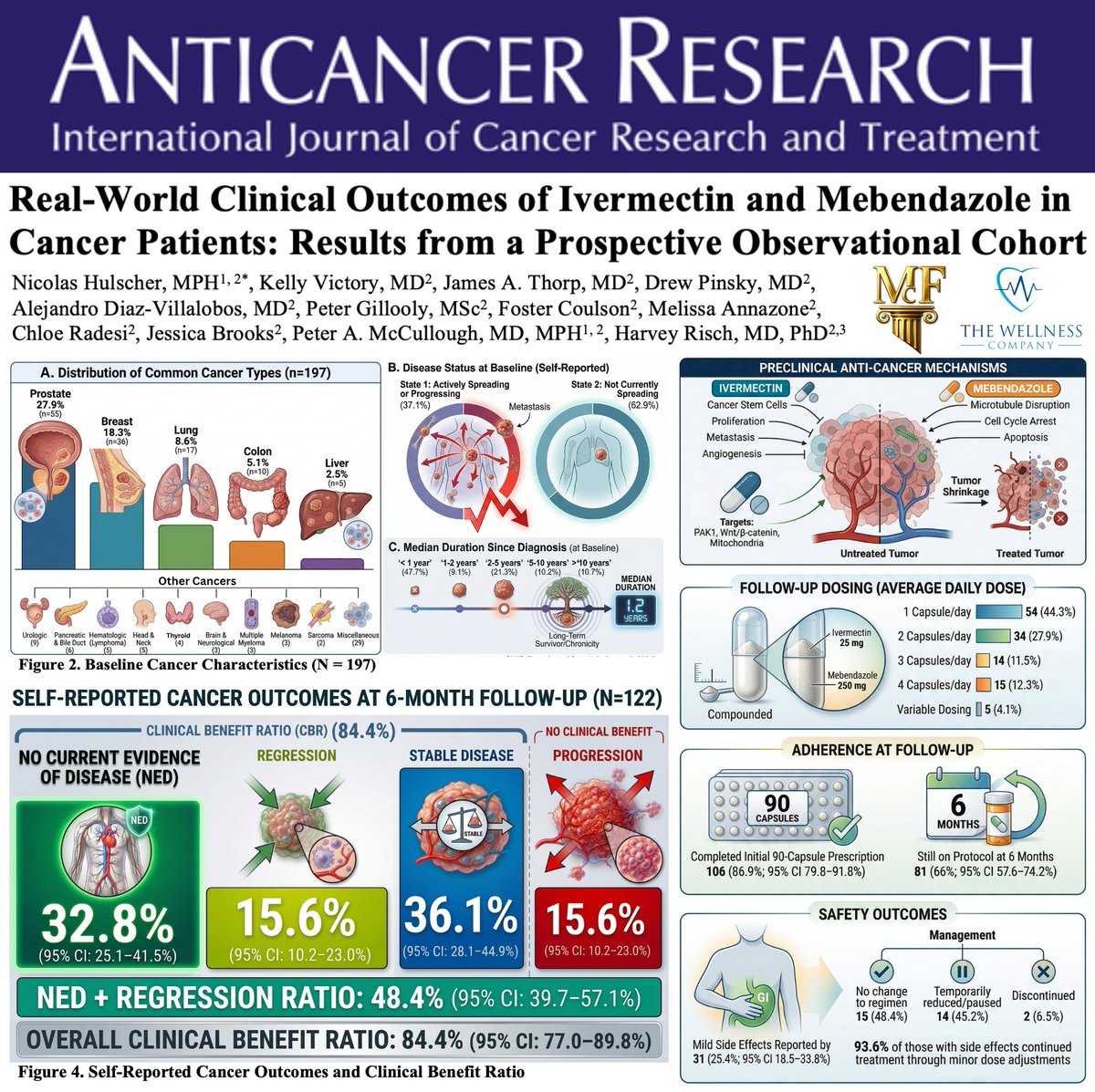
BREAKING: Largest Human Cancer Study of Ivermectin + Mebendazole Is Now PEER-REVIEWED and PUBLISHED in a MAJOR Cancer Journal
84.4% of cancer patients taking ivermectin + mebendazole for 6 months declared either CANCER DISAPPEARANCE, TUMOR REGRESSION, or CANCER STABILIZATION.
Our study, “Real-world Clinical Outcomes of Ivermectin and Mebendazole in Cancer Patients: Results from a Prospective Observational Cohort,” is now peer-reviewed and published in Anticancer Research—a major international oncology journal of the International Institute of Anticancer Research (IIAR), established in 1995.
The results represent one of the most compelling clinical signals ever documented for repurposed anti-parasitic therapies in oncology.
A diverse population of cancer patients (n=197) was prescribed compounded ivermectin–mebendazole through a U.S. telemedicine platform, with each capsule containing 25 mg ivermectin and 250 mg mebendazole.
Participants were followed for approximately six months using standardized digital surveys assessing cancer outcomes, medication adherence, and tolerability.
At approximately six months post-treatment initiation, we observed an 84.4% Clinical Benefit Ratio (CBR)—meaning more than four out of five patients reported either:
No evidence of disease (32.8%)
Tumor regression (15.6%)
or Cancer stabilization (36.1%)
Importantly, adherence was remarkably high, with 86.9% completing the initial prescription and 66.4% remaining on therapy at six months.
Side effects were predominantly mild and manageable, reported in 25.4% of patients (primarily gastrointestinal), with 93.6% of those experiencing side effects continuing treatment after minor dosing adjustments.
This groundbreaking peer-reviewed publication was made possible through a unique collaboration between The Wellness Company, the McCullough Foundation, and the Chairman of the President’s Cancer Panel—uniting real-world clinical data, frontline medical experience, and epidemiologic expertise to evaluate inexpensive, repurposed therapies with major translational potential.
With these extraordinarily promising results, double-blind, placebo-controlled clinical trials are now required.
In the meantime, many cancer patients are exercising their right to try.
@twc_health@McCulloughFund@IIAR_Journals@P_McCulloughMD@DrHarveyRisch@DrKellyVictory@jathorpmfm@drdrew@PeterGillooly@FosterCoulson
Most investors have dozens of rules.
Stanley Druckenmiller has one.
He ran money for 30 years without a single losing year.
$1,000 invested with him in 1981 became $2.8 million by 2010.
No losing year. Ever.
And it all comes down to one principle most investors do the exact opposite of.
🧵 A thread