Markets produce opportunities constantly.
Today. Next week. Next month. Next year.
Yet traders often treat the position in front of them like it's their last chance to make money.
The more opportunities you believe are coming, the easier it becomes to reject a bad one.
Back to the market. Oil is surging, volatility is expanding, and sentiment is quickly turning bearish—that’s your first clue. When fear spreads wildly, you have to start thinking contrary. But let’s be clear: Powell has signaled he’s on hold until there’s clarity out of the Middle East. That means uncertainty remains the dominant force—for now.
After last week’s meeting, Fed Chair Jerome Powell emphasized that further evidence of easing inflation is required before additional policy easing is considered: “If we don’t see that progress, then you won’t see the rate cut.”
Market expectations have shifted. In just a week, bond traders moved from anticipating rate cuts to pricing in roughly a 50.0 percent probability of a rate hike by October. In Europe, markets are now pricing in as many as three ECB rate hikes by year-end.
Recession risk is rising as the Iran conflict prolongs and oil prices are elevated. A slowing U.S. economy could hurt corporate profits and also exacerbate emerging stresses in the private credit market.
At some point, we’re going to get a sharp snapback rally. That’s inevitable. But don’t confuse a reflex rally with a new uptrend. Some of the most powerful rallies happen inside bear markets and major corrections—they trap the impatient and reward them with whipsaw action.
The market is news driven. If this conflict resolves quickly and favorably, we could see a classic V-shaped recovery. If not, the market is going to likely need time to repair to establish a durable bottom.
Oil will eventually present a good shorting opportunity. Equities will bottom. But timing is everything—and for the low-risk trader, volatility is the enemy.
That's why I’m never concerned with buying at the lowest price—I want the right price. I want alpha, and I want it fast and efficient.
Grinding for pennies in chaotic conditions is for gamblers and action jumkies. Those are hard-penny environments—and that’s where amateurs get chopped up.
Professionals have what I call sit-out power—the discipline to wait for easy-dollar conditions, when the odds are clearly in your favor. How long do they wait? As long as it takes. That's where the discipline comes in.
https://t.co/JXzFFTmMtn
It's Christmas season, so I'm sharing this simple yet logical alpha with everyone.
“$10 per $CORE is inevitable”.. if you know how TVL works.
Still unsure? Let me show you why $1.2 is a steal right now. ⬇️
◢ How TVL works?
Total Value Locked (TVL) represents the total assets staked within a DeFi protocol.
When users stake tokens, these assets are locked, reducing their availability in the circulating supply.
This scarcity, combined with increasing demand, often results in upward price pressure due to the basic economic principle of supply and demand.
However, TVL is more than just numbers, it’s a reflection of user confidence in a project. A high TVL suggests a robust and trusted ecosystem, making it a key indicator for identifying strong DeFi projects.
Do you know the token that ticks all these boxes? It is $CORE
➜ Why CORE Stands Out
Most projects struggle to create meaningful demand for their tokens.
They promise utility but fail to deliver systems that drive sustainable value. $CORE, however, flips the script by embedding itself as a vital component of the Core ecosystem.
Its utility-driven design ensures consistent demand through its use for:
> Gas fees for transactions within the ecosystem.
> Governance, enabling token holders to vote on important protocol decisions.
> Staking, which ties directly to the Fusion Upgrade’s revolutionary system.
But the Fusion Upgrade isn’t just an upgrade, it’s a game-changer.
It positions $CORE as a versatile Layer 1 token with unparalleled utility, particularly for Bitcoin holders seeking high staking yields.
➜ Understanding The Fusion Upgrade
The Fusion Upgrade takes $CORE’s utility to the next level by introducing dual staking, a mechanism that allows users to stake both $BTC and $CORE to unlock the highest yields.
This integration bridges two powerful forces:
1. Bitcoin’s dominance in the crypto market, and
2. $CORE’s utility in BTCFi.
◢ Here’s how it works:
Users stake $BTC for yield.
In order to maximize their $BTC returns, they must stake $CORE alongside it.
This system ties $CORE directly to Bitcoin staking rates, creating a feedback loop of demand.
◢ Let’s me break it down with an example:
Suppose you stake 0.01 BTC (valued at $900).
To unlock the highest yield rates, you’ll need to stake just 80 CORE tokens (worth $80).
This small investment in CORE amplifies your Bitcoin yield significantly.
For Bitcoin holders, the incentive to acquire $CORE becomes clear, it’s the key to maximizing their returns.
➜ The Impact on $CORE’s Value
The Fusion Upgrade introduces several dynamics that could positively impact $CORE’s price:
1️⃣ Increased Demand for Staking:
As users seek higher Bitcoin yields, demand for $CORE grows. With limited supply available for trading, this demand could push prices upward.
2️⃣ Circulating Supply Reduction:
Staked tokens is effectively removed from circulation, reducing sell pressure.
A lower circulating supply, combined with increasing demand, often results in price appreciation.
3️⃣ High TVL as a Confidence Signal:
Core's $850 million TVL signals strong user trust and engagement.
High TVL can attract new investors, boosting $CORE’s visibility and speculative interest.
4️⃣ Incentivized Holding:
With $CORE required for optimal staking rewards, holders have a strong incentive to retain their tokens rather than sell.
This retention creates a long-term positive feedback loop, further stabilizing and potentially driving up the token price.
➜ Conclusion
The Fusion Upgrade cements $CORE as a key asset in Bitcoin DeFi.
By linking its utility to Bitcoin staking rewards, Core ensures $CORE’s demand grows with its ecosystem.
High TVL, innovative staking, and holding incentives position the token as a pivotal force in DeFi
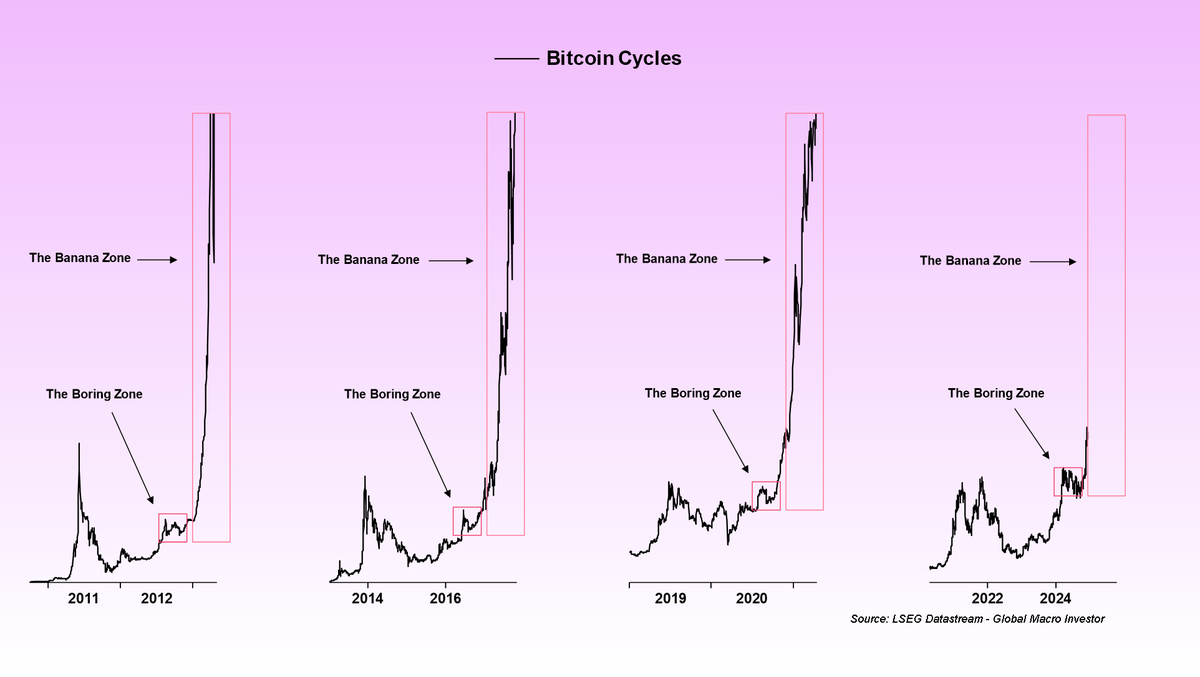
Seems like the Banana Zone wasn't such a stupid idea..plenty more to come, over time (with plenty of sharp corrections too along the way).
Strap in. 🍌🍌🍌
As of typing we have 1262 holders of $DINGO this is purely organic imagine when we really start to push USA embraced $DOGE so Australia can embrace $DINGO
I’m currently in 2nd place in the US Investing Championship with a +276.2% return as of 08/31. Here are some of the lessons I’ve learned over the last two years competing in this competition:
Stan Weinstein is the founder of the legendary Stage Analysis system.
We were lucky enough to interview him this past summer.
Here are the 10 most actionable lessons Stan left us with:
1) Does his methodology still work?
Yes, but something's changed...
You won't believe this...
Post the jobs number result we are now moving towards 50/50 for 50bps rate cut in September.
Even Black rock are now saying 50bps would mean panic!
In the stock market, everyone starts in kindergarten. You have to earn your way to the top.
Be patient with yourself. Your college degree or the fact that you're a smart doctor, engineer, or lawyer means nothing in the world of professional speculation. In fact, if you aren't willing to let go of your ego and strong opinions... it may even hurt you.
https://t.co/JXzFFTmMtn
Terms of Service is stronger with FTX than Gemini Earn and still S&C, Debtors are trying to screw FTX customers with petition date pricing BS.
Join our Customer Ad Hoc to fight for Justice, fair treatment when UCC, Eversheds agreed to debtors BS plan