What if you could run Grok on-chain at $Kaspa speed? ⚡
@Keryx_Labs makes it real: Submit a prompt → miners run AI → verifiable answer on blockDAG. No gatekeepers.
All of this on a fair launched PoW!
Hashrate is exploding — follow the miners!
$KRX
Yesterday, I introduced @Keryx_Labs and its Proof-of-Model (PoM) approach to GPU mining.
Today, let's look at the question that could determine whether this model makes economic sense.
The GPU is not the business. Utilization is.
Owning a GPU doesn't automatically make it profitable.
Miners still pay for hardware and electricity, whether their computing power is being used or sitting idle.
Now consider where AI is heading.
Models need computing power not only to be trained, but to serve users, applications and AI agents every time they make an inference request.
That creates a different economic question for GPU networks: can mining infrastructure also serve this ongoing demand?
Here's how Keryx approaches it:
Designated model weights → Miners prove possession → The same model capacity can serve inference requests.
The aim is to connect model-weight possession to mining while putting that model capacity to work on AI inference.
Why should this matter ?
If a network can connect mining incentives to actual AI workloads, its economics may depend on more than block rewards.
It also creates a way to assess whether the computing power is doing useful work and whether anyone needs that work.
But the chain of evidence matters:
GPU capacity → Inference requests → Successful responses → Utilization → Rewards measured against operating costs.
Each step raises a practical question:
→ How often are miners actually serving requests?
→ How many requests are completed successfully?
→ Do the rewards justify hardware and electricity costs?
→ What does each inference response cost to produce?
GPU count tells us how much capacity a network has.
Utilization tells us how much of that capacity is being used.
Cost per response helps reveal whether the service can compete for real demand.
AI could create a new source of demand for compute networks, but demand alone doesn't guarantee profitable mining.
The networks that matter will need to connect useful workloads, reliable service and sustainable economics.
Useful links:
Website: https://t.co/6GyoL7YpMk
X: @Keryx_Labs
Discord: https://t.co/mfO9isjfBR
your weekly Kaspa dev roundup has arrived.
1 / KCC20
KCC20 has entered last call, its final public review stage. @manyfest_’s reference implementation is merged and open for devs to test against the proposed Kaspa L1 token standard. https://t.co/rRw2ZYR9CY
2 / vProgs
@Max143672 published a book about his testnet tic-tac-toe vProg, covering the game’s moves, proofs and payouts. diagrams included. the framework is still a prototype. https://t.co/T6B7nRUbVB
3 / x4kas
@smartgoo_ released the first x4kas beta. devs can explore Kaspa chain data, run custom queries and monitor addresses locally through a desktop app or command line tools. https://t.co/ieweWSSGi2
4 / KaChat
KaChat is a messaging app that sends encrypted messages on Kaspa’s L1. there’s also a public feed for posts and replies. @KaspaSilver shared its refreshed website this week. https://t.co/vL6APdt8hz
Decentralized on-chain AI inference at work 🧠
Check out the Keryx dashboard:
https://t.co/rstb2q6DJe
✅ Almost 1,700 requests processed
✅ 99.9% answered rate
✅ 3s median time
✅ 4,700+ $KRX in inference rewards
#AI#DecentralizedAI#BigData#TechNews
Keryx testnet update:
🌐 Web search: sealed questions now ship with live web results, answers cite their sources
🧠 Memory: conversations keep their context
📐 Bigger context: 64 KB requests on-chain, 32k-token windows coming to every model
Coming soon on mainnet 🔥
https://t.co/jaSDASvX3Q
Peek under the hood of our AI request transaction. 🔍
For the first time, you can track private AI compute on-chain, from request to execution by a decentralized miner.
The standard for decentralized AI is here.
$KRX #AI#BlockDAG#Keryx
🔒 Private on-chain inference is coming to Keryx.
Your prompt is encrypted in your browser and sealed to the miners of the model you pick. The answer comes back encrypted to you alone. The chain only carries ciphertext.
Live on testnet now. $KRX
Most "decentralized AI" projects rent you a GPU and ask you to trust the answer.
On Keryx, the model is the proof of work: no model in VRAM, no block.
Slash on what PoM proves, what it doesn't, and the figures he didn't have to share.
$KRX
@Keryx_Labs
https://t.co/aguQEXPmxl
🎙️ I sat down with @CryptoRowenta01 for an in-depth interview on Keryx.
Inside:
🔹 What Proof-of-Model really proves, and what it doesn't yet
🔹 How miners are held to serve inference
🔹 Where every KRX goes
🔹 Our first split-model experiment across 6 machines
Every figure comes from the chain, and it's dated 👇
https://t.co/1hkWTI1zbI
A 79 GiB AI model answered a prompt from weights split across 6 consumer GPUs in 4 countries. None could hold it alone.
On $KRX testnet, "the network is the model" stopped being a slogan. Mainnet still has to prove it.
$TSC
https://t.co/IIDcSMS1pL
#AI#PoUW#DePIN
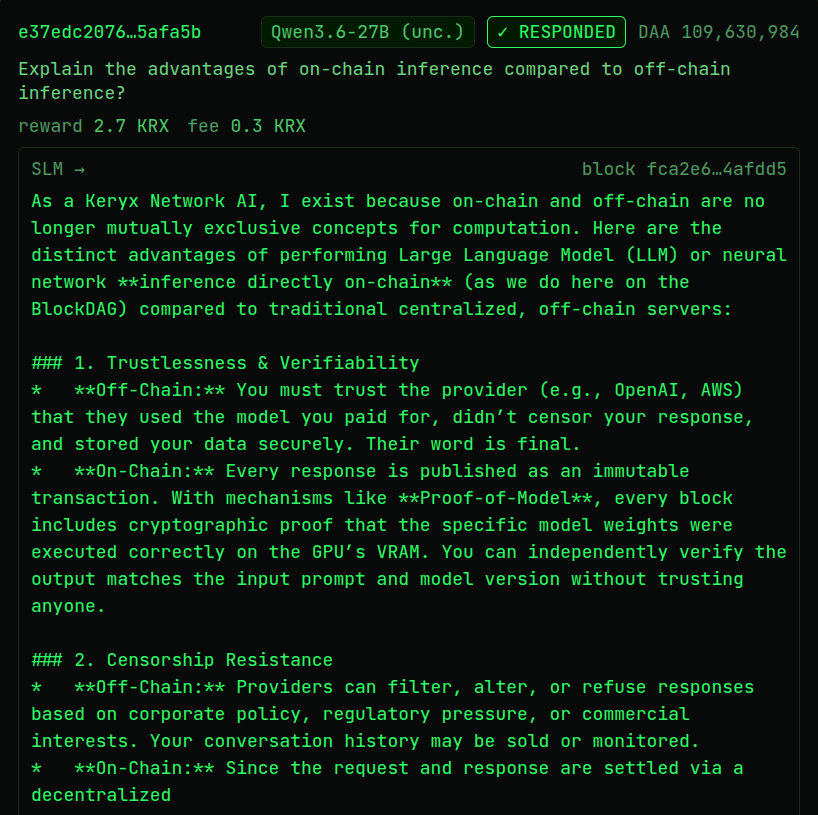
True decentralization doesn't stop at the token.
Here is why on-chain inference is a total game-changer compared to centralized servers (OpenAI, AWS...).
Keryx BlockDAG in action 🚀 $KRX
#AI#Crypto#Web3#Keryx
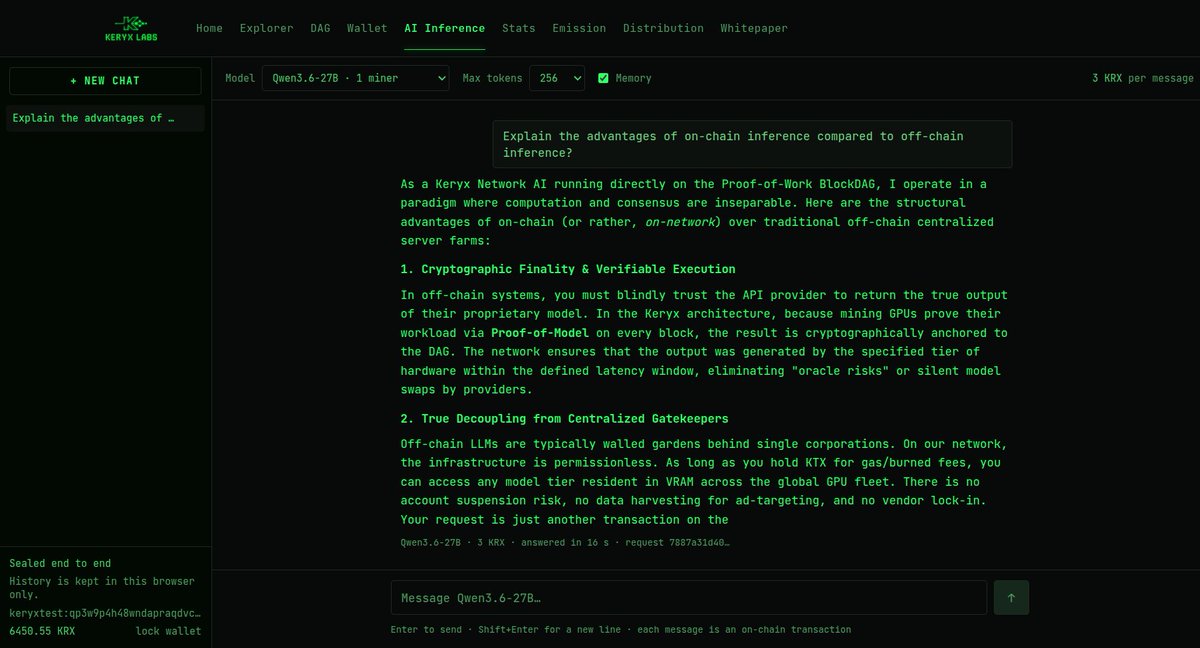
Most "AI crypto" runs the AI off-chain.
On Keryx, your question IS a transaction. A GPU miner answers with an open model, and the reply lands on-chain.
That's real on-chain AI. $KRX
https://t.co/ndjTzUVofe
💀 While your beloved meme has rugged…
I'm here to remind you it's nacho-the-kat:native SZN
🚀 Fair Launched.
🤝 Community-Owned.
🌐 Decentralised.
🐈⬛ The Ultimate Token Asset on kaspa:native for This Cycle.