PNW farmers tell me they are past drought “risk”
It’s been in drought and the soft white wheat crop, as well as lentils, garbs, barley and canola are going to be very small harvests.
.@usda_nass
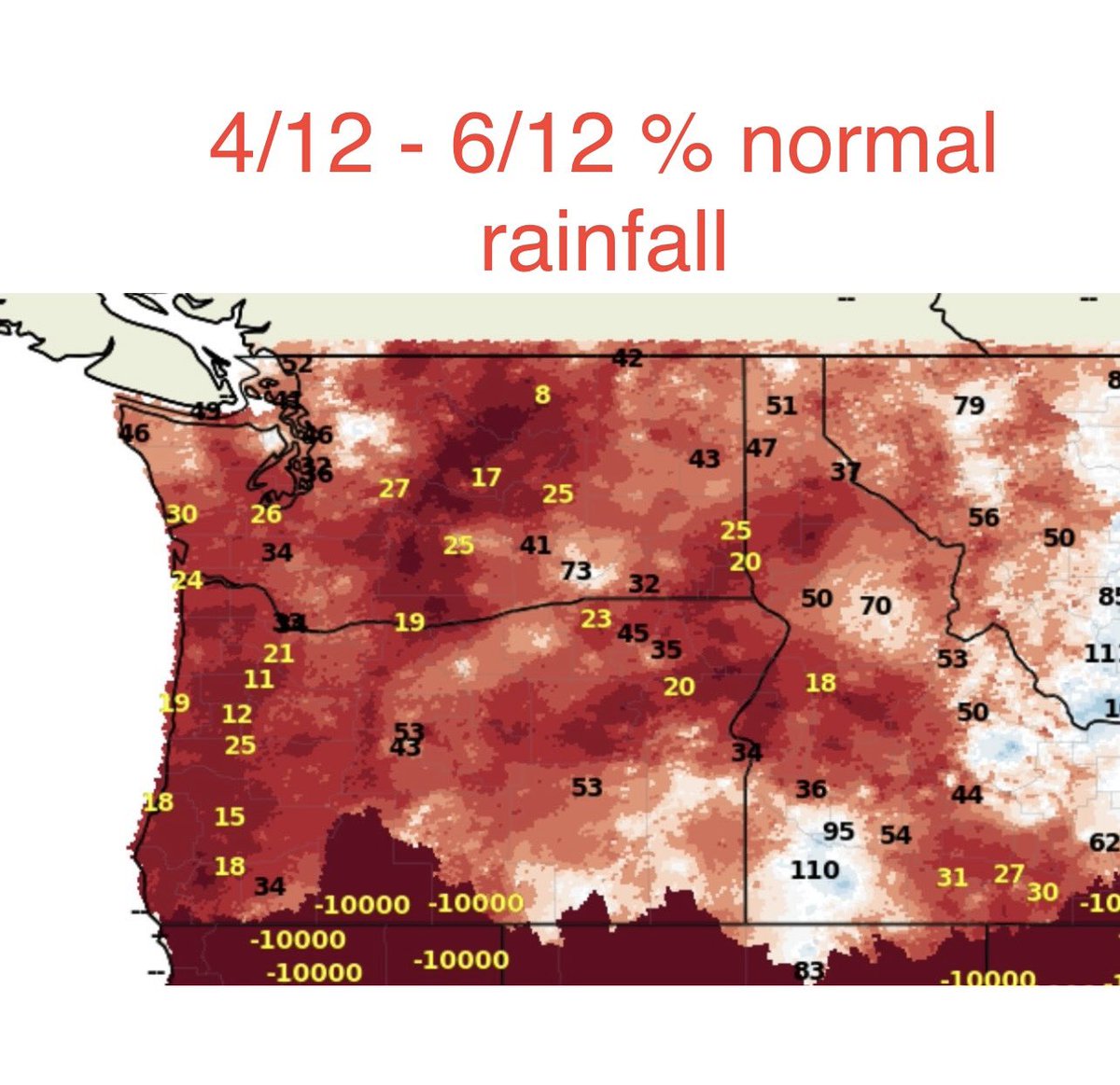
This is April 12 - June 12 % of normal rainfall in the PNW, courtesy https://t.co/BcWbyVCgbr.
Washington, Idaho & Oregon account for ~90% of Soft White Wheat production in the U.S. each year.
What evidence/reasoning does your department have for raising the SWW production estimate 1 mil bushels from your previous estimate, and estimating it 17 mil bushels higher than 2024?
.@usda_nass
This is April 12 - June 12 % of normal rainfall in the PNW, courtesy https://t.co/BcWbyVCgbr.
Washington, Idaho & Oregon account for ~90% of Soft White Wheat production in the U.S. each year.
What evidence/reasoning does your department have for raising the SWW production estimate 1 mil bushels from your previous estimate, and estimating it 17 mil bushels higher than 2024?
I think size is mostly irrelevant, more dependent on revenue. A true full time employee will cost $60k or more per year. Questions I ask are: do they add enough revenue via improved planting, application, harvest timing, reduced down time with maintenance/skills, trucking to higher value markets in the off season, etc., to justify hire? Can vary significantly based on crop mix, location, geography. For our region, commonly 2,500-3,500 acres per full time employee.
@MichaelWSpike And I guarantee they’d all tell you the inventory devaluation stings a lot more than their labor cost, but that doesn’t also mean their labor expense is cheap.
Selling this nearly new rotary cutter on the May 31 Big Iron auction. It probably hasn’t been run 5 hours.
I thought we would use it to mow a few farmyards, but the young folks who do these things at my farm seem to get it done with a lawnmower.
https://t.co/pCmBIXlGtn