Your cells are aging faster than you think.
After age 18, mitochondrial density declines by 1% every year—one of the clearest biological markers of aging.
By 70, you’ve lost more than half your cellular energy capacity.
Here’s what most people miss: this decline isn’t inevitable. 🧵👇
Not only that, but this morning's news is that when Zelensky misbehaved, Elon slowed down starlink so that their military drones couldn't work.
You might like *that* choice if you didn't like how Zelensky was behaving, but that's also the power to slow down your own internet if *you* misbehave.
The Supreme Court struck down net neutrality regulations last year. That means this is totally legal if it is done in a way that is not deemed discriminatory by civil rights statutes, and possible to do illegally if kept hidden.
This means that as the global control grid consolidates, freedom-loving people are going to have to think a lot more carefully about how to maintain decentralized access to the internet.
THE GLOBAL CONTROL GRID IS BEING BUILT. FOLLOW THE TIC, MIC & FIC.
Everyone is talking about SpaceX potentially merging with Tesla.
But I think they’re missing the bigger picture.
We’re watching the consolidation of the Technical Industrial Complex (TIC) into an increasingly integrated global infrastructure.
Consider what a SpaceX and Tesla combination could bring together.
AI models and computing infrastructure.
Satellite communications through Starlink.
Robotics and autonomous vehicles.
Energy generation and storage.
Space infrastructure and military communications.
Now look at China.
While Washington restricts China’s access to its most advanced AI chips, Chinese technology giants are reportedly placing enormous orders for export-compliant NVIDIA chips.
Meanwhile, Beijing is seeking to protect its own advanced AI technologies while developing its domestic computing infrastructure.
China wants access to the American technology ecosystem while building its own sovereign alternatives.
At the same time, American AI companies, chipmakers, energy providers and financial institutions are assembling enormous data-centre projects.
We’re watching the integration of:
AI
CHIPS
DATA CENTRES
ENERGY
SATELLITES
DIGITAL IDENTITY
SURVEILLANCE
MILITARY SYSTEMS
FINANCIAL INFRASTRUCTURE
This is what I mean by the emerging GLOBAL CONTROL GRID.
Not necessarily one centralised organisation controlling everything.
But increasingly interconnected regional infrastructures capable of shaping how people communicate, transact, identify themselves, access information and interact with governments.
Now add the economic layer.
As energy costs rise and the cost of capital increases, the economics of this entire ecosystem become even more important.
AI infrastructure requires extraordinary amounts of electricity, financing, land, chips and physical infrastructure.
Those costs don’t disappear.
They flow through the economy.
Households and businesses consuming energy face higher bills.
Governments and companies borrowing to finance infrastructure face higher debt-servicing costs.
Meanwhile, those issuing the loans, owning the infrastructure, refining the energy and selling the energy can capture an increasing share of the economic value.
A massive potential wealth transfer from energy consumers and borrowers to energy producers, infrastructure owners and creditors.
And much of that infrastructure is increasingly owned or financed through the same global capital markets.
Now apply my framework.
TIC builds and operates the technological infrastructure.
MIC integrates it into military, intelligence and national-security systems.
FIC finances the expansion, structures ownership and captures financial returns through debt, equity and infrastructure assets.
And as the cost of energy and capital rises, those who control scarce energy supplies and financing can gain even more leverage over those dependent on them.
The interesting part is China.
Is China building a completely separate system?
Or are we watching competing regional control grids emerge, with different governments and corporations but overlapping suppliers, capital markets and technological dependencies?
I suspect the latter.
A multipolar political world does not necessarily mean a decentralised technological world.
And the global control grid isn’t just about surveillance, AI or digital identity.
It’s also about who owns the infrastructure, who supplies the energy, who issues the debt and who ultimately pays for it.
The flags may be different.
The infrastructure may be remarkably similar.
And the wealth transfer can continue regardless of which regional power comes out ahead.
You need to be building towards the ownership layer rather than the consumption layer, every month starting today.
Hibernating brown bears have roughly double the cholesterol and triglycerides of healthy humans—yet show no atherosclerosis or heart disease.
During winter hibernation, free-ranging brown bears (Ursus arctos) experience plasma cholesterol levels around 12 mmol/L (versus ~5 mmol/L in humans) and elevated triglycerides, along with obesity, physical inactivity for months, and other metabolic stressors that would typically promote vascular disease in humans.
Histopathology of coronary arteries and aortic arches from adult bears has repeatedly shown no fatty streaks, foam cell infiltration, inflammation, or atherosclerotic lesions—even in animals that have lived through multiple hibernation cycles.
Key protective mechanisms identified in research include:
• LDL particles that are larger and have 5–10× lower affinity for arterial proteoglycans (the binding that helps drive plaque formation in humans)
• Higher plasma cholesterol efflux capacity
• Stabilized or more cardioprotective HDL composition (including increased HDL2b)
• Greater antioxidant capacity and reduced inflammatory/oxidative markers during hibernation
These findings come from multiple studies on Scandinavian brown bears, including work in Scientific Reports, the Journal of Lipid Research, and related papers.
The takeaway is straightforward: high circulating cholesterol and triglycerides do not automatically produce atherosclerosis. Context—lipoprotein structure, function, inflammatory status, and overall metabolic handling—matters. Bears offer a natural model of high lipids without the expected vascular damage.
Well, I didn’t lie about anything.
I have no idea who did it but as far as I can glean no one has access to that information and there’s nothing straightforward about who controls it, so much so that two days ago senators were asking for clarity.
https://t.co/RjKPqbj0Ci
Trump denies involvement, Musk denies involvement, no one admits involvement.
@Kevin_McKernan So did Trump. Who did it has absolutely nothing to do with my point, which is that centralization of internet access creates tremendous centralization of power.
Kermit the frog could have hacked Spacex to do it and my point would be the same.
@TuckerGoodrich Well every side is disclaiming they did it. So who knows, they obviously like the plausible deniability.
But the point we agree on is the one I care about.
@frenlyraven Makes sense but it’s illustrative of the power of centralized control and if Dixon is right that it’s undergoing much more centralization at the consumer level with privatized versions of financial tokens and social credit scores the centralization itself is a threat.
@alexandrosM No, it isn’t, but I didn’t ask you to do anything for me.
I didn’t express any blind faith in news.
Noting a headline is not an expression of blind faith.
To begin with I said “this morning’s news was” and I was correct that the morning news reported what I said it did.
If it was wrong, due to lying or confusion, that’s not a criticism of my facts, it’s a criticism of my source, and the best critique that can be made of me is I didn’t critically analyze it.
In any case it doesn’t sound like you have even a refutation of the news claim, more like good reasons to be skeptical of it.
Your comments were about your perceived emotional tone of what I wrote, not facts.
Your concern I have “EDS” is exactly that — you *feel* that the emotional tone of my post is against Elon, as if I care about being for or against anyone.
On facts, for example I didn’t claim Ukraine was using starlink in accordance with its TOS or that Ukraine has constitutional protections in the US, but you “disputed” these strawmen without disputing anything I actually stated.
@alexandrosM Ok but that has nothing to do with the point that centralization of internet access allows behavioral punishment via internet speed control etc.
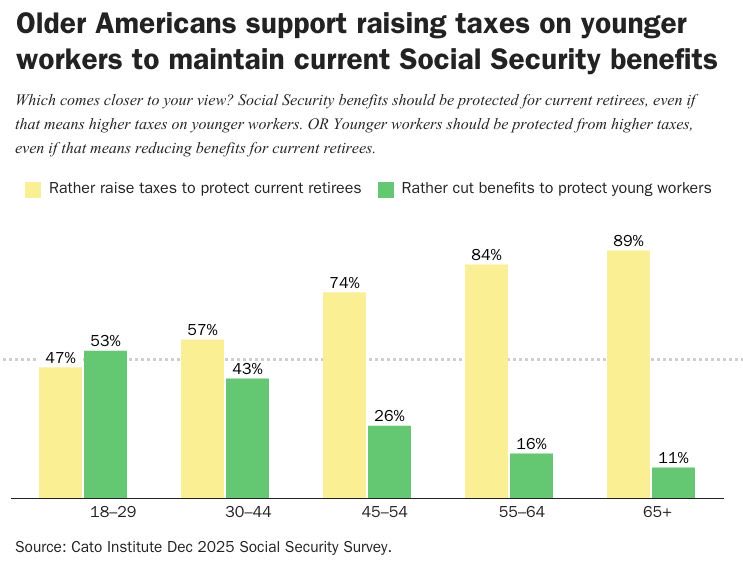
To be a bit fairer to boomers, the statement that boomers want young people to be taxed more to pay their social security benefits is derived from the dataset depicted in the attached graph.
1) The 65+ group doesn’t have their upper range defined and could include boomers, silent, and greatest generations.
2) The article about the survey itself doesn’t mention “boomers.”
3) The 55-64 group blends Gen X and boomers, so there is no actual “boomer” category.
4) The trend in support for this belief actually starts with Millenials!
The most accurate thing to say is that the older you get, the more likely you are to agree with the statement that taxes should be increased on young people to pay your own social security benefits.
A second reason to temper the interpretation is that the question is whether they agree more that young people should be protected from tax increases even if it means retirees have benefits cut, or if retirees should be protected from their benefits being cut even if it means young people pay higher taxes.
This is quite different from asking people “what is your most important political concern” and large numbers of older people saying “that we raise taxes on young people to pay for my social security.”
There are all sorts of permutations in between that would indicate different levels of commitment to the concept that taxes should be raised on young people to pay for older people’s social security, and the way the question was phrased is among the lighter forms of commitment to that concept.
Some people in the comments of my last post said this is a false binary.
It isn’t.
Social security is not an investment program.
It is by definition redistribution from young people who work to old people who no longer work.
Current taxes on workers pay for current benefits to current retirees.
The Social Security Trust Fund is bound by law not to borrow money unless authorized by Congress and this was done only once in 1982 in a loan that was repaid with interest in 1986.
Even if the law were changed to allow it to be funded with government debt, this would cause inflation that would drain the value of future dollars from young people to pay for the current dollars of older people.
All redistribution in the economy is a zero-sum or negative-sum game unless it increases productivity.
The classical definition of entrepreneurship is the intellectual and executive activity of moving resources from areas of lower productivity to areas of higher productivity.
Technology increases producticity by increasing the leverage each unit of resources has to contribute to productivity.
While entrepreneurship and technology lead to positive-sum games (the size of the pie grows), moving money from one person to another with no respect to what they do is on average a zero-sum game (the pie stays the same, some get bigger slices some get smaller slices) and moving money from workers to non-workers is a negative-sum game that actually shrinks the pie.
None of that is to say that we must maximize productivity at all costs. I am not saying that.
I am saying that social security does not increase the size of the pie so it is simply a movement of value from young people who work to older people who no longer work.
As such, the question was completely fair and the binary was not false.
There is no other way to pay for older people’s social security than to tax younger people.
The most accurate statement is that “older people support raising taxes on young people to pay for their own social security benefits, and the older they are, the more they agree.”
Boomers overwhelmingly say in polls that young people should be taxed more to pay for their social security.
Social security is going bankrupt because it is a ponzi scheme misleadingly marketed to the missionary generation as if it were some sort of retirement account, and successively marketed to each generation through the boomers this way.
Just because a ponzi scheme goes broke doesn’t make the people caught with the bag entitled to sell it to the next generation of victims.
Hold the people who created it reputationally responsible and the people who perpetuated it financially responsible.
Blame congress for spending it away.
Blame the fed for backing up the right of banks to make money out of thin air.
If boomers want to tax young people to pay for it, a fair trade would be that we
a) tank the housing market by removing its artificial support (for example Fed could sell its mortgage-backed securities)
b) subsidize home loans for everyone under 30 so they can buy them on the cheap
c) put a property tax on homes bought with subsidized loans that is used to pay boomer social security
This would be especially fair because it wouldn’t artificially tank the housing market, it would just stop artificially propping it up; only boomers who own homes would be hurt but poor boomers would be unaffected; poor boomers would even have a chance to get a home on the cheap if they had good credit; and the extra taxes would only go on young people who took advantage of the subsidy.
However, inter-generational battles are a distraction from congress, the fed, the banks, and the regulatory state.
Boomers have much more wealth than younger generations and young people can’t afford to pay their bills.
That’s not because boomers made so much better choices than young people.
It’s because money printing and public debt steals from the future.
Each generation gets worse off as the bills of the past come due on those in the future.
Boomers got houses that the government artificially made massively increase in value. Young people are now priced out of the market.
The regulatory state and subsidized college loans let boomers become university presidents making corporate CEO salaries and gave admin jobs to lower-paid boomers while the cost of education went to the moon and young people got saddled with debt.
Boomers took a blind eye to what their rulers were doing just like the missionary generation, the lost generation, the greatest generation, and the silent generation before them, and just like generation X and millennials have done after them and Z and alpha are doing so far.
Blame the spenders and the printers — congress, the fed, and the banks — not the older or younger generations.
Sue the ponzi for damages, don’t pass it on to the next sucker.
Bind together against the people who screwed us and start with the spender and the printers.
@TuckerGoodrich@SBakerMD Ok but confounded by less fartable H2S despite CO2 being non-toxic and H2S being toxic. I have a little more trouble than you.
The problem with this quip is it appeals to our collective sense that farting is gross.
But our collective sense that pooping is gross runs much deeper.
And we all know what happens when we don’t poop…
The bias is that they forced them to face the tradeoff they consider realistic.
It in fact is realistic: all spending gets funded from somewhere and it will either come from higher taxes or more inflation.
Directionally your analysis is way off.
Look at the direction of the gap as a function of age: it closes toward zero in the youngest group and it monotonically spreads toward a 10-fold gap at the oldest ages.