Happy to share our latest paper in the frame of the @SFB1453_NephGen project that got published in
@JMolBiol
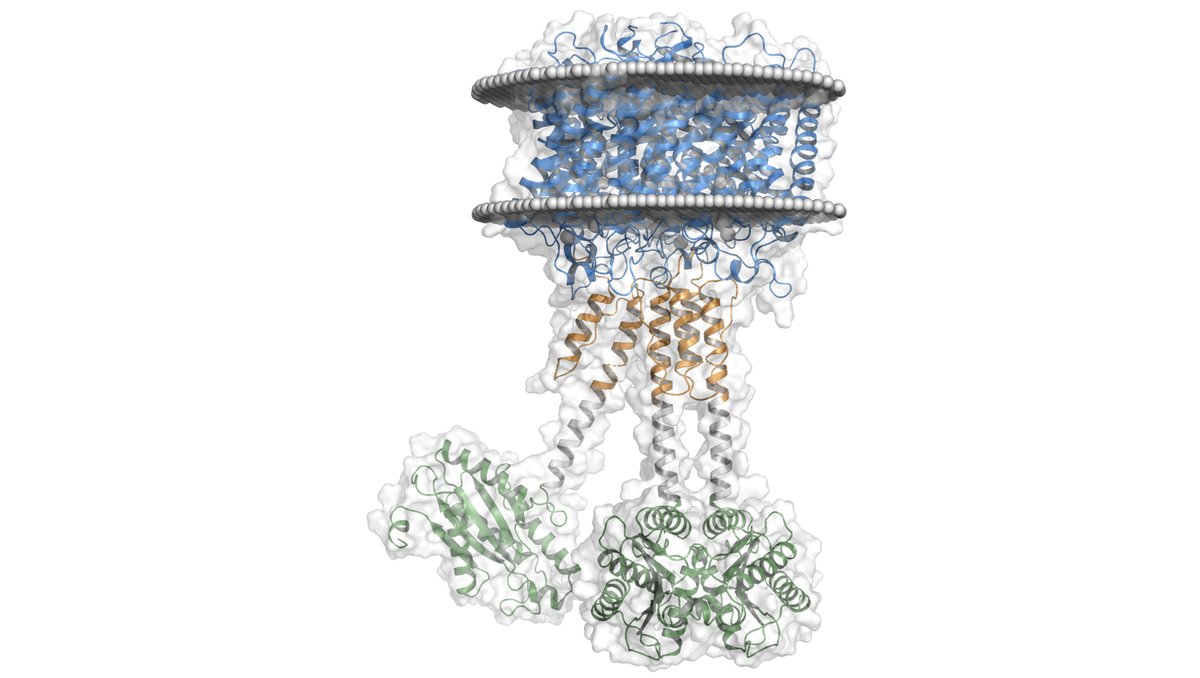
Tremendous work from @EMymrikov and co-workers, on how the scaffold protein PDZK1 interacts with the urate transporter URAT1.
⬇️
https://t.co/rvJO1cAUcz
🚨 Paper Alert! We’re starting off the year with our latest publication in @NatureCellBio on the role of phase separation in selective autophagy initiation!
This work was a close and exciting collaboration with @WilflingLab
🔗 https://t.co/KLEgfgHAVu
Here are the key findings👇
@VielJulien@dnatweets Aucun transport fluvial de prévu ici. La largeur et la profondeur du canal ne permet pas cela. De plus, ce tronçon est parallèle au Rhin (5 km) qui est bien plus pratique pour le transport fluvial.
Ce n'est "que" pour la circulation de bateaux/petites péniches touristiques.
🎉Now out in its final version ⬇️
Fantastic work from Suraj Patil and all others @Uniklinik_Fr and elsewhere.
Proud to have contributed to discover the function, in the #mitochondria , of SLC25A48 and thereby to deorphanize this transporter in the frame of @SFB1453_NephGen
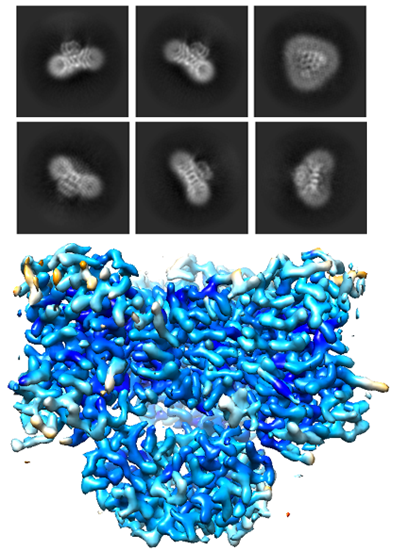
We often see small molecules (ligands) in cryo-EM structures❄️🔬, but how do we know if they were properly modelled into the maps? Proud to be a team @CIBSS_UniFR of the EMDataResource Ligand Model Challenge, and the outcomes are published in @naturemethods 🥳
Scientists from the @UniFreiburg have used the ESRF beamlines and the Cryo- electron microscope to characterise a new membrane protein that can turn ammonium transporters to receptors.
The results are published in @ScienceAdvances
▶️https://t.co/MsVQUTT56x
🧫Our new article on mammalian autophagy is now online in @JMolBiol! We induced mitophagy via ULK1 tethering and examined the role of FIP200 phosphorylation in the later stages of mitophagy. Huge thanks to all our collaborators!
https://t.co/Vt8AIfsZxk
🤔Ever wonder why Atg8 has a C-terminal overhang that is always cleaved? Why conserve it? In this mini piece on @JMolBiol Saskia dives into these questions. Thanks to
@AutophagyAarhus
and Prof. Hofmann for the collaboration!
https://t.co/EE57ujWjmc
New in JBC press: "Scientists' data suggest that YeGT and YkGT are likely bacterial effectors belonging to the family of tyrosine glycosylating bacterial glycosyltransferases."
Learn more:
https://t.co/mxTBMlSUXi
We therefore could identified a residue (E177 in YeGT) that, when it is modified to the one found in YkGT broadens signigicantly the target specificity of YeGT.
This provides information on residues important for target protein recognition/selection.
📢Our latest paper is online in @jbiolchem ! 🎊🎉
Tyrosine-modifying glycosylation by Yersinia effectors https://t.co/DEgoYvS1ir
Work was in collaboration with Silvia Schneider and Thomas Jank from the group of Prof. Klaus Aktories.
Despite very high sequence identity (96%) between them, the 2 enzymes differ in their target protein specificity. One enzyme (YeGT) modifies only RhoA, B and C, while the other (YkGT from Y. kristensenii) has a broader range of targets, including Rac and cdc42 subfamily proteins.
CIBSS member Nils Wiedemann was elected into the Academia Europaea @acad_euro for his "outstanding achievements as a scientist" in the field of biochemistry and molecular biology. Congratulations!👏
➡️https://t.co/GduYlRW6EC