Joint student Yukun Liu (Dravid/Kanatzidis) brilliantly defended his thesis today! Wolverton, Snyder as cmte members. He did outstanding work on high entropy alloy semiconductors: deep, fundamental science. Next stop: Lam Research, Oregon. Wishing him great success!
A proud moment for the #MirkinGroup as we commemorate 33 years of excellence in nanotechnology! 🎉 Thank you to all our collaborators and supporters for being part of this incredible journey. #Mirkinute33#Nano
Transforming GeSe into a top-notch thermoelectric material by raising its symmetry and doubling its performance! Our latest study shows that alloying GeSe with LiBiTe2 leads to doped samples enhanced ZTs, power factors, and ultra-low thermal conductivity.
https://t.co/tr3aSXWKE3
Now online:
Article by @ZihaoYe1419, @Boshen2, Dohun Kang, @ChrisWolverton1, @CHADNANO & co-workers
A data-driven approach for the guided regulation of exposed facets in nanoparticles
https://t.co/iYRNsWRL9i ($)
Our most recent paper in Advanced Materials @AdvSciNews explores the use of silicon oxynitrides as bioresorbable barrier layers in ‘transient’ electronic devices. Thanks to Ziying Hu and Jie Zhao for leading this project, and to Profs. Yonggang Huang and @ChrisWolverton1 for a great collaboration!
https://t.co/n5ZtzjYw9F
Oxygen Vacancy Formation Energy in Metal Oxides: High-Throughput Computational Studies and #MachineLearning Predictions
By @ChrisWolverton1 et al. @NorthwesternU
Read the paper 👉 https://t.co/XebL8ADZYH
Thrilled to share that our figure made it to the cover of Chem. Mater.!
Designing this cover was a blast - my first journal cover experience!
Huge thanks to our PI and our co-authors for making this journey unforgettable. @ChrisWolverton1#MyACSCover@ACS4Authors@ChemMater
Our latest work in Nature Materials! 🌟 We've developed a new photoluminescent material, Rb6Re6S8I8, with isolated [Re6S8I6]4− clusters. It shows a 42.7% PL quantum yield and a PL lifetime of 77 μs, opening doors for optoelectronic device applications. https://t.co/PmzsyP4FjY
Excited to share recent work, led by Bianca Baldassarri and @ChrisWolverton1, on 'Oxygen Vacancy Formation Energy in Metal Oxides'. We present a database of comprehensive DFT calculations to predict O vacancy energy and predict new functional materials: https://t.co/EZFkU8uFrP
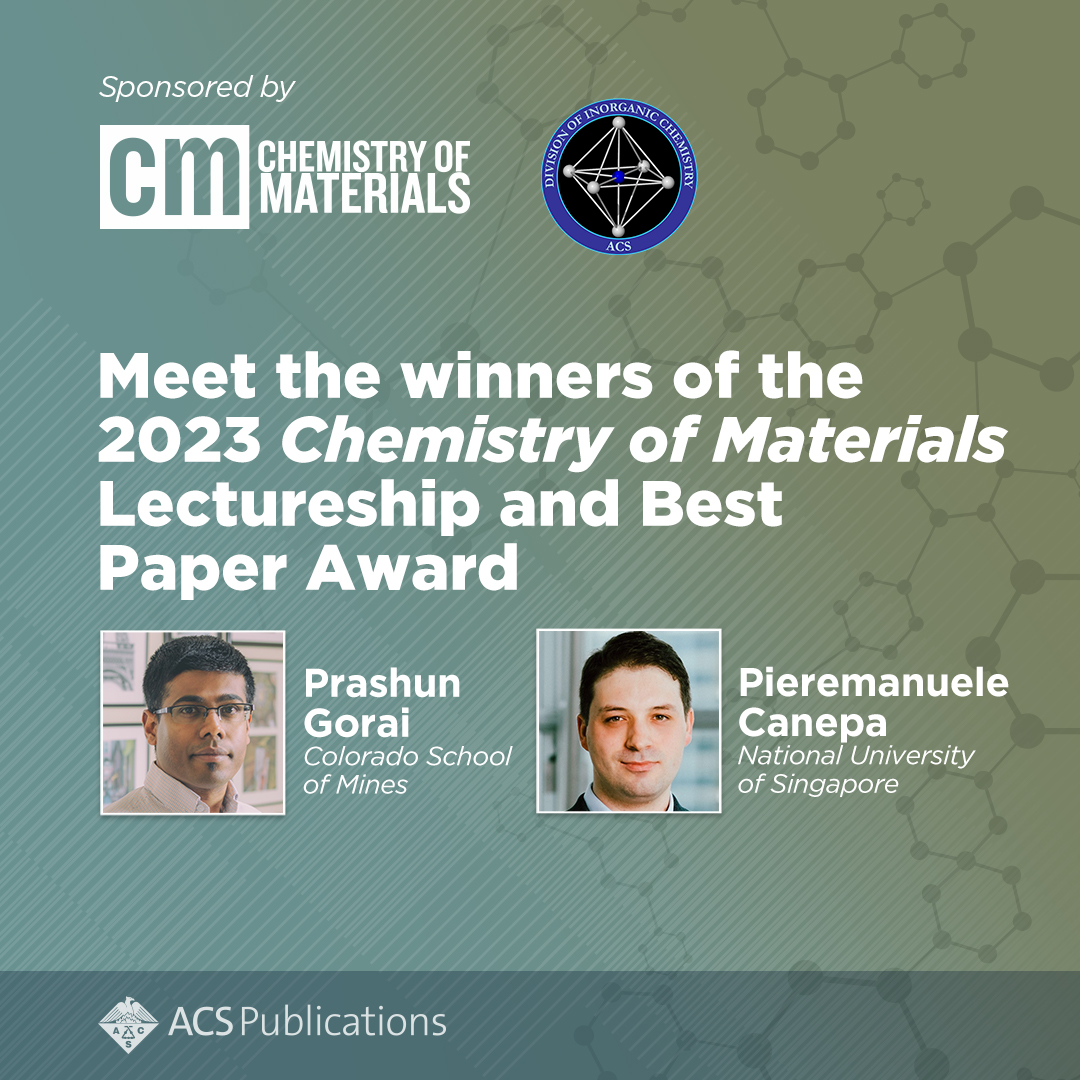
🏆 We're delighted to announce our 2023 winners 🏆 This annual award from @ChemMater honors the authors of a research article that has made notable impact within #materialschemistry and recognizes the team nature of the winning research. 🔗Meet the winners https://t.co/uNOa4CTCF2
A Review by @ChrisWolverton1 and colleagues (@NorthwesternEng) discusses recent developments in ML techniques for assessing the stability of materials and highlights opportunities for further advancing materials discovery. https://t.co/h5RmqxNmP8
👉https://t.co/TJO2Mn3Gld
Professor @ChrisWolverton1 and his colleagues demonstrated the potential effectiveness of a cobalt-free battery cathode, and the work could have implications with EVs and products such as smart phones and laptop computers. https://t.co/9Uft9rCcR8
Presenting our collaborative work within the Wolverton group @ChrisWolverton1 , I'm pleased to share our recent findings on #LK_99: https://t.co/EgSB7bCPoO
Here’s a summary🧵:
Congratulations to Mercouri Kanatzidis! The International Mineralogical Society has named a recently discovered chalcogenide mineral, Kanatzidisite to honor @MercouriK’s pioneering work in the field of chalcogenide chemistry! #ScientificLegacy
https://t.co/sfnyLZdWOR
A system developed by Professor @ChrisWolverton1 and colleagues allows scientists to search very efficiently for new materials that have low thermal conductivity, which could potentially change the balance of how much energy is used and how much is wasted. https://t.co/G3EHti7zVu
Unlocking the secrets of minimum lattice thermal conductivity! A groundbreaking model unifies heat transport in 1000s of compounds, revealing a universal lower bound. Advanced machine learning predicts κ-min accurately, useful for material design. https://t.co/P7xLxKSWuV
Excited to share our recent publication in @acsnano! We used SPBCL to create a library of multicomponent hollow nanoparticles and investigated the synthetic fundamentals. Great thanks to @CHADNANO@ChrisWolverton1 and @MirkinGroupNU! https://t.co/32pC6UNmx9