We've been evaluating an AI model to assist our team w/planning. Here's its summary of our 2025: "You built visions from soil and from steel, Turning trust into frameworks that feel. Through cottages planned, And blueprints well‑manned— You proved foresight can architect real."
🚨 Sec. Marco Rubio just NAILED IT:
"One of the criticisms you sometimes hear of communism is that it 'sounds good in theory, but it never works in practice.'"
"That's actually NOT TRUE. Communism does NOT sound good in theory. The world that envisions for all of us is small, flat, gray, leveled of all exception, drained of all that is good and noble in the human soul."
"The world that envisions is a world without courage, a world without creativity, or ambition, a world without heroes, or glory, or great causes to strive towards, without a world without miracles, without men who rise above the rest to do incredible and extraordinary things."
"And the world communism envisions is a world without God."
"For these architects of revolutionary violence, the towering achievement of our civilization, for them, it's an unbearable humiliation, a reminder of what they cannot do and a reminder of what they cannot be. So they choose instead to destroy." 💯
Yesterday, using multiple one-way attack surface drones, CENTCOM forces successfully struck a submarine and ship maintenance facility in Iran. Three Corsair unmanned surface vessels hit the port at Bandar Abbas Naval Base, marking the first time American forces have employed sea drones in combat operations. Last night’s strikes degraded Iran’s ability to continue attacking commercial shipping.
@dom_lucre that coach reminds me of my 1982-1985 @lschs high school assistant wrestling coach, Pat Henderson: looked, acted and sounded exactly the same. An awesome man who, along with head coach Dave Siegel, had a profound impact on my character development. https://t.co/Y9iut6fBQX
The more you learn about George Washington's life the more it becomes abundantly clear that divine intervention played a role in the formation of the American Nation.
🚨 WOW! President Trump dropped this gem from Marco Rubio CALLING the rise of communism years ago
MARCO NAILS IT: "At the core of democratic socialism is Marxism, and at the core of Marxism is this fake offer that if you turn over more of your individual freedom, we're going to provide you security. We're going to provide you free healthcare. We're going to provide you free education."
"But the problem is that when they can't deliver on it or when you're not happy with it, you don't get your freedoms back. And by freedoms, I don't just mean elections."
"I'm talking about the right to choose your own doctor, the right to make healthcare decisions for yourself, what your kids learn in school, what schools they go to, all that stuff you lose control over."
"And you don't get it back just because the security they promised you didn't happen."
"So that's what we're on the verge of having to decide here in this country. It's a reason why people flee countries that have this stuff!"
"It's a big deal for America, and I hope people start waking up to that reality." 🇺🇸
Rubio knew.
$100 million+ deals took 87.5% of the $412 billion deployed in H1 26. 86% of venture dollars were AI-related w/3 firms—Andreessen Horowitz, Thrive Capital, and Founders Fund—raising 48.1% of all capital. Yet, lack of distributions to LPs is a problem. https://t.co/5UzXj4Tr0g
more evidence from the other side of the country that "rent control" and other top-down controls on housing supply hurt both landlords and renters: just the possibility of rent control drove down investment and development in Massachussetts. https://t.co/XHB6hSJhDJ
even w/proof, socialists in CA government won't recognize the damage they're doing. ULA transfer tax leads to fewer transactions which leads to less property tax collected and fewer new home starts; that won't fix "affordability;" only more supply will. https://t.co/cFTKtjKMf4
Liberty is not self-sustaining; it requires constant vigilance against evolving threats. Core freedoms—especially religious liberty, free speech, and the right to life—remain central battlegrounds in preserving America’s founding ideals. Prayer is vital.
https://t.co/dxL9tYCemO
3 years; 138 condos purchased one at a time. Considering the amount of effort it took to accomplish this; must have included some amazing team work. https://t.co/qWcgLKgT45
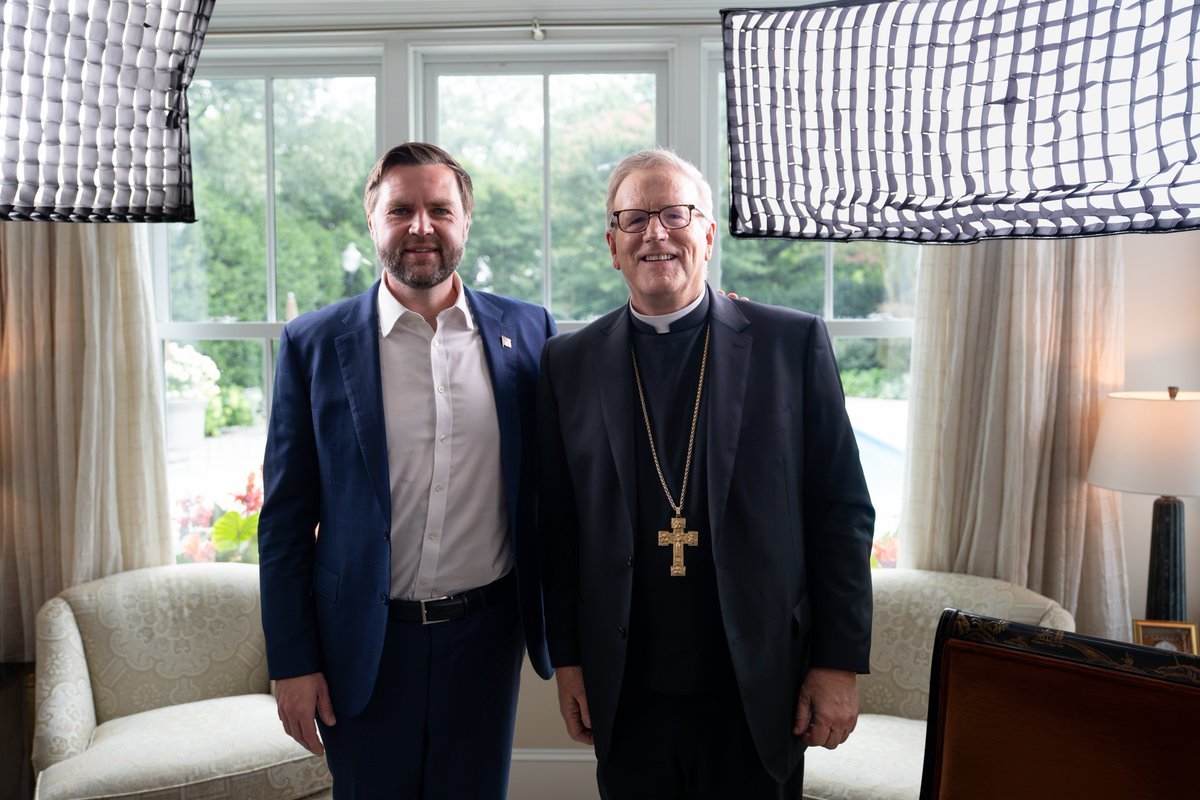
Friends, I recently traveled to Washington, DC, to sit down with Vice President @JDVance for a special edition of Bishop Barron Presents. We spoke about his new spiritual autobiography, “Communion”; the Augustinian arc of his life; America's grounding in spiritual values; and his own prayer life as a Catholic. Our rich and wide-ranging conversation will be released soon on my channels, so be sure to tune in.
In September of 1814, America was once again in trouble.
The young republic was only thirty-eight years old. The War of 1812 had gone badly. British troops had marched into Washington, burned the Capitol, set the White House ablaze, and now turned their sights toward Baltimore. If Fort McHenry fell, the harbor would be open, the city would likely follow, and another devastating blow would be dealt to the fragile nation.
Amid this uncertainty, a young American lawyer named Francis Scott Key sailed under a flag of truce to the British fleet. He had come to negotiate the release of a friend, a physician the British had captured.
He succeeded.
The British agreed to free the doctor.
But there was a catch.
Because Key and his companions had seen too much of the British fleet and learned too much about its plans, they were not allowed to return to shore. Instead, they were detained aboard a ship in the harbor and forced to watch the coming battle from behind enemy lines.
On the morning of September 13, the bombardment began.
For the next twenty-five hours, British warships unleashed somewhere between 1,500 and 1,800 bombs and rockets upon Fort McHenry. These were the “bombs bursting in air” and the “rockets’ red glare” of the song—not poetic embellishments, but terrible realities.
Key stood on the deck through the endless day and the long, terrifying night. Every explosion lit the darkness for a fleeting instant before the smoke swallowed everything again. Somewhere beyond that wall of fire stood the fort. Somewhere beyond it flew an American flag if it still flew at all.
He could not see.
He could only listen.
As long as the guns continued firing, there was reason to hope. The British would not waste ammunition on a fort that had already surrendered.
Then, just before dawn…
The guns fell silent.
For the first time all night, there was only stillness.
It was the most frightening sound of all.
Had the fort finally fallen? Had the defenders surrendered? Had the flag been torn down in the darkness while no one could see?
There was nothing to do but wait.
As the first light of September 14 slowly pushed back the smoke, Francis Scott Key strained his eyes toward the distant fort.
Then he saw it. Not a British flag.
The American flag. Still there. Still flying.
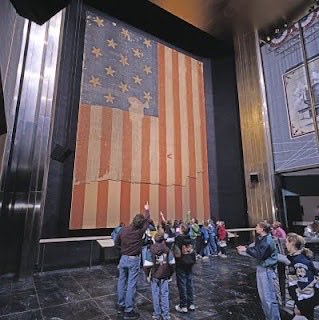
That flag was no ordinary banner. Months earlier, the fort’s commander had commissioned a Baltimore flagmaker, Mary Pickersgill, to sew a flag so enormous “that the British would have no difficulty seeing it from a distance.” It measured roughly thirty by forty-two feet, carried fifteen stars and fifteen stripes, and was so large it had to be assembled on the floor of a brewery because no ordinary room could contain it.
That was the Star-Spangled Banner.
The very flag Key saw through the morning mist.
The very flag that still survives today in the Smithsonian.
Overcome by what he had witnessed, Key reached into his pocket, pulled out an envelope, and began writing. The words came from a heart that had spent an entire night fearing his country might disappear with the dawn.
He first titled the poem Defence of Fort M’Henry.
Within days it was printed and circulating throughout the country. Before long, people began singing it to a melody they already knew—an old British tune called “To Anacreon in Heaven,” originally written for a London social club. There is something beautifully ironic in that: America’s most beloved patriotic song borrowed the melody of the very nation it had just survived. It also explains why the anthem is so notoriously difficult to sing. It was never written for ordinary voices gathered in stadiums or school assemblies.
The song spread quickly and became one of America’s favorite patriotic hymns, but it would wait more than a century before receiving official recognition. Not until 1931 did Congress declare “The Star-Spangled Banner” the national anthem of the United States.
"I am hunted like a fox by the enemy." A signer of the Declaration of Independence actually wrote those words. He moved his family five times in three months to keep them alive. Meet Thomas McKean.
McKean is one of the most important Founders you were never taught about, partly because he was too busy actually fighting to sit still for the famous painting.
Here's the setup. In July 1776, the vote for independence came down to the wire, and Delaware's delegation was deadlocked. McKean was one of its delegates, and he's the man who sent an urgent rider through a thunderstorm to fetch the third Delaware delegate, Caesar Rodney, for that legendary all-night ride that broke the tie and swung Delaware to independence. McKean helped make the yes vote happen.
Then, instead of hanging around Philadelphia to sign the pretty copy, he grabbed a musket. He took command of a militia battalion and marched off to actually fight the war he'd just voted for. Which is why, when almost everyone else signed the engrossed Declaration on August 2, 1776, McKean wasn't there. His signature got added later. In fact there's real evidence his name wasn't put on the document until years afterward, which can make him the last man to sign the Declaration of Independence.
And while he was out there, the British wanted his head. He was a marked man, a signer and a rebel officer, and they hunted him relentlessly. In 1777 he wrote to his friend John Adams the line that says it all: "I am hunted like a fox by the enemy." He described being forced to move his family five times in just three months, at one point stashing them in a little log house on the banks of the Susquehanna, only for them to have to run again.
Think about that. Not a general on a horse in a portrait. A husband and father dragging his family from hideout to hideout, staying one step ahead of soldiers who wanted to hang him.
He survived all of it. And then he just kept going. McKean served as President of Congress in 1781, meaning he was effectively leading the nation when the news arrived that Cornwallis had surrendered at Yorktown and the war was won. He later spent years as chief justice and then governor of Pennsylvania, and lived all the way to 1817, dying at 83.
A man who voted for freedom, fought for it with a gun, got chased across the countryside like an animal for it, and lived long enough to see the whole thing hold together.
Thomas McKean. Hunted like a fox, and never caught.
What an appalling speech the Mayor of New York delivered for the 250th anniversary of the nation.
Sadly, it reflects the view of America propagated for years by Howard Zinn and his like-minded colleagues in the universities and believed by armies of the young: a dark, oppressive country where common people are denigrated by tyrants and oligarchs, where immigrants are treated with contempt, where those with “soft hands” hold the wealth created by those with dirty hands.
No sensible person would claim that our country is without flaws, but the relentlessly negative picture painted by Mayor Mamdani is just absurd.
And it is the fruit of the Marxism that, sadly, is all the rage today.
“The time is now near at hand which must probably determine whether Americans are to be freemen or slaves…the fate of unborn millions will now depend, under God, on…this army.” George Washington to his troops on July 2, 1776
Take pride in your forefathers and your Heritage.
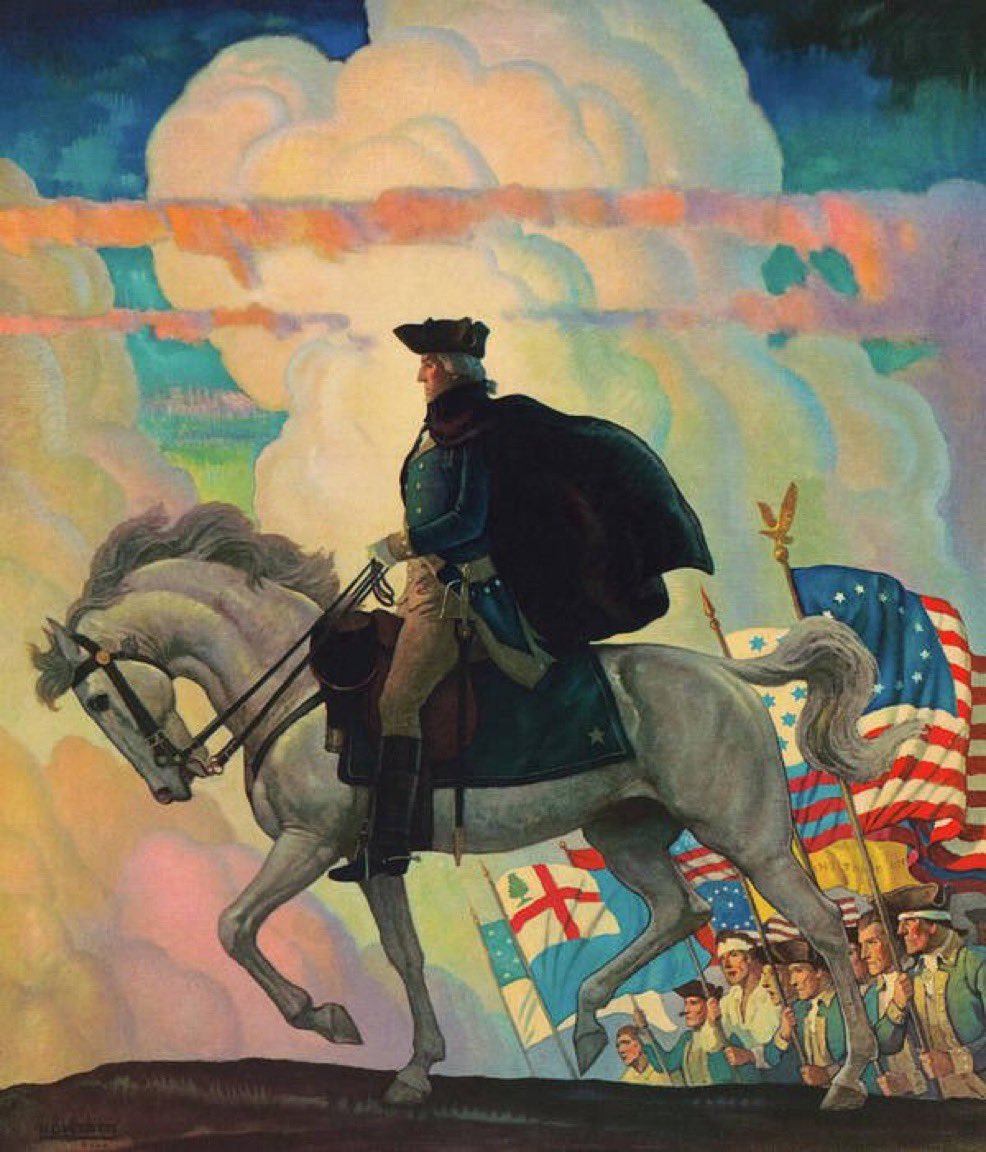
‘George Washington’ —Newell Convers Wyeth
If you ever feel like complaining about the heat just remember that the Continental Army under George Washington marched 75 miles in full wool uniforms over ten days in 100 degree weather before fighting the Battle of Monmouth.
American, remember who you are descended from.
On this day in 1776, the United States was actually born. Not July 4. July 2. That's the day the Continental Congress voted to break from Britain, and John Adams was so certain of it that he predicted July 2 would be the great American holiday forever. He nailed everything except the date.
The vote came down to the wire, and one man had to ride through the night to save it. Delaware's delegation was split, one for independence, one against, which meant the colony's vote canceled itself out. The tie-breaker, Caesar Rodney, was 80 miles away in Delaware. He got word that he was needed and rode all night through a summer thunderstorm, sick and in pain, boots and spurs still on, and made it into Philadelphia just in time to cast Delaware's vote for independence.
The other holdouts fell into place too. In Pennsylvania, the men most opposed, including John Dickinson, deliberately stayed away from the chamber so their colony could swing to yes. South Carolina came around for the sake of a united front. When the roll was called, twelve colonies voted for independence and not a single one voted against. New York simply abstained, waiting on permission from home.
And so, on July 2, 1776, it was done. The colonies had legally, officially declared themselves free. The next day Adams wrote to his wife Abigail that this day "will be celebrated by succeeding generations as the great anniversary festival," with "pomp and parade, with shows, games, sports, guns, bells, bonfires, and illuminations." Fireworks and all. He was describing the Fourth of July two days early.
So why do we celebrate the 4th? Because that's the day Congress approved the final wording of the document explaining the decision, the Declaration of Independence. The vote to be free happened on the 2nd. The paperwork got finished on the 4th, and history remembered the paperwork.
The country was actually born in a rainstorm and a roll call on July 2, thanks in part to one sick man who refused to let a tie decide the fate of a nation.