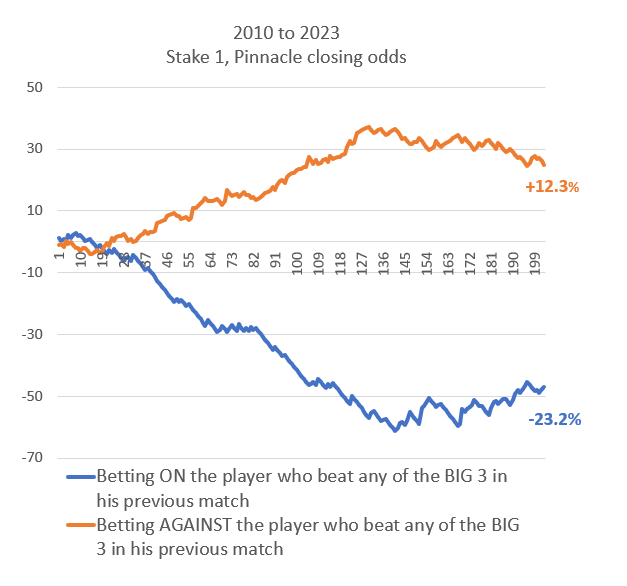
✅ Betting against a player who has defeated any of the BIG 3 in his previous match has been highly profitable.
You can read below all the details of the analysis. 👇
🛠 For years, I had the intuition that betting against players who had just defeated Djokovic, Nadal, or Federer was a profitable strategy. Why?
• The physical and also psychological toll of beating the three greatest players in history took a toll on the following match. But not only that, I also believed that the market was not efficient in adjusting the odds for the winner in their next match.
• So, I got to work only some days ago and researched it. Some clarifications:
1) I have Pinnacle odds data since 2010, so the study dates back to that year. In the future, I will expand it to 2004 or 2005 (Federer won his 1st GS in 2003) by using odds from other bookmakers or some sort of average prices.
2) I have excluded Andy Murray from these matches. The reason is that, although he is not part of the BIG 3, he would be of the BIG 4. He has been an incredible player of a superior caliber. The objective of the analysis is to see what happens to players overall when they beat the BIG 3, but I believe including him in the study would have distorted it.
3) Finals are not included. That means if player X defeats any member of the BIG 3 in a final, their next match is not included. This is because the next match would be in a different tournament and could have been played several days or even weeks later. And this is not what we want to measure.
4) Obviously, the head-to-head matches between the 3 members of the BIG 3 are not included.
• As you can see in the results, the lines are completely divergent until a little over halfway through the graph. Betting against the player who defeated the BIG 3 was incredibly profitable, while betting in their favor was a significant loss of money.
• From there, things start to stabilize, and in fact, the trend changes. The main reason for this is the emergence of players like Medvedev or Zverev, who have often defeated the BIG 3 players and had already reached a level and experience sufficient not to be affected in their next match by beating them. We could have excluded these players from the study, but I've preferred to keep them.
• You may think that the sample size is too small to draw significant conclusions, and you may have a point. 203 bets are not a lot. However, the difference between both yields is high enough that even with 203 bets, the results are significant.
• On the other hand, when it comes to evaluating data from a statistical perspective, I have always liked to complement it and provide a subjective assessment. And I believe it makes a lot of sense to think that players who have beaten those from the BIG 3 have gone through physical fatigue and also a psychological high that, on average, may have significantly affected them in their next match.
• Within the BIG 3, the most significant case is that of Rafa Nadal. Out of the matches that meet the criteria I have mentioned above, Nadal appears in a total of 79. Well, of these 79 matches played by the players who defeated Nadal, they only won 25 of their next matches and lost 54!! Unbelievable, isn't it? This translates to a Yield of +19.6% if you had bet against them in their next match and -38.0% if you had bet on them. I always got this feeling with those who defeated Nadal. Didn't you?
• So, looking ahead, be cautious if you bet in favor of players who have just defeated Djokovic, Nadal, Alcaraz, Medvedev, Sinner or the new stars that might arrive. I'm not sure that betting against these players will make you money, but betting in favor of them will most likely lead to losses.
❤ If you like this type of analysis and want me to do more, give it a LIKE!
Never bring your ego down to your low level of competence.
Increase your level of competence to match your ego.
You gotta get that ego hurt as much as possible for it to be real.
You have to challenge your own self-image and let it prove its worth.
Take the L as a reason to get better and live up to your own expectations.
Don't take it as a threat to your self-image.
A strong ego looks forward to adversity.
A weak ego shies away from it.
You have to see your failures as extra motivation to increase your competence to match your ego.
You don't bring your ego down to match your low level of competence.
This should be common sense.
You should work to live up to your self-image not take it for granted.
Our self-image is what helps us keep going.
If you accept your low level of competence, you will put yourself in a box of limiting beliefs that is hard to break out of.
But if instead...
You accept your ego as the real version of you:
Then you accept that you have work to do to live up to the idea you hold of yourself.
The ego is not the enemy.
But refusing to accept that we have work to do to match those expectations make it seem so.
Because most people would either give up or blame their shortcomings on others.
Both are weak egos that avoid taking responsibility.
Having a strong ego does not mean being arrogant.
It means you're aware that you are the only one responsible for yourself.
And that any failure is a sign that there is work to do.
Your ego has to be hurt.
You have to accept that it needs to be challenged and that the only way to get over it is by objectively increasing your competence level.
Again:
Never bring your ego down to your low level of competence.
Increase your level of competence to match your ego.
People are nicer than you think.
But if you're obnoxious and entitled?
Of course, everyone is gonna be an asshole to you.
Not because they are despicable; but because people tend to reciprocate.
If you think everyone is an asshole, find the closest mirror and think again.
Poker players most knowledgable subject by year:
2023 - Artificial Intelligence
2022 - NFTs
2021 - Crypto
2020 - Pandemics
2019 - Poker
2018 - Poker
2017 - Poker
2016 - Poker
2015 - Poker
2014 - Poker
2013 - Poker
2012 - Poker
2011 - Poker Regulation
2010 - Poker
"I'm at the bottom of my range, so I have to bluff"
Are you playing LLinusLove or BERRI SWEET heads up?
No? Then you don't have to bluff.
You should only bluff if you think it's more profitable than checking and losing.
It's really that simple.
It really feels like Millennials were the last people who got a largely apolitical high school experience. I don’t remember anything political, just a bubble of blissful ignorance. “Jackass” and Blink-182 were popular. The main concern was asking out your crush.