IR theorists’ debate on the future of the liberal international order 👇
G. John Ikenberry, The Future of the Liberal World Order, Foreign Affairs, May/June 2011
“The liberal international order is alive and well. The struggle over international order today is not about fundamental principles. Emerging great powers do not want to contest the basic rules and principles of the liberal international order; they wish to gain more authority and leadership within it. Indeed, today's power transition represents not the defeat of the liberal order but its ultimate ascendance. Rising powers have all become more prosperous and capable by operating inside the existing international order -benefiting from its rules, practices, and institutions, including the World Trade Organization (WTO) and the newly organized G-20. Their economic success and growing influence are tied to the liberal internationalist organization of world politics, and they have deep interests in preserving that system.
The liberal international order has no competitors. On the contrary, the rise of non-Western powers and the growth of economic and security interdependence are creating new constituencies for it.
Given the emerging problems of the twenty-first century, there will be growing incentives among all the great powers to embrace an open, rule-based international system. In a world of rising economic and security interdependence, the costs of not following multilateral rules and not forging cooperative ties go up. As the global economic system becomes more interdependent, all states -even large, powerful ones- will find it harder to ensure prosperity on their own.
The old and rising powers may disagree on how exactly the multilateral cooperation should proceed, but they all have reasons to avoid a breakdown in the multilateral order itself. So they will increasingly experiment with new and more extensive forms of liberal internationalism.
The liberal international order has sown the seeds of its own discontent, since, paradoxically, the challenges facing it now -the rise of non-Western states and new transnational threats- are artifacts of its success. But the solutions to these problems -integrating rising powers and tackling problems cooperatively- will lead the order's old guardians and new stakeholders to an agenda of renewal. The coming divide in world politics will not be between the United States (and the West) and the non-Western rising states. Rather, the struggle will be between those who want to renew and expand today's system of multilateral governance arrangements and those who want to move to a less cooperative order built on spheres of influence. These fault lines do not map onto geography, nor do they split the West and the non-West. There are passionate champions of the UN, the WTO, and a rule-based international order in Asia, and there are isolationist, protectionist, and anti-internationalist factions in the West”.
John J. Mearsheimer, Bound to Fail, International Security, Vol. 43, No.4 (Spring 2019)
“The liberal international order was destined to fail from the start, as it contained the seeds of its own destruction.
First, intervening in the politics of countries to turn them into liberal democracies is extremely difficult, and attempting such ambitious social engineering on a global scale is virtually guaranteed to backfire and undermine the legitimacy of the enterprise itself. Nationalism is almost certain to cause significant resistance inside the countries targeted for regime change. Balance of power politics will also help impede the enterprise in particular cases. States that fear regime change will band together for mutual support and seek ways to thwart the policy of regime change.
Second, the liberal international order ultimately creates conditions that lead to serious political problems regarding sovereignty and national identity within the liberal democracies themselves. Again, the principal cause of the problem is nationalism, which is the most powerful political ideology in the world, and thus is at odds with international institutions and the universalistic or transnational perspective of liberalism.
Third, hyperglobalization has produced significant economic costs for large numbers of people inside the liberal democracies. Those costs, including lost jobs, declining or stagnant wages, and marked income inequality, have serious domestic political consequences, which further undermine the liberal international order. Moreover, the open international economy helped fuel the rise of other powers, which eventually undermined unipolarity, an essential condition for creating a liberal international order, because this order can arise only in unipolar systems where the leading state is a liberal democracy. The emerging multipolar world will consist of a realist international order (not liberal) where great powers engage in intense security competition and balance of power politics.”
G. John Ikenberry, The Next Liberal Order, Foreign Affairs, July/August 2020
“The liberal world order is collapsing because its leading patrons have given up on it. Some people in their foreign policy establishment have moved on to the next global era: that of great-power competition. This fractured world, the thinking goes, will offer little space for multilateralism and cooperation. The grand strategy will be defined by what international relations theorists call “the problems of anarchy”: hegemonic struggles, power transitions, competition for security, spheres of influence, and nationalism.
Ironically, it was the success of the liberal world order that sowed the seeds of the current crisis. With the collapse of the Soviet Union, the last clear alternative to liberalism disappeared. As the liberal order grew from being one-half of a bipolar system to a truly global order, it began to fragment, in part because it no longer resembled a club: states cooperate with the liberal system on an opportunistic, ad hoc basis.“
10 de junio | Día de la Afirmación de los Derechos Argentinos sobre las Islas Malvinas, Georgias del Sur y Sándwich del Sur y los espacios marítimos circundantes.
Hace 197 años, el 10 de junio de 1829, se creó la Comandancia política y militar encabezada por Luis Vernet, acto que constituyó un ejercicio efectivo de soberanía.
La República Argentina ratifica sus legítimos e imprescriptibles derechos de soberanía sobre las Islas Malvinas, Georgias del Sur y Sándwich del Sur y los espacios marítimos circundantes.
👉 https://t.co/5pyfr6R2Dy
🇦🇷🇫🇷 Argentina y Francia: inversiones, negocios y nuevas oportunidades regionales
El Consulado General y Centro de Promoción de la República Argentina en San Pablo organizó, conjuntamente con la Cámara de Comercio Francia-Brasil (CCIFB) y el Servicio Económico Regional de la Embajada de Francia en Argentina, un encuentro dedicado a analizar el nuevo escenario económico argentino y las oportunidades de inversión y expansión regional para empresas francesas con presencia en América Latina.
🤝 La actividad reunió a altos ejecutivos, representantes institucionales y referentes empresariales franceses y brasileños vinculados a sectores estratégicos como retail, tecnología, seguros, energía, industria y servicios.
Entre los participantes se destacaron representantes de Carrefour, Dassault Systèmes, CNP Assurances, Coface y Business France.
🌎 Durante su presentación, el Cónsul General Emb. Luis María Kreckler abordó el nuevo contexto macroeconómico argentino, las reformas orientadas a promover inversiones de largo plazo y el potencial de la Argentina como plataforma regional complementaria para empresas francesas con operaciones en Brasil y el Mercosur.
⚡ Asimismo, se destacaron oportunidades vinculadas a energía, minería, petróleo y gas, infraestructura, economía del conocimiento y transición energética, junto con instrumentos como el RIGI y el nuevo escenario generado por el acuerdo Mercosur–Unión Europea.
🇫🇷 Actualmente, cerca de 250 empresas francesas operan en la Argentina, empleando aproximadamente a 50 mil personas y consolidando a Francia como uno de los principales inversores extranjeros en sectores estratégicos de la economía argentina.
🚀 El encuentro permitió fortalecer el diálogo con actores empresariales franceses radicados en Brasil y continuar promoviendo oportunidades de inversión, integración productiva y cooperación económica entre Argentina, Brasil y Francia.
#Argentina #Francia #Brasil #Inversiones #Negocios #Mercosur #Industria #Energía #Innovación
Argentina em transformação amplia oportunidades para empresas francesas e reforça integração regional | Câmara de Comércio França-Brasil https://t.co/EVgV737L8V
🏥 INVAP explora oportunidades en el sector salud brasileño 🇦🇷🇧🇷
El Consulado General y Centro de Promoción de la República Argentina en San Pablo recibió a representantes de INVAP, en el marco de Hospitalar 2026, con el objetivo de explorar oportunidades de cooperación y desarrollo de negocios en el mercado brasileño de salud.
🇦🇷 INVAP es una de las principales empresas tecnológicas argentinas, referente internacional en proyectos de alta complejidad y desarrollos llave en mano en áreas como tecnología nuclear, espacial, defensa y sistemas médicos.
🏥 En el área de salud, la compañía desarrolla proyectos hospitalarios integrales, centros de radioterapia y medicina nuclear y nuevas soluciones tecnológicas aplicadas al sector médico. Entre sus desarrollos se destacan el Centro Argentino de Protonterapia —el primero de su tipo en el hemisferio sur— y centros de radioterapia y medicina nuclear en Argentina y Bolivia.
🤝 Desde el Consulado acompañamos a INVAP en la generación de vínculos y oportunidades con actores estratégicos del ecosistema sanitario brasileño, promoviendo la inserción de capacidades tecnológicas argentinas en uno de los principales mercados de salud de América Latina
🏥 Argentina fortalece vínculos con el ecosistema hospitalario brasileño en Hospitalar 2026 🇦🇷🇧🇷
En el marco de Hospitalar 2026, el Consulado General y Centro de Promoción de la República Argentina en San Pablo realizó un evento de networking junto a empresas argentinas participantes de la principal feria y plataforma de negocios del sector salud de América Latina.
🌎 Hospitalar reúne hospitales, industrias médicas, laboratorios, empresas de tecnología y healthtechs de todo el mundo, consolidándose como uno de los espacios más relevantes de generación de negocios y actualización técnica del ecosistema sanitario regional. La edición 2026 cuenta con más de 1.200 marcas expositoras, visitantes provenientes de 55 países y +85 mil profesionales del sector salud.
🇦🇷 La participación argentina reunió a +10 empresas especializadas en dispositivos médicos, insumos hospitalarios, infraestructura sanitaria, ortopedia, anestesia y tecnología aplicada a salud, acompañadas por PromArgentina.
🤝 El encuentro contó con la participación de referentes institucionales y empresariales de Brasil, incluyendo representantes de ABRAMED —entidad que reúne a las principales empresas brasileñas de medicina diagnóstica— y ANAHP, asociación que nuclea a algunos de los hospitales privados más importantes de Brasil.
🏥 Participaron además actores estratégicos del ecosistema sanitario brasileño como Hospital Sírio-Libanês, Siemens Healthineers y empresas vinculadas a diagnóstico, regulación sanitaria, logística hospitalaria y tecnología médica.
🚀 La participación argentina en Hospitalar 2026 permitió fortalecer vínculos con actores clave del mercado brasileño y generar nuevas oportunidades de cooperación e internacionalización para las empresas nacionales del sector salud.
#Hospitalar2026 #Salud #HealthTech #Argentina #Brasil #TecnologíaMédica #IndustriaSalud
El Instituto del Servicio Exterior de la Nación (ISEN) fue creado el 10 de abril de 1963 por iniciativa del entonces Min. de Relaciones Exteriores y Culto, Embajador Carlos Muñiz. Es el organismo único de selección, formación e incorporación del personal para el Cuerpo
(Sigue)
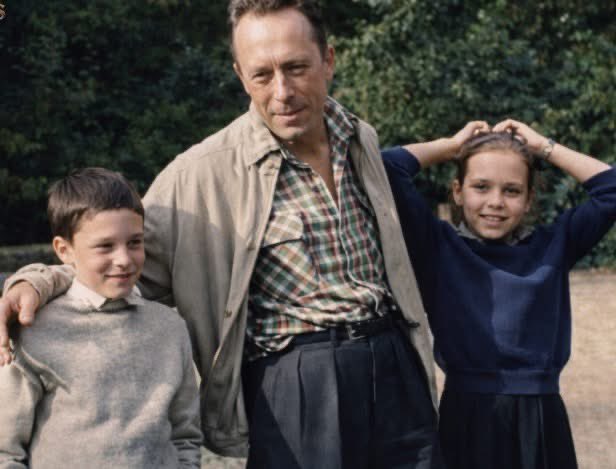
Il a écrit que la vie n’a pas de sens — puis il a remporté le prix Nobel et est mort trois ans plus tard avec un billet de train inutilisé dans sa poche.
Le 4 janvier 1960. Albert Camus rentrait à Paris après les fêtes, assis dans la voiture de sport Facel Vega de son éditeur. Dans sa mallette se trouvait un billet de train inutilisé : il avait prévu de prendre le train, mais avait accepté un trajet en voiture à la dernière minute. La voiture percuta un arbre à grande vitesse. Camus mourut sur le coup. Il avait 46 ans.
Ce billet inutilisé devint un symbole de l’absurdité qu’il avait passée sa vie à explorer : l’indifférence de l’univers face à nos projets, nos intentions, et même notre existence. Mais avant ce moment final, Camus avait vécu selon ce qu’il prêchait — créer du sens dans un monde qui n’en offre pas.
Né en 1913 en Algérie, Camus grandit dans la pauvreté. Son père mourut pendant la Première Guerre mondiale, et sa mère, partiellement sourde et analphabète, faisait des ménages pour survivre. Ils vivaient dans un petit appartement de deux pièces avec sa mère, sa grand-mère et ses oncles. Il n’avait presque rien, sauf un esprit curieux. Un instituteur remarqua son intelligence et lui obtint une bourse qui lui permit d’étudier la philosophie à l’Université d’Alger. Là, il découvrit Nietzsche et Dostoïevski, joua gardien de but au football et souffrit de la tuberculose, maladie qui le poursuivra toute sa vie.
De la pauvreté, de la maladie et des pertes précoces, Camus forgea sa philosophie de l’absurde — le choc entre la quête humaine de sens et un univers qui n’en offre aucun. La plupart des gens, confrontés à l’absurde, sombrent soit dans le désespoir, soit dans des illusions réconfortantes. Camus proposait une troisième voie : l’accepter et vivre malgré tout. Vivre pleinement, passionnément, avec révolte — non pas parce que la vie a un sens, mais parce que vous choisissez de lui en donner un.
En 1942, pendant l’occupation nazie de Paris, il publia « L’Étranger », un roman sur un homme condamné non pas pour meurtre, mais pour avoir refusé d’exprimer les émotions attendues par la société. Il rejoignit la Résistance et participa à l’édition du journal clandestin Combat, risquant l’exécution pour lutter contre le fascisme. Après la Libération, il devint l’un des intellectuels majeurs de la France, même si son amitié avec Jean-Paul Sartre se termina par une rupture publique à propos de politique et de morale.
Camus s’opposa à la violence coloniale tout en défendant ceux qu’il aimait. Il déclara un jour :
« Je crois à la justice, mais je défendrai ma mère avant la justice. »
En 1957, à 44 ans, il reçut le prix Nobel de littérature pour avoir éclairé la conscience humaine. Mal à l’aise face à la célébrité et conscient de sa santé fragile, il se tourna vers sa famille et vers les plaisirs simples de la vie — ces moments ordinaires où l’on peut créer du sens au milieu du chaos.
Trois ans plus tard, l’accident de voiture mit fin à tout. Le manuscrit de son roman inachevé, « Le Premier Homme », révéla une grande tendresse et un monde de souvenirs : celui d’un garçon tentant de comprendre sa mère silencieuse. Camus avait compris l’obscurité mieux que la plupart — et pourtant il avait choisi la lumière.
Le billet de train inutilisé dit tout : la vie est imprévisible, la mort arbitraire et nos projets fragiles. Mais la façon dont nous vivons entre la naissance et la mort — cela nous appartient.
Camus a vécu avec intention : en combattant l’injustice, en écrivant la vérité, en aimant ses enfants et en défendant la dignité humaine.
Il est mort soudainement, absurdement, sans raison apparente.
Et pourtant, en vivant délibérément, il avait accompli sa propre philosophie.
Me reuní en Davos con la Presidente del Comité Internacional de la Cruz Roja (@ICRC), Mirjana Spoljaric.
Entre otros temas, conversamos sobre la identificación de los restos de caídos en Malvinas y el papel crucial que tuvo la Cruz Roja en las dos primeras fases del Plan Proyecto Humanitario.
Hoy se cumplen 377 años del nacimiento de sor Juana Inés de la Cruz, autora de estos versos:
«Detente, sombra de mi bien esquivo,
imagen del hechizo que más quiero,
bella ilusión por quien alegre muero,
dulce ficción por quien penosa vivo».
¿Conocen otros?
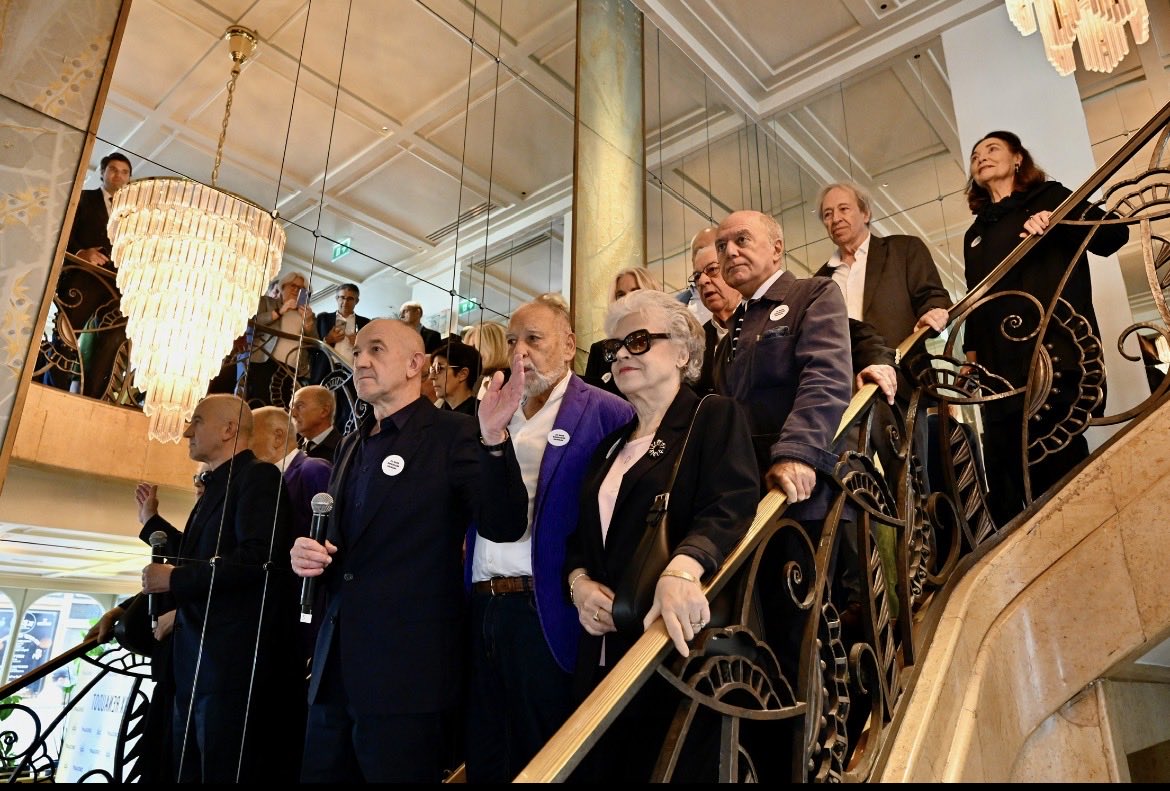
Philippe Claudel et l’ensemble du jury portant un badge « Je suis Boualem Sansal » annoncent le Goncourt 2025 : Laurent Mauvignier au 1er tour pour « La maison vide » par 6 voix contre 4 au « Bel obscur » de Caroline Lamarche @Drouant2 @EdeMinuit 📚
📖🏅 "Ce qui m'a le plus surpris, c'est d'arriver dès le premier tour."
Laurent Mauvignier, écrivain, réagit à son prix Goncourt pour son livre "La maison vide ». #JT20h
"La vraie horreur de l'existence n'est pas la peur de la mort, mais la peur de la vie. C'est la peur de se réveiller chaque jour pour affronter les mêmes luttes, les mêmes déceptions, les mêmes douleurs.
C'est la peur que rien ne change jamais, que vous soyez piégés dans un cycle de souffrances auquel vous ne pouvez pas échapper. Et dans cette peur il y a un désespoir, un désir de quelque chose, n'importe quoi, pour briser la monotonie, pour clamer sens à la répétition sans fin des jours."
Albert Camus, La chute
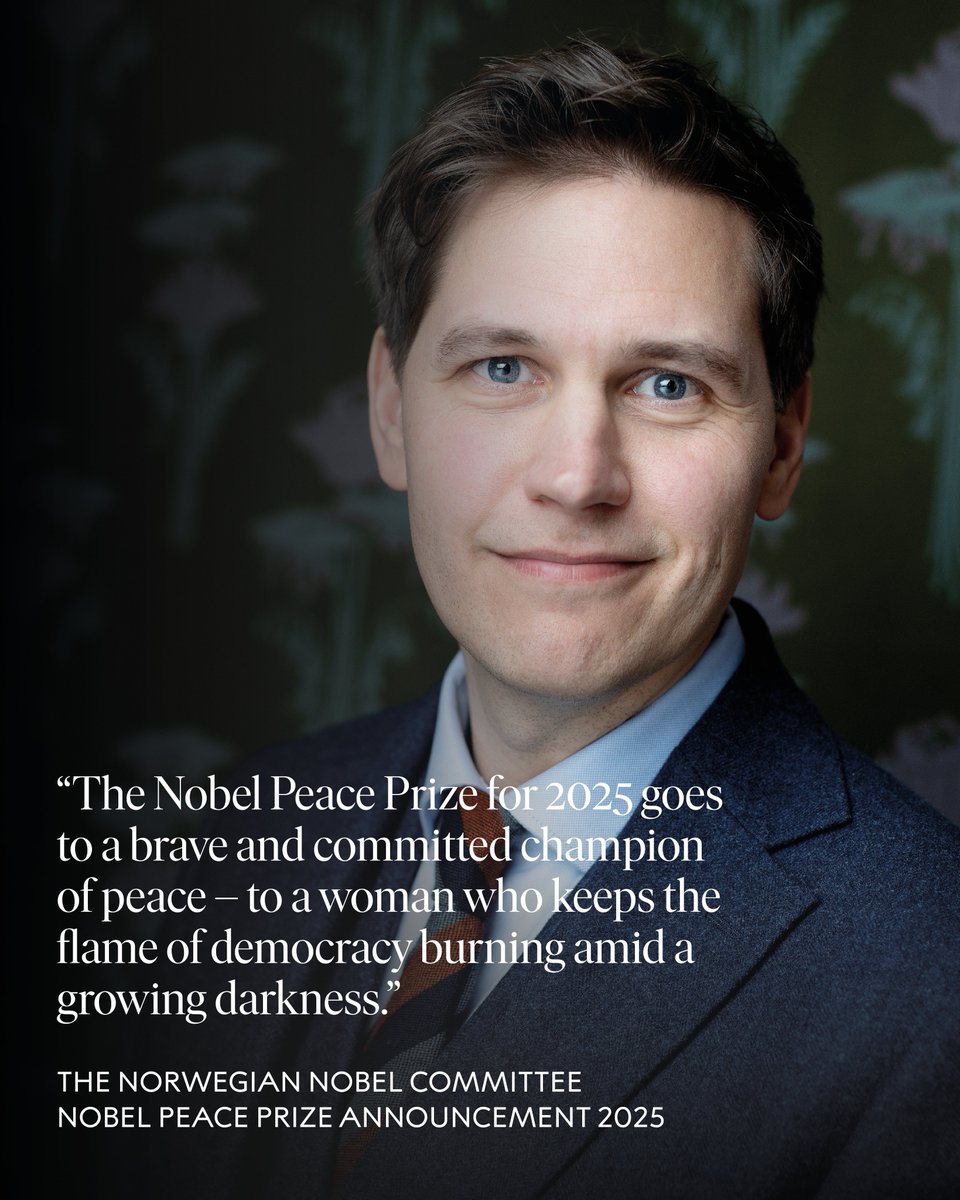
“The Nobel Peace Prize for 2025 goes to a brave and committed champion of peace – to a woman who keeps the flame of democracy burning amid a growing darkness.”
The Norwegian Nobel Committee, Nobel Peace Prize Announcement 2025.
The 2025 #NobelPeacePrize is awarded to Maria Corina Machado. #MariaCorinaMachado @MariaCorinaYA
"Felicitamos a @MariaCorinaYA por haber sido anunciada como ganadora del @NobelPrize. Este reconocimiento refleja las claras aspiraciones del pueblo venezolano de contar con elecciones libres y justas, derechos civiles y políticos" -@UNHumanRights
https://t.co/Tti6b4ae9U