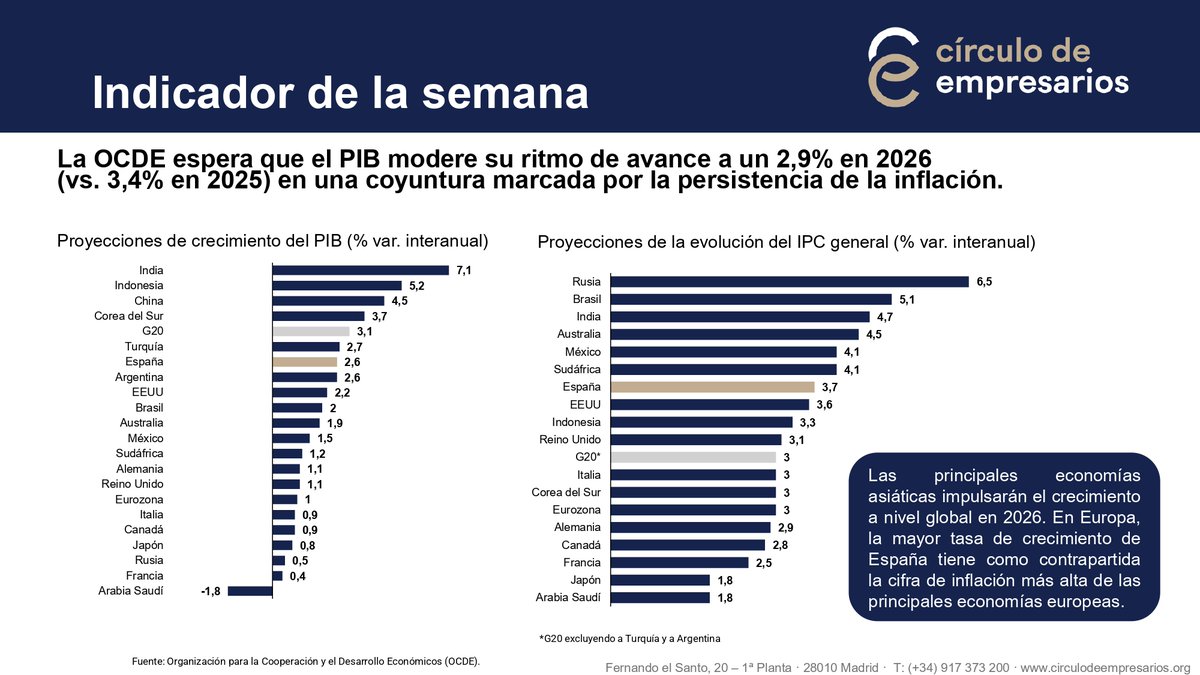
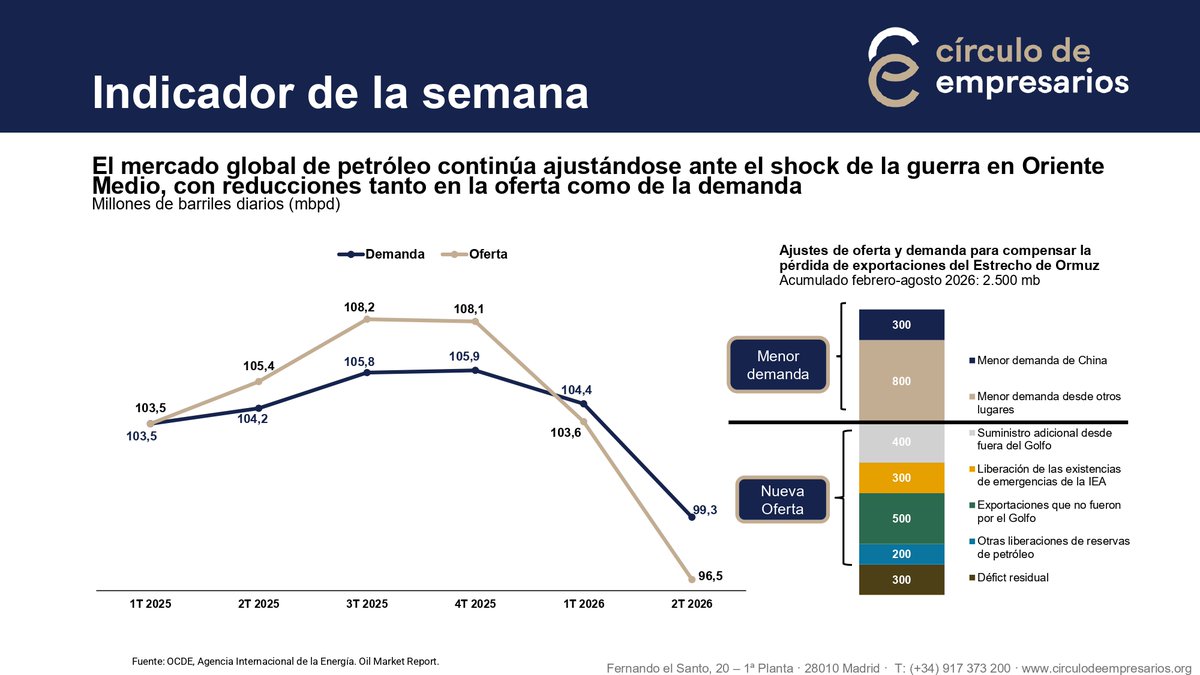
🚀 Indicador de la Semana Círculo de Empresarios - Perspectivas económicas de la @ocdeenespanol.
➡️ La OCDE espera que el PIB modere su ritmo de avance a un 2,9% en 2026 (vs. 3,4% en 2025) en una coyuntura marcada por la persistencia de la inflación.
➡️ El mercado global de petróleo continúa ajustándose ante el shock de la guerra en Oriente Medio, con reducciones tanto en la oferta como de la demanda.
Nuestro presidente, Juan Maria Nin Génova, ha participado hoy en el Forbes Economic Summit 2026, en una conversación junto a @MatildeMas, directora de Proyectos Internacionales del IVIE y catedrática de Análisis Económico de la @UV_EG .
Durante el encuentro, Juan María Nin destacó el impacto del marco regulatorio y administrativo sobre la capacidad de las empresas para crecer y mejorar su productividad, así como la importancia del capital para aumentar la dimensión empresarial.
Además, reclamó mantener adecuadamente las infraestructuras existentes y acelerar las inversiones en ámbitos como la energía, el agua y la educación, y abordó también el impacto del absentismo laboral sobre la productividad.
Nuestro agradecimiento a @Forbes_es por contar una vez más con el Círculo de Empresarios y por impulsar espacios de reflexión y debate sobre los grandes retos de nuestra economía.
📰 Nuestro Chief Economist, @ChristianDChase, analiza en @capital_revista algunos de los principales retos de la economía española y su impacto sobre la actividad empresarial.
“La falta de Presupuestos dificulta la actividad empresarial”.
👉 Lee la entrevista completa: https://t.co/FzwWM6eHOO
Los fondos NGEU llegan a su fin
Hoy escribo en @elmundoes que el Plan de Recuperación concluye con un impacto modesto en la inversión y sin lograr el despegue de la productividad en España.
Con los últimos datos disponibles, España ha adjudicado desde 2021 hasta julio de 2026 contratos y ayudas financiados con transferencias del Plan de Recuperación por 69.035 millones de euros, cerca de cuatro puntos del PIB.
Aunque esta cifra impresiona y no sabemos cuál habría sido el comportamiento de la economía española sin estos fondos, el Plan no ha sido suficiente para observar la mejora neta de los indicadores macroeconómicos que perseguían sus objetivos.
La inversión pública creció sin alcanzar el 4 % del PIB que se fijó como objetivo, sin converger al promedio de la UE y con dudas sobre su adicionalidad. El efecto sobre la inversión privada no ha sido suficiente para garantizar su recuperación y el PIB por persona ocupada se sitúa al nivel de finales de 2019.
https://t.co/fBF72GZIWH cc @BBVAResearch
This paper by @davidautor & co-authors is one of the most important papers to date in the space of what AI does to learning.
It's highly credible. And very much consistent with my own experience with use of agentic AI in research and teaching.
https://t.co/R4PeyhrBER
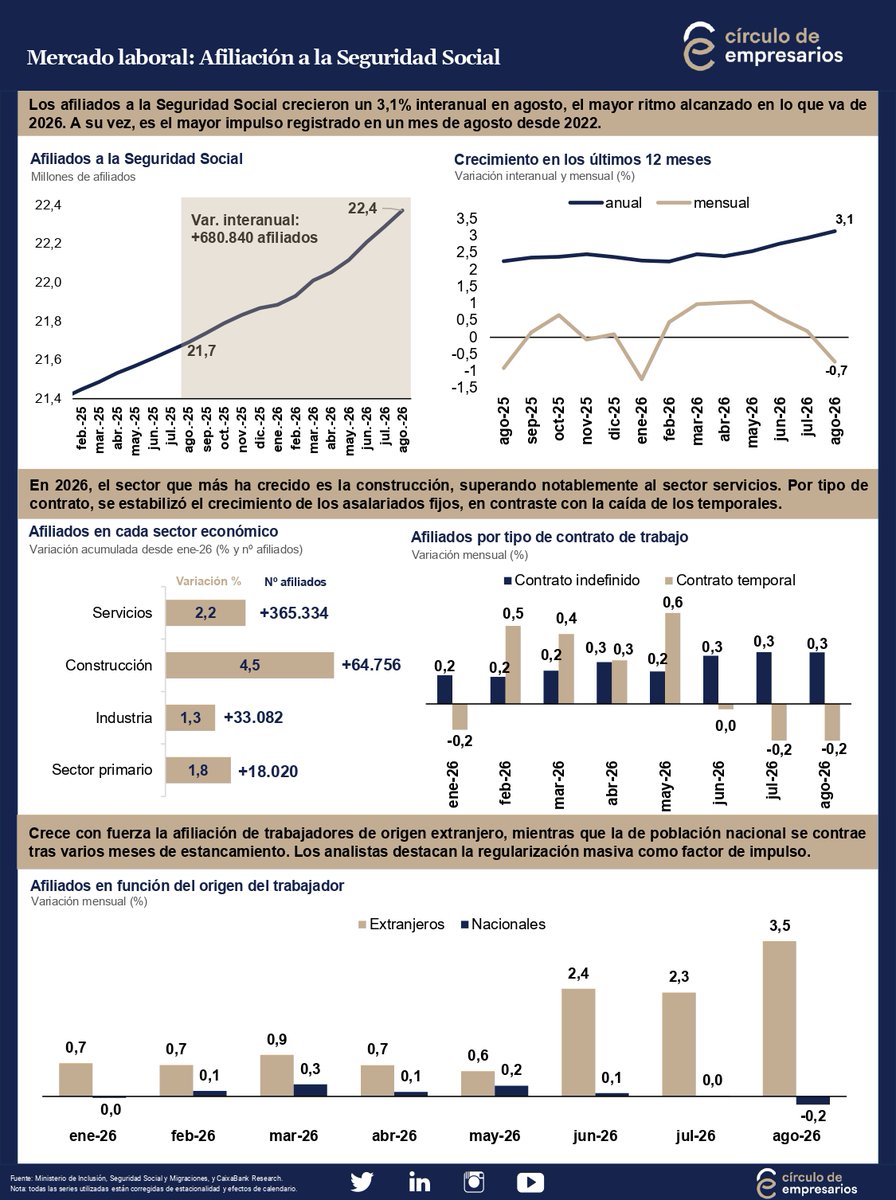
🚀 Infografía | Evolución de la afiliación a la Seguridad Social en España
➡️ Los afiliados a la Seguridad Social crecieron un 3,1% interanual en agosto, el mayor ritmo alcanzado en lo que va de 2026. A su vez, es el mayor impulso registrado en un mes de agosto desde 2022.
➡️ En 2026, el sector que más ha crecido es la construcción, superando notablemente al sector servicios. Por tipo de contrato, se estabilizó el crecimiento de los asalariados fijos, en contraste con la caída de los temporales.
➡️ Crece con fuerza la afiliación de trabajadores de origen extranjero, mientras que la de población nacional se contrae tras varios meses de estancamiento. Los analistas destacan la regularización masiva como factor de impulso.
Consulta y descarga la infografía aquí: https://t.co/3GPA1CmQil
@lucas_gortazar No descartaría tan rápidamente el papel de los móviles. Que no estén en colegio no quiere decir que no estén en casa, donde estudian, ni que no hayan alterado su capacidad de prestar atención (u otras capacidades).
1/ The big news of the week: the official launch of the Rhine Group by Mario Draghi, @patrickc, and @lugaricano. I’m honored to join as one of the few lawyers in this economics heavy group. Thread on why this initiative is different - and why it matters.
Recently I've flipped from being bullish to being bearish about AI.
I think I'm updating my bearishness to be more solidly bearish. Early thoughts (which I hope to be disproven in the next year or so, I would prefer progress) and my reasoning:
The whole 'it turns out if you keep training and scaling the models more they develop broad new capabilities in lots of domains' thesis is wrong (sorry Demis). The recent batch of models haven't got more general, they've got less general. This is most obvious in the fact that their language outputs have got much worse in comparison to e.g. o3. If they were gaining generalist capacities we would expect them to be describing their work in ever more graceful and comprehensive prose!
The image that was being shared as the AGI thesis (November 2025, Tomas Pueyo) was the spiky bubble that has a current spike or two out past human capabilities (e.g. on coding or math) but below human on other capabilities on the other spikes - the future prediction was that as the models scale/advance, every spike would grow bit by bit until the whole center encompasses the human capabilities, with super-superhuman on some spikes. I think it seems like what's actually happened in the last few models has been that the coding/math spike has grown, but leaving behind or even at the cost of the other spikes. The models are no better at some simple logic, language (and sometimes worse!).
This makes sense from a simple RL perspective; you can't RL something endlessly on one domain of tasks and expect it to improve on the other tasks. The fact that early LLMs did seem to improve generally was a byproduct of the written language corpus covering everything - that corpus is general, so training it on that gave the appearance of something generally intelligent and becoming more generally intelligent as it got better at replicating that corpus. But the actual logic and underlying ground truths behind the language aren't captured efficiently enough and weren't effectively RLd in - they top out at some point (I guess this happened around the time that there was the 'has scaling hit a wall' discussion in late 2024). Chain of thought was then a genuine breakthrough, along with web search, which plugged into that general LLM global-corpus intelligence to lead to post 2024 gains.
The AI companies have since worked out that coding works (and pays) really well (basically this is because the entire job is nearly perfectly recorded and exists as training data, and you can set up clear benchmarks and rewards). The recent models (and benchmarks) have been maxxing that and we've seen degradation on normal English use for that reason. This could still be transformative, leading to extremely powerful (and potentially dangerous, particularly in cyber security) models but it's not a pathway to AGI.
I'm probably at about 40% confidence about this. It fits my current observations of AI progress and has a basic explanatory model. It doesn't account for potential breakthroughs, which is a major reason for discounting.
To make some predictions, I guess if I'm right this will become broadly apparent and more widely acknowledged in the next year or two, as we see how the spikiness of models that keep getting released develops.
Maybe there will be efforts to concentrate on specific spikes e.g. health or law which require going back to earlier models and RLing on a different data set/with different rewards/benchmarks. Maybe those separate models can be linked together to give a more apparently general model. How capital intensive that is/the potential profitability will be a defining question. But I just don't see general abilities emerging atm, and I don't think we will any time soon. Good news - a whole industry of tackling important specific problems/sectors can open up!
Does immigration harm labour markets? The data for the euro area from 2014 to 2024 suggest the opposite:
➡️Strong inverse correlation: Countries with the steepest declines in unemployment also experienced the largest increases in net migration rates (like ES, CY, PT, IE) .
➡️Demand-driven integration: Migration flows dynamically responded to economic recoveries, helping ease severe labour supply bottlenecks across Member States.
➡️No crowding-out effect: The concurrent rise in native employment rates suggests that foreign-born workers complemented rather than displaced native jobseekers.
Source: European Commission / Eurostat:
Chapter III. Migration, mobility and the euro area labour market: Recent developments, by A. Kiss, A. Turrini and K. Van Herck @ecfin
https://t.co/KYLHnx8hwM
🌐 Ya está disponible la nueva web del Círculo de Empresarios.
Hemos renovado por completo nuestra página para que sea más intuitiva, dinámica y útil.
En ella podrás acceder de forma más sencilla a nuestras publicaciones, propuestas, encuentros e iniciativas, y conocer mejor la actividad del Círculo de Empresarios.
Te invitamos a descubrirla, navegar por sus contenidos y compartir con nosotros tu opinión.
Entra en la nueva web: https://t.co/IOrzAGiuBT
El Círculo de Empresarios cuenta desde hoy con una nueva identidad visual, presentada con motivo de la celebración de nuestro 50 aniversario. Con esta evolución, queremos reforzar la imagen que proyectamos a la sociedad, manteniendo intactos nuestra esencia, nuestros valores y el legado construido a lo largo de estas cinco décadas.
El resultado es una identidad más actual, clara y reconocible, que refleja mejor lo que hoy es el Círculo de Empresarios: una institución con historia, fiel a sus principios y, al mismo tiempo, preparada para seguir proyectando su voz y su labor en una sociedad en constante transformación.
Confiamos en que esta nueva identidad visual contribuya a reforzar el reconocimiento del Círculo de Empresarios y a acercar aún más nuestra labor a socios, instituciones, empresas, medios de comunicación y sociedad en general.
📢 TOMA DE POSICIÓN: ESPAÑA NECESITA UN NUEVO MANDATO ELECTORAL PARA LAS REFORMAS QUE EXIGE UN MUNDO EN TRANSFORMACIÓN.
Desde el Círculo de Empresarios hemos publicado una Toma de Posición en la que señalamos que España necesita un nuevo mandato electoral y acometer reformas estructurales de fondo.
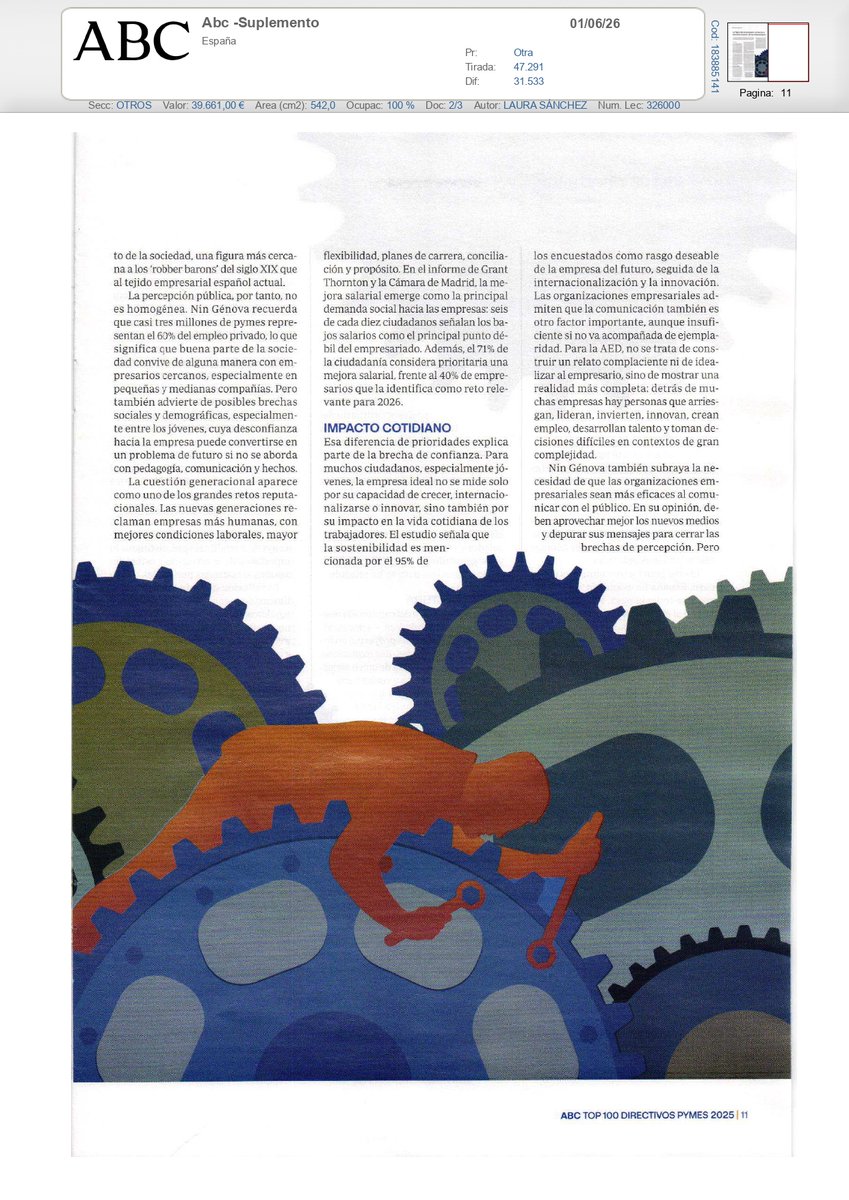
“La figura del empresario comienza a sacudirse el peso de los estereotipos”.
@abc_es publica un reportaje sobre la figura del empresario, en el que participa Juan Maria Nin Genova, presidente del Círculo de Empresarios, señalando que “la función empresarial es esencial para el sistema económico y social” y que “los empresarios asumen riesgos, invierten, innovan, crean empleo y ofrecen bienes y servicios en los mercados”.
Our paper “Difference-in-Differences Designs: A Practitioner’s Guide” is now published in the Journal of Economic Literature. It took us a while but we are happy!
We put together a lot of material to make the paper useful in practice: https://t.co/30TbAgihlz
Hope you like!
🤔 ¿Tienen los directivos del sector público andaluz el mérito y la capacidad necesarios para ocupar los cargos que ostentan… o pesan más las vinculaciones políticas?
En Hay Derecho lo hemos analizado y presentamos el #Dedómetro - edición Andalucía 2026 🔎: 25 años, 6 legislaturas y quiénes han dirigido 40 entidades públicas andaluzas.
The German media are reporting that €10bn of the recovery fund money earmarked for Spain ended up in the country’s pension system. This is how the good idea of a eurobond gets killed. Mistrust is not only present. It is justified. This example also goes to show that a eurobond can only work as a sovereign debt instrument of a unified state. If you really care about a eurobond to fortify a capital markets union and the euro as a global currency, you should talk about political union first. Don’t make this a technical discussion.
https://t.co/xhrTyJS1Hq
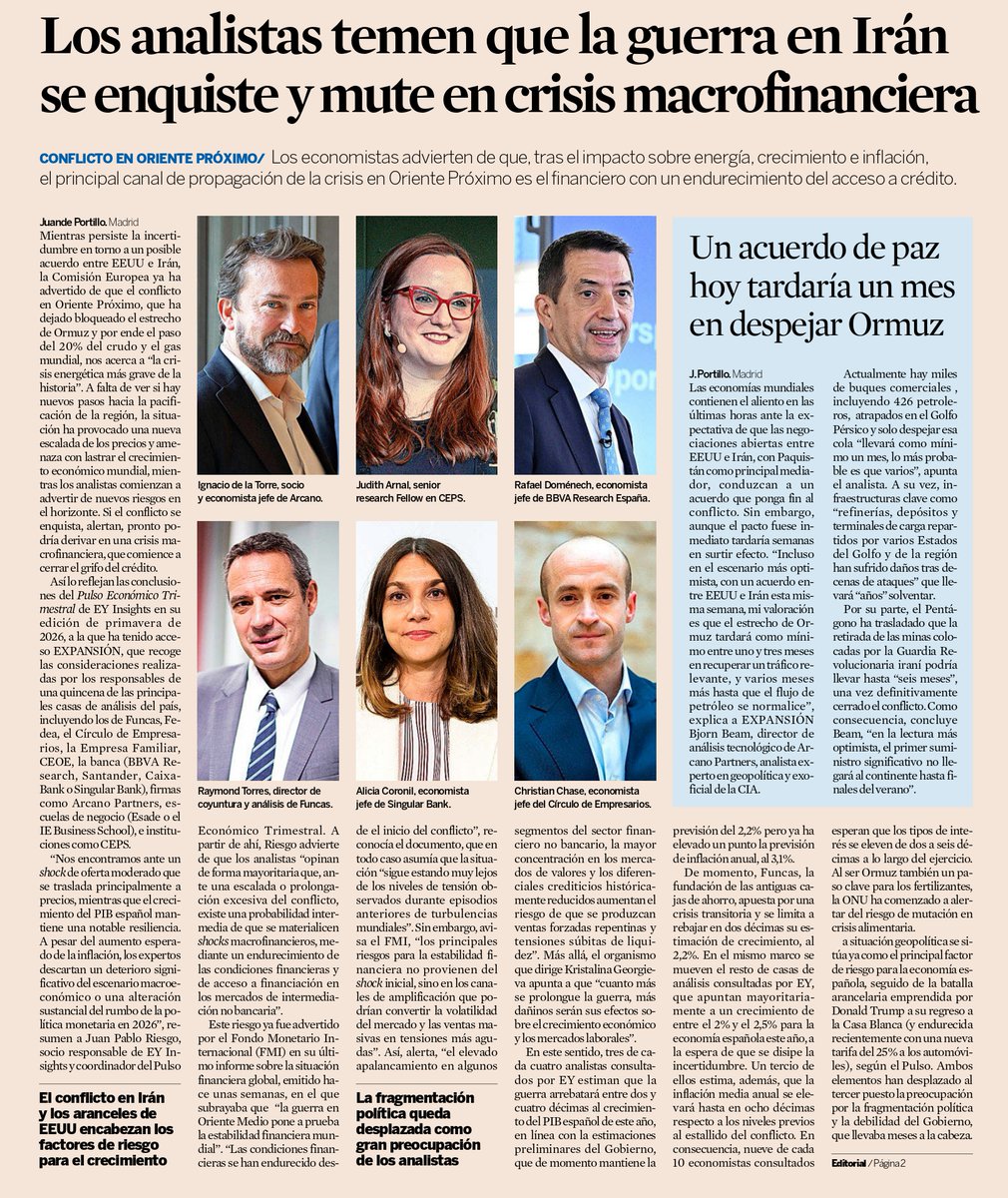
📰 Los analistas temen que la guerra en Irán se enquiste y mute en crisis macrofinanciera.
Desde el Círculo de Empresarios compartimos nuestra participación en este análisis publicado en @expansioncom, en el que interviene nuestro Chief Economist, @ChristianDChase.
Los economistas advierten de que, tras el impacto inicial sobre la energía, el crecimiento y la inflación, el principal canal de propagación de la crisis en Oriente Próximo podría ser el financiero, a través de un endurecimiento del acceso al crédito.