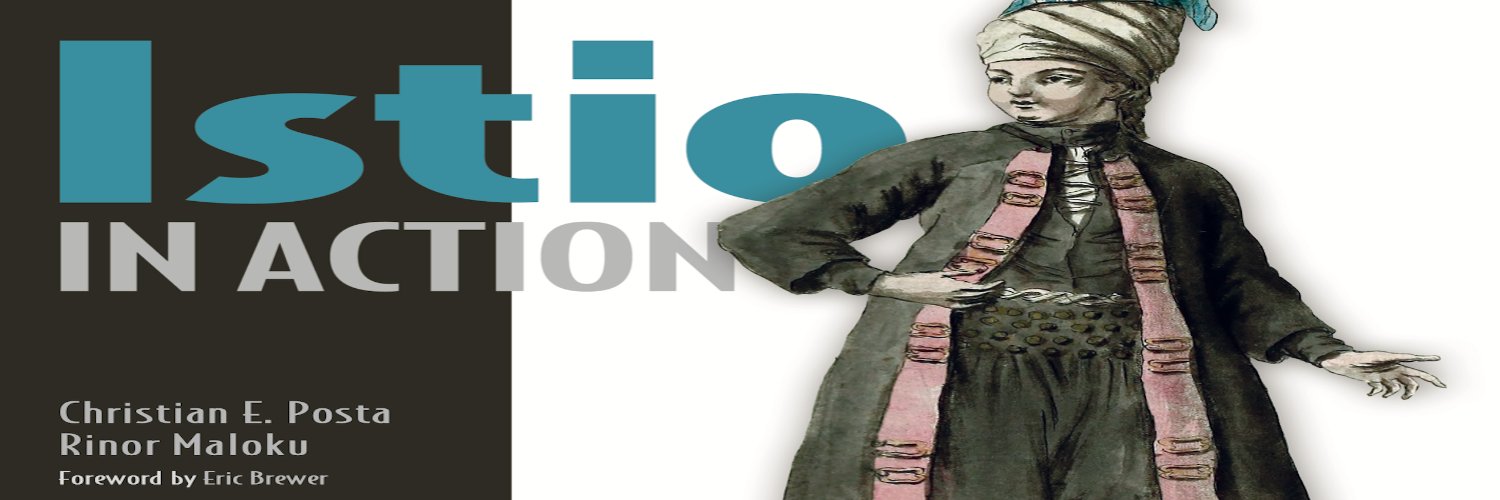
It's official! Today @rinormaloku and I announce the release of our (long-awaited!) book, #Istio in Action with @ManningBooks and forward written by @eric_brewer! With 450+ pages built over 3.5 years... we are both very proud of this work to help the @IstioMesh community.
Not for me or my servers thank you @OpenAI . And I hope some other people will think twice. Look past the "self-defending infrastructure" PR and see what OpenAI and Cisco are actually building with Shirudo: a permanent, network-connected kernel-injection daemon sitting inside Ring 0 of global Linux servers.
The real dangers go way beyond performance overhead:
- a global Ring-0 supply chain target: Shirudo normalizes a background daemon on production servers built to accept signed eBPF bytecode and hot-inject it straight into the live kernel. OpenAI explicitly wants to distribute "tested shields" alongside vulnerability disclosures. One compromised signing key or poisoned shield feed hands an attacker instant, kernel-level control across every connected fleet on earth, making SolarWinds look like a toy.
- total kernel telemetry harvesting: look at their own diagram. To generate shields, the agent continuously observes kernel hooks, network traffic, and per-process system calls. That turns the deepest, most sensitive execution telemetry on your servers into an ingestion pipeline for external AI infrastructure.
- mandatory compliance lock-in via TPM: by tying shield loading to hardware TPM attestation, cloud vendors and enterprise auditors can eventually treat "running approved OpenAI/Cisco kernel shields" as a baseline security requirement. Refuse the agent, fail the audit.
- silent traffic and behavior control: eBPF LSM and uprobe hooks sit below user-space firewalls, containers, and audit logs. The exact same mechanism that blocks a malicious Base64 payload inside a running process can silently drop, alter, or censor specific network traffic and syscalls without ever touching application binaries.
Handing a centralized AI and telecom alliance a standardized, cryptographically privileged hook directly inside the Linux kernel is not "open security."
It is building the ultimate remote control plane for modern compute.
Very cool to see NVIDIA AI Cluster Runtime uses @agentgateway just like llm-d for smart inference and cache aware routing for self-hosted/open models on Kubernetes:
https://t.co/2G7qMfdiau
We’re introducing Shirudo, an open-source Linux runtime allowing agents to defend systems without downtime. It lets agents write dynamic eBPF controls to shield systems from exploits, giving defenders more time to test and roll out patches. Built by @cisco together with OpenAI.
Shirudo is a first step toward self-defending infrastructure that can adapt to new threats while keeping services running. Our goal is for defenders to work with AI agents to find affected systems, test and share shields, and deploy them without disrupting workloads.
https://t.co/0AqGmcbxWH
@ylecun@huxlab Notice how the people screaming loudest that AI could destroy humanity are never volunteering to shut down their own data centers. They just want yours regulated out of existence.
I’m reading “The design and implementation of FreeBSD operating system”. The initial idea was to use this book as a trial of “llm assisted reading” - read the book and use the llm to help me understand the challenging parts.
So far, no llm was necessary. The book is so well written. Even complex ideas (like the weirdness of process creation) are explained simply and clearly.
This is so much more enjoyable than any llm-generated text I’ve read, that the entire idea of using an llm to help me understand feels laughable.
Anyway, great book. Worth reading if you want to understand Unix (and networking) in more depth.
People keep asking what happens to Nvidia if the board installs a safe, DC-approved corporate CEO instead of bringing Jensen back. We already saw this exact movie play out at Nokia in 2010.
When former Microsoft exec Stephen Elop took over Nokia, it still controlled 33% of the global smartphone market. Instead of protecting the builders who made Nokia dominant, he circulated his “Burning Platform” memo trashing Nokia’s own software ecosystem, alienated its core engineers, and locked the company into an outside political partnership before a real alternative existed.
Within three years, Nokia’s smartphone market share collapsed from 33% to 3%, its stock plunged over 60%, and the company was sold off for scraps.
Nvidia’s moat was never just silicon. It was 33 years of founder-led engineering conviction and CUDA lock-in. Hand the keys to a suit who answers to board committees and Washington lobbyists instead of the engineers in Santa Clara, and watch hyperscalers, custom ASICs, and open-weight ecosystems eat that 90% dominance alive.
Using a DGX Spark today vs using a DGX Spark 4 months ago is not the same experience.
It feels like a different machine with the optimisations the community has been delivering.
Agent Substrate From Pods to Sandboxes: actors and workers
Check out @christianposta book on Agent Substrate: From Pods to Sandboxes
https://t.co/MPKqyHCJKt
Agent Substrate From Pods to Sandboxes: Why Pods Stuggle with Agents
Check out @christianposta book on Agent Substrate: From Pods to Sandboxes
https://t.co/MPKqyHCJKt