Did your MEV protection actually work? Paste your transaction into our explorer and find out. It covers Ethereum, Solana, Base, and Tron, the four chains where we found persistent sandwich bots.
https://t.co/13ZrumHwLd
Your MEV protection may not work as you expect. We discuss our latest paper on protected order flow sandwich attacks and release an explorer to check if your protected transaction was sandwiched, and how. https://t.co/J18z6KQPDc
🚨 New paper alert 🚨
No Place to Hide: An Analysis on Protected Order Flow Sandwich Attacks
w/ Ozan Solmaz @boez95@ChristofTorres
Bots watch every pending trade in Ethereum's public mempool and sandwich the ones worth attacking. Hence the nickname: the dark forest. In response, Ethereum and other chains built protections, from private RPCs to mechanisms native to the chain, that shield trades from these bots. We call this protected order flow.
How well are these users actually protected? We measured it in a three-year study of sandwich attacks by persistent bots against protected order flow on Ethereum, Solana, Tron, Base, Arbitrum, and Monad. The protections on these chains range from private RPCs on Ethereum and private submission to a centralized sequencer on Base and Arbitrum, to first-come-first-served ordering in Tron's public mempool and local mempools on Solana and Monad. Local mempools were never meant as a full front-running prevention, but they do limit who sees a trade before it lands.
On four of the six chains, we observe protected order flow sandwich attacks: 28.0M attacks on Solana, 38,567 on Tron, 30,607 on Ethereum plus 2,576 more through reorged blocks, and 1,889 on Base.
We trace each chain's exposure and find that it sits in various places along a transaction’s path.
🟠 Ethereum: OFAs can expose enough information to make private trades sandwichable, especially when the same transaction reaches multiple OFAs or when searchers receive full transaction details. Reorged blocks also expose private transactions. We find transactions that were private and untouched in a block that got reorged, and then sandwiched on the canonical chain.
🟠 Solana: transactions are sent to the upcoming leaders, and early on we find that a few leaders carry far more attacks in their blocks than their share of blocks, i.e., they are likely the exposure source for these transactions. From 2025 that fades, but we see that victims concentrate around a few apps.
🟠 Tron: we presume that bots win latency races in the public mempool, so the first-come-first-served ordering in block building does not fully prevent sandwiches.
🟠 Base: we see two different kind of exposure. One lines up with a documented RPC bug that exposed pending transactions. The other has attackers preying on victims who trade on a predictable schedule, if the vicim does the same trade every couple of blocks, the attacker can front-run them without observing the pending trade.
Protected order flow sandwiches look very different from public mempool sandwiches. The attacker's transactions often land in a different block than the victim's, and unlike in the public mempool, their success is not guaranteed. These attackers simply don't act with the same certainty.
The dark forest may have shrunk, but we show there's an even darker corner of it, where users who think they're protected still get front-run. Protection has to hold at every layer, from the app to the RPC to the block producer. Encrypted mempools and TEE-based designs can help, by keeping transaction contents out of attackers' reach until inclusion. But even they might not be enough on their own without privacy, for example if the victim is too predictable.
Link: https://t.co/PhEVob36pl
📣 Lecture Series FS25 at UZH Blockchain Center
We are excited to invite you to our next lecture in the UZH Blockchain Center series, featuring Dr Christof Ferreira Torres @ChristofTorres
Here is our latest paper - Pandora’s Box: Cross-Chain Arbitrages in the Realm of Blockchain Interoperability
Co-authors: @ChristofTorres, @j9ebele,@rezabfil,@0xBrMazoRoig
Link: https://t.co/2kXPtN1Y6p
Short 🧵
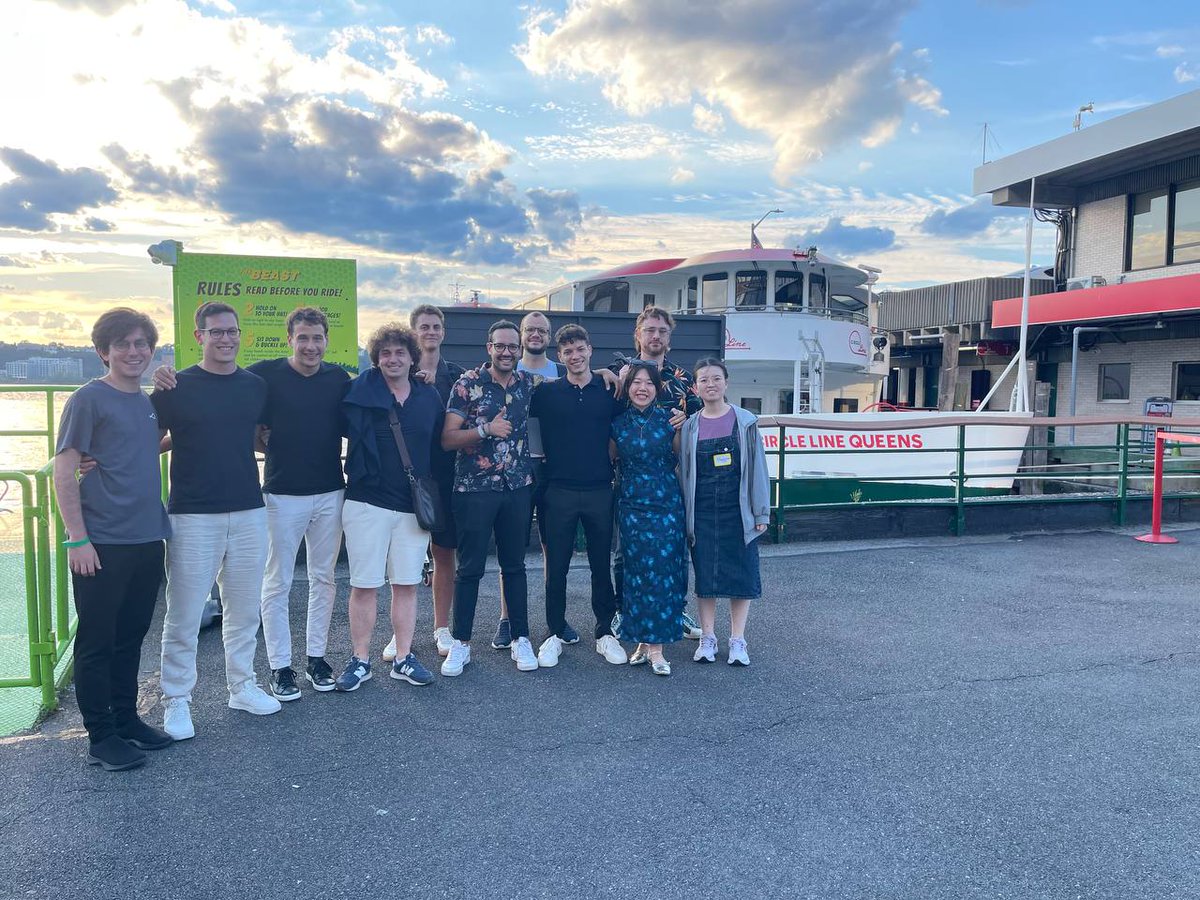
TL;DR's Research Fellows tackle the most pressing problems in DeFi research. Congratulations to the 18 TLDR Fellows selected for the 2024-25 cohort! We all gathered to kick off the fellowship this weekend in NYC. Meet them in the thread below:
We found 15 smart contract lotteries that were victims of insertion frontrunning attacks (also known as block stuffing) over the past 5 years🚨An attacker made with a single attack a profit of over 700K USD 💵 https://t.co/4ClSZMppfg #DeFi#Ethereum
Almost 200K attacks with an accumulated profit of 18.41M USD 💰Check out our latest paper on studying the 3 different types of frontrunning attacks on the Ethereum blockchain: https://t.co/4ClSZMppfg #DeFi#Ethereum@ramirocamino@RaduState@SnT_uni_lu@uni_lu
Just finished our paper https://t.co/NpEg3qSu34 on data driven analysis of Front Running Attacks on the Ethereum network. Many thanks to @Ripple's #UBRI for the support.
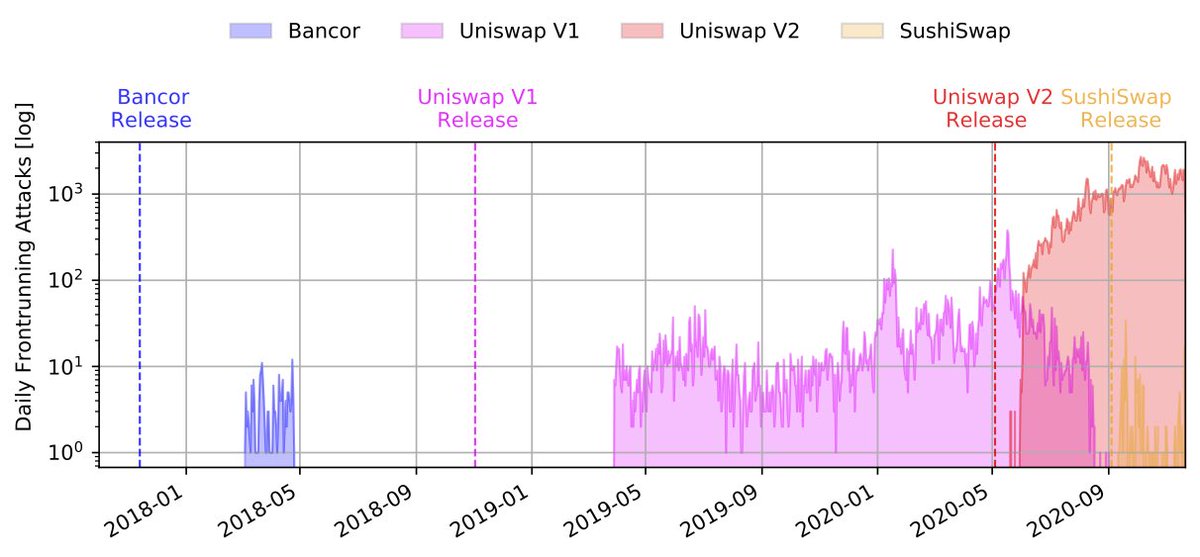
Thousands of traders are being frontrunned 🏃♂️ every day on DEXs, thereby losing millions of dollars!💰Here is a little sneak peak of our results! Stay tuned for even more cool stuff... #DeFi#Ethereum@RaduState@ramirocamino@SnT_uni_lu@uni_lu
We're celebrating 2 industrial fellowships grants! Well done François Robinet and Cristof Ferreira Torres 👏 Interested in joining a driven research team? Come work with @RaduState and his team: https://t.co/7Vqh4SGyRr @FnrLux@uni_lu