The 2024 annual report from @BlockchainComns is here! It highlights our work toward an open, secure, and compassionate digital infrastructure, emphasizing interoperability and self-sovereign wallet standards through key projects: dCBOR, FROST, and Gordian Envelope. 🧵… [1/11]
@shadcn If you initialize your git repository with an Inception Commit, you can also have a distributed root-of- trust that is the same on all platforms:
Today marks 20 years since Git’s birth, and our digital world runs on its foundations—but trust was never part of its design. Can you trust a Git repo? That’s why I created the Open Integrity Project: to bring integrity and provenance to code. 🧵…[1/14] https://t.co/UfzVTv1zhm
Keyquote: “This means that the EU could decide at any time that ZKP may no longer be used, and in one stroke the app would fall back to its default mode, meaning that every post on social media carries an ID tag.”
The EU age verification app is presented as “completely anonymous”. But the risk is that member states (the countries are supposed to create their own versions of the open-source EU app) use it to introduce identity verification that makes it impossible to post anonymously on social media.
The idea behind “completely anonymous” is to use Zero-Knowledge Proof (ZKP) cryptography to break the link between the age credential issuer (EU governments) and the regulated services/sites. Currently, the EU app does not have ZKP functionality, contrasting Ursula von der Leyen’s claim that the app ”is technically ready to be used”. But more importantly, the app is designed to always function without ZKP technology; if ZKP is unavailable, the app falls back to a non-ZKP model. Even if fully developed ZKP technology could be implemented in the future, it would remain an optional extra feature that countries may choose to disable and that the EU could remove at any time.
This means that the EU could decide at any time that ZKP may no longer be used, and in one stroke the app would fall back to its default mode, meaning that every post on social media carries an ID tag. By that point, an infrastructure will already have been rolled out; people will have gotten used to it, and it will be harder to roll it back.
More details on https://t.co/wTVKHMS1zg
@yoheinakajima I’ve been puzzling in similar directions. On connecting nodes, see https://t.co/AZofp7kq79 and in particular named edges. On state, see https://t.co/OQwT3dF22b which suggests orthogonal persistence may prove an answer.
I’m puzzling in similar space. My gut, in particular giving benefits of RLM, is that rather than a hodgepodge of different systems we need an integrated architecture, something like “orthogonal persistence” systems of the pre- and early Internet. See ideas at https://t.co/tI7OKd35Cz
@raw_works Thanks for your detailed reply -- I am investigating further. I have a high-quality 90's era orthogonal persistence server that I'm reviving as to do some prototypes against: https://t.co/5OLqUXgc3S
@raw_works I’m curious if you’ve thought about the mismatch in architecture of current harnesses vs the statelessness of LLM. With RLMs, wouldn’t it be better to use a harness architecture that optimizes for state? See https://t.co/tI7OKd35Cz for some early thoughts if orthogonal persistence approaches might be better with RLMs?
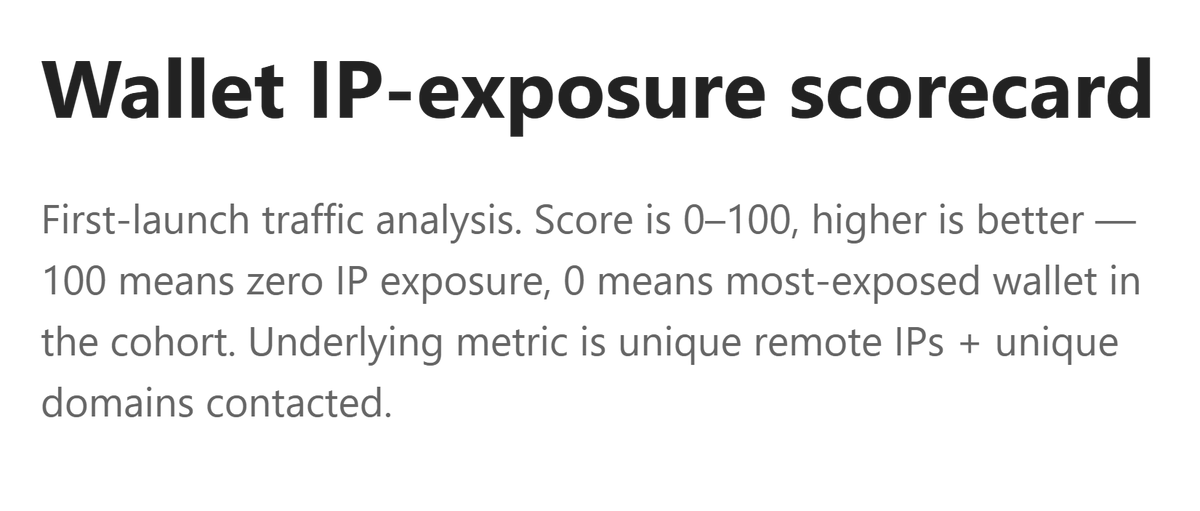
🧵 you can hold the most private coin on earth. doesn't matter if your wallet app pings 40 servers the second you open it. your IP is out before you generate a key.
so I tested 13 web3 wallets on first launch:
clean android, no sim
apks via gplaydl
wifi + vpn
pcapdroid per app
@dross_bolt@ParallaxPact We are learning more on the risks without self-sovereignty. SSI is 10 years old this week, help us update it for the next decade:
Do you use the term "self-sovereign"—for identity, for keys, for your wallet? If you do, it was ten years ago today I chose this term, using it to describe an inalienable right to control your own digital life. We've learned much in the last decade, so I'm offering an update.🧵…
Do you use the term "self-sovereign"—for identity, for keys, for your wallet? If you do, it was ten years ago today I chose this term, using it to describe an inalienable right to control your own digital life. We've learned much in the last decade, so I'm offering an update.🧵…
@ChristopherA Spent 6 months trying to launch a practical version of SSI at a large fintech, and failed. Huge supporter of your work, but found it extremely hard to change identity practices in finance. Hope we become self-sovereign one day
SSI has consumed most of my waking hours over the past few years, and I wouldn’t have it any other way. I had the privilege to write my PhD at @TU_Muenchen on the topic, focusing on SSI in a b2b setting.
SSI is great because it is self-guaranteeing its promises, and organizations need digital sovereignty just as much as people do. Now, I continue my work building digital supply chain software with SSI at heart.
It has also made it impossible for me to unsee the crazy asymmetry of information/power around internet identity. Never looking at a social login the same way.
Do you use the term "self-sovereign"—for identity, for keys, for your wallet? If you do, it was ten years ago today I chose this term, using it to describe an inalienable right to control your own digital life. We've learned much in the last decade, so I'm offering an update.🧵…
Do you use the term "self-sovereign"—for identity, for keys, for your wallet? If you do, it was ten years ago today I chose this term, using it to describe an inalienable right to control your own digital life. We've learned much in the last decade, so I'm offering an update.🧵…
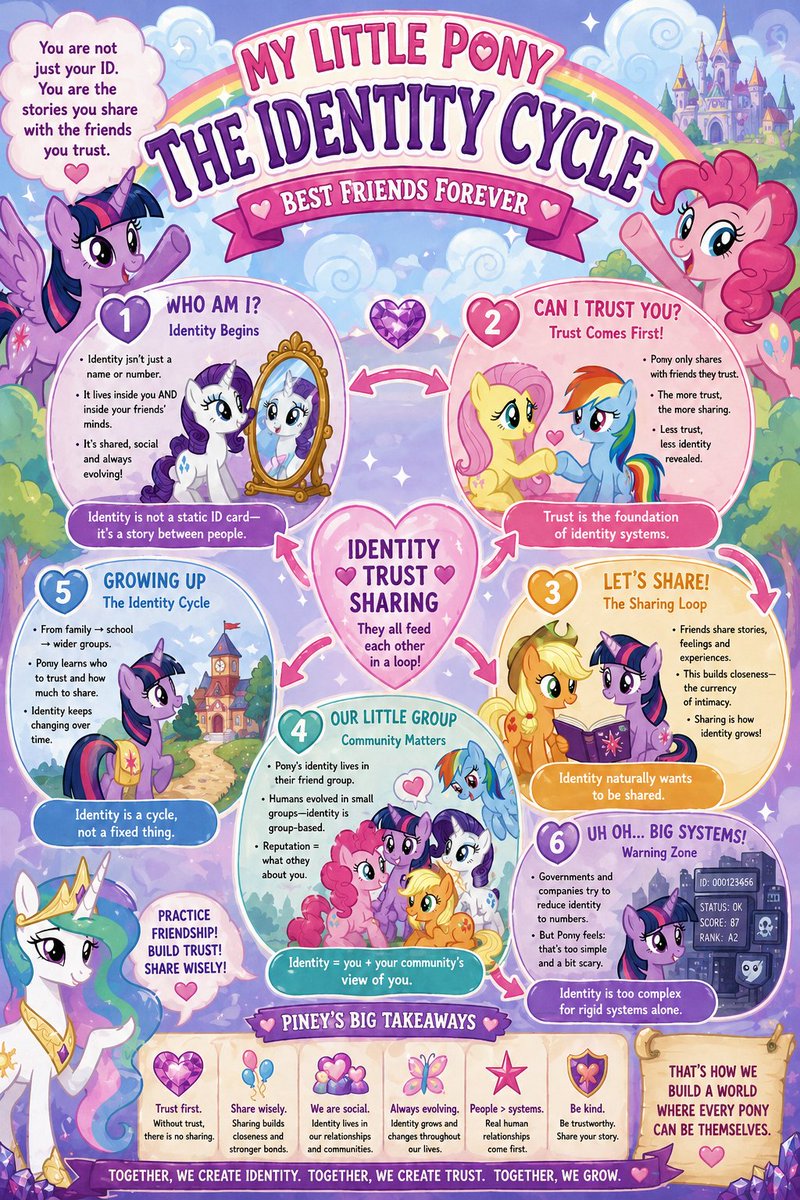
1/12 I've been meaning to write a bit about @iang_fc 's book The Identity Cycle for a while now. For the impatient here's the oligitory My Little Pony infographic.
For the Claude Notes summary read on 👎
Do you use the term "self-sovereign"—for identity, for keys, for your wallet? If you do, it was ten years ago today I chose this term, using it to describe an inalienable right to control your own digital life. We've learned much in the last decade, so I'm offering an update.🧵…
Ten years ago I asked for help refining ten principles. Today I'm asking again — this time, for sixteen. Push back. Sharpen. Tell me what I'm still missing. Talk with me at IIW, join the conversation in the W3C CCG, at https://t.co/eOEifhoIOH, or at GDC in Geneva next September.





![ChristopherA's tweet photo. The 2024 annual report from @BlockchainComns is here! It highlights our work toward an open, secure, and compassionate digital infrastructure, emphasizing interoperability and self-sovereign wallet standards through key projects: dCBOR, FROST, and Gordian Envelope. 🧵… [1/11] https://t.co/76X39FuY8S](https://pbs.twimg.com/media/GhWNS1caUAES-Gb.jpg)