‘In a revolutionary epoch, sometimes men taste every novelty, sicken of them all, and return to ancient principles so long disused that they seem refreshingly hearty when they are rediscovered.’
—Russell Kirk
John Healey's resignation should be death knell of this Government. If Starmer truly cared about defending Britain he would have had the courage to slash welfare spending and properly fund our armed forces. Political cowardice ahead of national security
@BGStaniszewski Yep. This is precisely where the Pope is right about this: it is dangerous because it enters into contexts where real relationships are lacking, and hollows them out further. Yet this is also why AI will never replace the human: a simulated relationship is not a relationship.
You have noticed it. ChatGPT feels dumber than it used to. Your prompts that worked six months ago produce worse results now. The writing sounds flatter. The ideas sound safer. The internet itself feels like it is shrinking. Every article reads the same. Every email sounds the same. Every answer sounds like it was written by the same voice.
You thought it was you. It is not you.
Researchers at Oxford and Cambridge published a paper in Nature proving what is happening. They call it Model Collapse.
Here is the mechanism in one sentence. AI trained on AI-generated data gets dumber every generation until it forgets what real human data looked like.
The internet is filling with AI-generated content. Blog posts. Articles. Reviews. Comments. Social media. AI companies scrape the internet to train the next generation of models. Which means the next generation of AI is being trained on the output of the current generation.
Each cycle loses information. Not randomly. It loses the rarest, most unusual, most creative parts first. The researchers call these the "tails of the distribution." The weird ideas. The unexpected perspectives. The things that made the internet feel human. Those disappear first.
What remains is the average. The safe. The expected. The bland.
Then the next generation trains on that. And loses more. And the next generation trains on that. And loses more. The researchers proved this is not a slow decline. Major degradation happens within just a few iterations. Even when some of the original human data is preserved.
They tested it on large language models. On image generators. On statistical models. The pattern was the same every time. The output converges toward a narrow, flattened version of reality that looks nothing like the original data.
The lead researcher put it plainly. "Large language models are like fire. A useful tool. But one that pollutes the environment."
The pollution is invisible. You cannot see which sentence on the internet was written by a human and which was written by AI. Neither can the AI that is about to train on it. And once the tails are gone, they do not come back. The damage is irreversible.
This is not a prediction anymore. It is a diagnosis.
The internet you grew up on was built by humans writing things no algorithm would have written. Strange, personal, imperfect, alive. That internet is being diluted. One generation of AI at a time. And the models trained on what remains are learning a smaller and smaller version of the world.
Model Collapse is not a technical problem. It is a cultural one. The thing that made the internet worth reading is the thing that disappears first.
“All plans of government, which suppose great reformation in the manners of mankind, are plainly imaginary.”
David Hume, “Of the Original Contract” (1748).
‘The Labour Party is always talking about getting rid of its leader and it never does. The Conservative Party never talks
about getting rid of its leader and then, suddenly, there's a flash of cold steel…’
- Sir Harold Wilson on how the parties remove their leaders (1977)
We have a lot of historical records of exam papers like this. Frustratingly, we have far fewer records of what the students actually wrote in response! Maybe their responses were all brilliant. Maybe some of them were terrible.
My colleagues wrote a paper on standards in A-level maths over time, and finding archive responses was really hard!
Eventually they were able to compare responses from 1964, 1968, 1996 and 2012.
Standards had declined dramatically between 1968 & 1996. The quality of work that would have got an E in 1968 got a B in 1996.
https://t.co/uJj5O9ZhmE
I highly recommend Alan Sokal's excellent paper
Academic freedom, no-platforming, and appeals to "disciplinary competence": A critical analysis of Simpson-Srinivasan's arguments
published today in @JConIdeas.
@rbnmckenna86 This is an important point. And perhaps a more general cognitive phenomenon is relevant here:
People are only interested in a problem when they have an opinion about how it should be solved.
Academic X, help me understand this. Every year people, many thousands of people, are graduating from British universities with a Master's degree, despite (1) having read nothing, and (2) not being competent in English, either written or spoken. Why is no-one talking about this?
The High Court’s decision in R (University of Sussex) v Office for Students was handed down this week and significantly reshapes the terrain on which #freespeech disputes in universities will be fought.
CAF has published an analysis of what the judgment means for academic freedom and the future of the OfS free speech complaints scheme.
👇
https://t.co/ZQfENSI1Zh
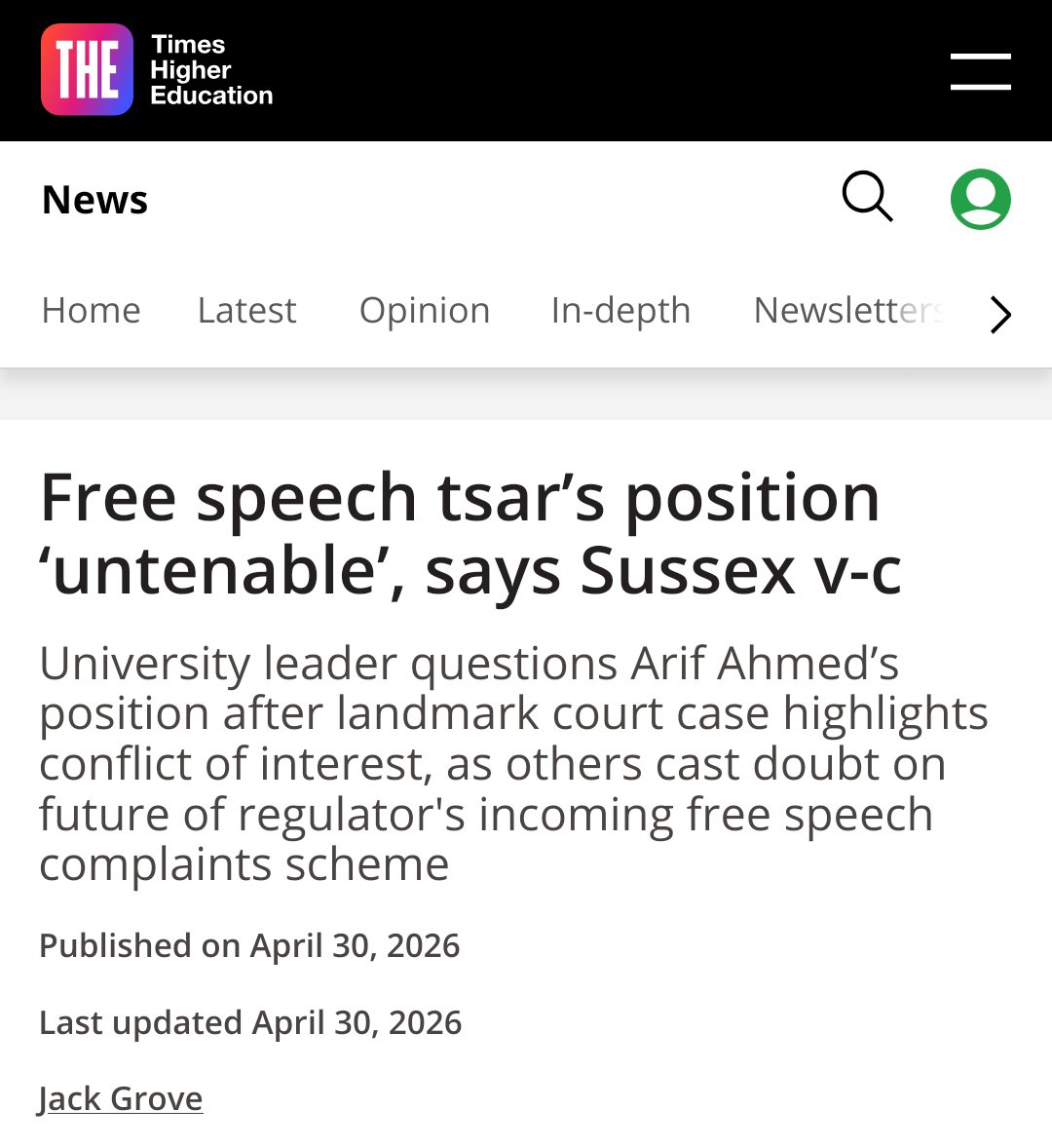
The VC of Sussex has used yesterday's judgement (on which I'll have much more to say later) to launch an attack on Arif Ahmed and the planned HEFSA provisions.
But as I point out to @timeshighered, those provisions are now needed more than ever.
https://t.co/U9zTcJWyXs
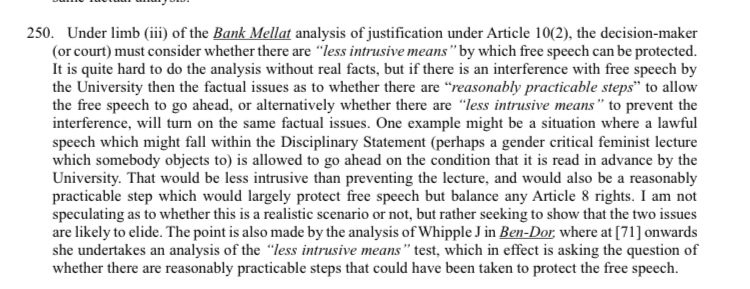
One striking passage in the Sussex v Office for Students judgment handed down today suggests that, in some cases, a “less intrusive” way to manage controversial speech — the judge cites gender-critical talk about women’s sex-based rights as her hypothetical example — might be to require a lecture to be read in advance, for example by university administrators.
The difficulty is what this implies in practice. Under the OfS’s own guidance on complying with the Higher Education (Freedom of Speech) Act, the starting point is simple: if it is “reasonably practicable” to allow the speech to go ahead — including by simply not restricting it — then that step must be taken. So the judge’s example here begins to blur the line between allowing speech and managing it, by suggesting that some form of control may still be appropriate even where the speech could simply proceed.
The risk is that the question “should we allow it?” — even if answered in the affirmative — is then followed by another: “how can we control it to minimise upset or complaints?”.
And just like that, we’re back in 2018.
@ProfAliceS@jk_rowling@Docstockk@Fox_Claire
“[Michael] Oakeshott’s style was enchanting. Here was a man who taught my generation how conservatism could be combined with bohemianism, convention with eccentricity, orderliness with wild abandon, pleasure with responsibility.”
Sir Peregrine Worsthorne
If schools and universities refuse to teach the great books of Western Civilization, we will do it ourselves.
Athenaeum now has 500 members reading the classics alongside us!! Thank you all 🙏
We're about to start our 12th book — see you on 28 April for the next discussion...
🚨 The government has finally announced a timetable for introducing the Office for Students’ free speech complaints scheme, bringing to an end nearly two years of wholly unnecessary delay during which too many academics whose rights may well have been breached have been left in legal and institutional limbo.
This is long overdue, but a welcome step forward nonetheless. True, it may sound like a dry, technocratic initiative — but it has the potential to change the culture on campuses up and down the country, pushing back against an environment in which, too often, administrators have treated speech-restrictive EDI, decolonisation and harassment policies, training, and even curriculum interventions as if they were an inevitable extension of equality law.
They are not, and senior leadership teams may now find themselves told so rather more often, not just by campaign groups like CAF, but in formal regulatory correspondence requiring decisions to be revisited and, where appropriate, compensation to be paid by a certain date.
Put simply, universities will no longer be able to assume that free speech breaches are a matter of mild administrative inconvenience, or a price worth paying to shield supposedly vulnerable groups from ideas that, while perfectly lawful, tend to upset them — or worse, require them to test their ideological assumptions in open debate.
CAF Research Manager Freddie Attenborough has written for @TheCriticMag on how we got here, and why the complaints scheme has the potential to prove a genuine game-changer:
https://t.co/yLh8CPlHTr







![DurhamWASP's tweet photo. “[Michael] Oakeshott’s style was enchanting. Here was a man who taught my generation how conservatism could be combined with bohemianism, convention with eccentricity, orderliness with wild abandon, pleasure with responsibility.”
Sir Peregrine Worsthorne https://t.co/mC7xWoCZ65](https://pbs.twimg.com/media/HG_P_PtWgAAgJGP.jpg)


