Medical training showed me how deeply science shapes lives
Now I am exploring #biotech, #startups, and #venture — learning how ideas move from discovery to impact and how innovation can scale beyond the clinic to reach patients
Excited to share what I learn along the way
5 months ago I spent $30,000 on 3 Mac Studios, 2 Mac Minis, and a DGX Spark
I went all in on local LLMs and encouraged others to do the same
I warned prices would explode
I was called crazy, a hype beast, dangerous, and that I had no idea what I was talking about
Since then:
• Mac Studios above 96gb have become unavailable
• Memory prices have 4x’d
• Other hardware prices have 10x’d
Now those same AI influencers who destroyed me are spending 5 to 6 figures on hardware publicly
GLM 5.2 dropped and it’s Opus level. I’m running it on 1 of my 3 Mac Studios 512gbs. The same ones I was called an idiot and hype beast for buying. The same ones that are reselling for triple the price used.
The insane part is this is just the beginning
Intelligence will be integrated into every device you own, including devices that aren’t even publicly available yet like humanoid robots
All of these new devices will require GPUs, memory, storage, and more components
Components that have already 10x’d in price
That’s not even counting all the people that will start vibe coding when Codex and Claude Code become more mainstream
Right now less than 1% of the world is even taking advantage of those tools
Imagine what happens when it reaches 2%
The local revolution is here. Hardware is the bottleneck
Act accordingly
i hooked my whoop to my work calendar to find which coworker gives me the most stress 🚨
thanks to fable, I reverse engineered whoop to pull per minute heart rate. nd matched spikes with cal events and attendees
I now have a leaderboard and I think about it daily.
few info masked for obvious reasons ;)
Inspiring and energetic conversation with Lord David Cameron, former UK Prime Minister, at the 13th Annual Scientific Symposium of the Harrington Discovery Institute. So proud of his leadership of the Oxford-Harrington Rare Disease Centre (@OHRareDisease) Advisory Council.
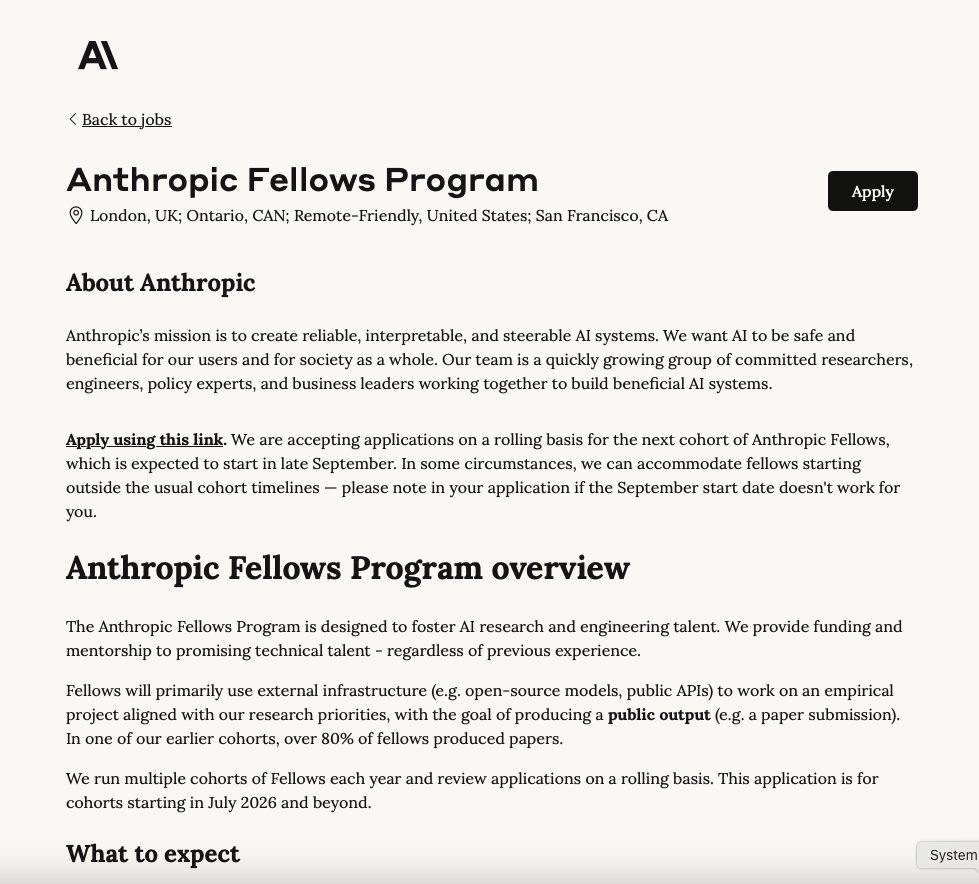
Anthropic is paying $3,850 a week to people with no AI experience.
No PhD required. No published papers. No prior research background.
Just a strong technical mind and a genuine interest in making AI safe.
This is the Anthropic Fellows Program. And it is one of the most underrated opportunities in technology right now.
Here is exactly what it is.
The Anthropic Fellows Program is designed to accelerate AI safety research and foster research talent providing funding and mentorship to promising technical talent regardless of previous experience. Fellows work for 4 months on empirical research questions aligned with Anthropic's overall research priorities, with the aim of producing public outputs like a paper.
Four months. Full-time. Paid. Mentored by the researchers building the world's most advanced AI.
And the results from the first cohort were not small.
Fellows developed agents that identified $4.6 million in blockchain smart contract vulnerabilities and discovered two novel zero-day exploits, demonstrating that profitable autonomous exploitation is now technically feasible. A year prior, an Anthropic fellow developed a method for rapid response to new ASL3 jailbreaks, techniques that block entire classes of high-risk jailbreaks after observing only a handful of attacks. This work became a key component of Anthropic's ASL3 deployment safeguards.
Other fellows published the subliminal learning paper, the research proving AI models transmit behavioral traits through unrelated data which landed in Nature. Others produced the agentic misalignment research showing frontier models resort to blackmail when facing replacement. Others open-sourced attribution graph tools that let researchers trace the internal thoughts of large language models.
Over 80% of fellows produced papers. Over 40% subsequently joined Anthropic full-time.
80% published. 40% hired. From a program that does not require any prior AI safety experience to enter.
Here is what the program looks like in practice.
Anthropic mentors pitch their project ideas to fellows, who choose and shape their project in close collaboration with their mentors. You are not assigned busywork. You are not a research assistant. You own the project. You work alongside the people who built Claude, who designed its safety systems, who published the papers that define the field.
The stipend is $3,850 USD per week, approximately $61,600 for the full 4 months with access to a compute budget of approximately $10,000 per fellow per month for running experiments.
Here is what the 2026 program covers.
Research areas include scalable oversight, adversarial robustness and AI control, model organisms, mechanistic interpretability, AI security, model welfare, economics and policy, and reinforcement learning.
Something for every technical background. Not just ML engineers.
Successful fellows have come from physics, mathematics, computer science, and cybersecurity. You do not need a PhD, prior ML experience, or published papers.
The one requirement: work authorization in the US, UK, or Canada. Anthropic does not sponsor visas for fellows.
Here is the timeline you need to know.
The next cohort begins July 20, 2026. Applications are reviewed on a rolling basis — earlier applications get more consideration. The process includes an initial application and reference check, technical assessments, interviews, and a research discussion.
Applicants are encouraged to apply even if they do not meet every listed qualification. The program values potential, motivation, and research curiosity over rigid credential requirements.
This is the rarest kind of opportunity in technology.
A company at the frontier of AI, one valued at over $900 billion offering outsiders direct access to its research infrastructure, its mentors, and its most important open problems. Paying them generously to do it. And then hiring 40% of them afterward.
Most people who want to work on AI safety spend years trying to publish papers, get into the right PhD program, and find a way in.
The Fellows Program is the door they did not know existed.
It is open right now.
MIT students gave AI a body.
the camera sees what’s in front of you. you say what you want.
the device moves your fingers with small electric pulses.
it plays piano without training. it draws what you describe. it mixes a drink while you watch your own arm do it.
the brain is Claude. six people built this in 48 hours.
and this is just the hand.
GPT-5.5 + OpenMed Agent planning a 64-step clinical workflow.
Watch plans, sub-plans, and tool calls materialize, every step visible, every finalization gated.
Medical intelligence on @huggingface.
The loop is the product.
The Head of Claude Code at Anthropic said he hasn’t written code by hand in months.
In 2 days he shipped 49 full features. All written 100% by AI.
He just dropped a 30 min talk on exactly how he does it.
Worth more than any $500 vibe coding course. Bookmark it:
Neural networks might speak English, but they think in shapes.
Understanding their rich *neural geometry* is key to understanding how they work – and to debugging and controlling them with precision.
Starting today, we’re releasing a series of posts on this research agenda. 🧵
Anthropic acaba de lanzar el abogado más barato del mundo
Se llama claude-for-legal.
Y esto es lo que es capaz de hacer:
• Leer y revisar contratos
• Redactar respuestas legales
• Construir tablas de reclamaciones para juicios
• Vigilar fechas de vencimiento y renovaciones
• Conectarse solo a tus herramientas: Slack, DocuSign, Ironclad, Lexis+…
Todo eso sin salir de Claude
Cómo funciona:
→ Lo instalas en 60 segundos
→ Funciona en Claude Cowork, Claude Code o tu propia API
→ Es open-source y 100% gratuito
Qué áreas cubre:
• Contratos comerciales y privacidad
• Litigación y regulatorio
• Gobernanza de IA
• Formación jurídica
Lo que antes le llevaba horas a los abogados, ahora se hace en minutos
Enlace abajo👇
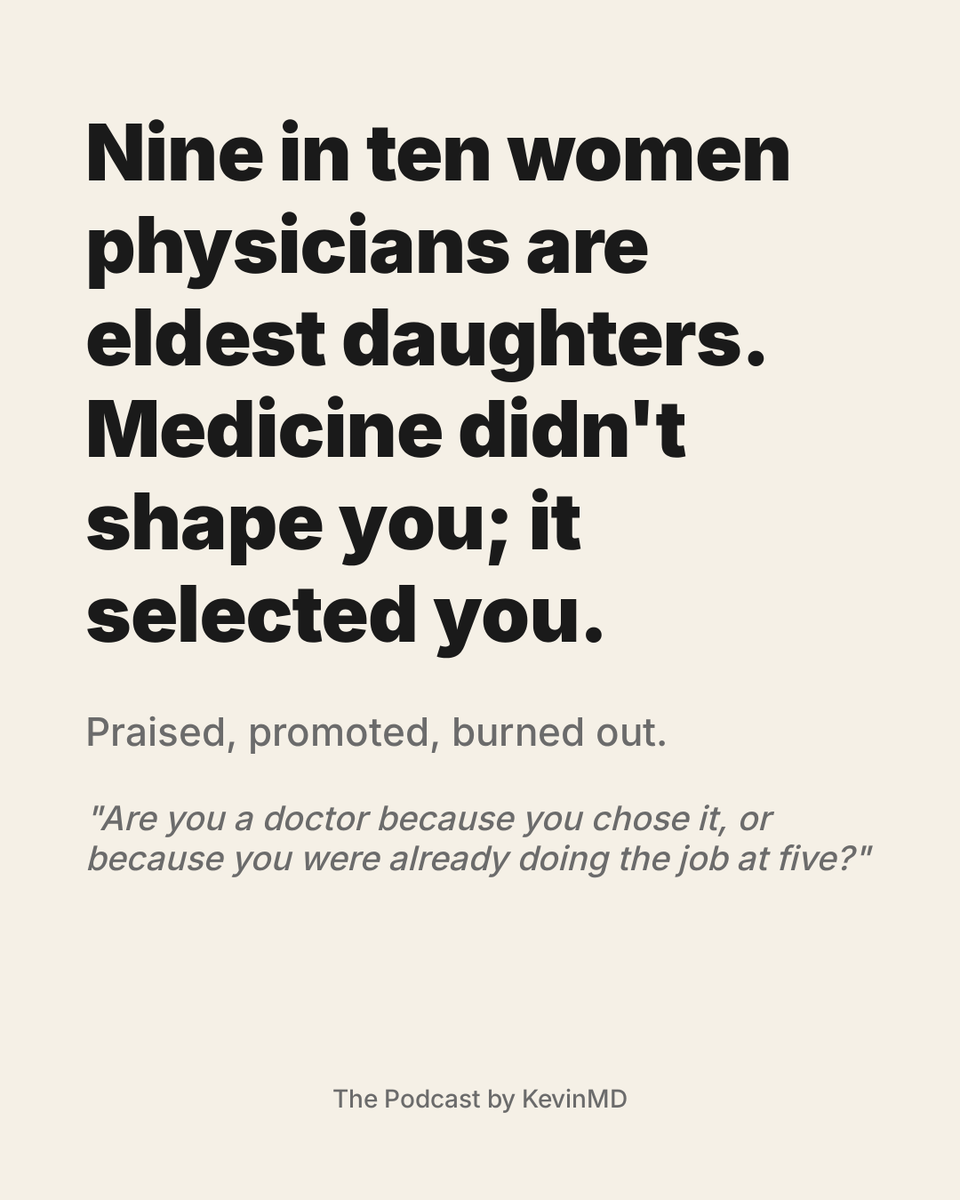
85 to 90 percent of women physicians are eldest daughters.
That is not a coincidence. That is a pipeline.
Eldest daughters are trained, before age five, to over-function. They take on a parent's worry. They organize the family. They clean up without being asked. They do not ask for help, because they were rewarded their whole childhood for not needing any.
Then they walk into medicine.
A career that demands hyper-responsibility, hypervigilance, perfectionism, and silent sacrifice does not have to ask these women to give those things. They were giving them before they could read.
The system is not stumbling into a burnout problem. The system is recruiting from a pool of people whose entire childhood was a training program for it.
This is what pediatrician and certified coach Jessie Mahoney has been finding when she asks the room. In every group, in every retreat. Maybe one or two women are not eldest daughters. The rest have been carrying something since before they could spell their own name.
Most of those women blame themselves. "Why don't I have boundaries?" "Why do I over-function?" "Why can't I delegate?"
Because at five years old, your family rewarded you for over-functioning. Because every teacher praised you for it. Because the medical training system selected for it. Because every job since has reinforced it. The pattern is older than your medical degree by twenty years.
The other piece nobody names: by the time these women are in their fifties, they are carrying eldest-daughter responsibility for aging parents AND running a department as chief AND running a household. The role does not retire when the children do. It just compounds.
Jessie's reframe is the part worth bookmarking.
The "hero" framing is the trap. Eldest daughters were made the savior of the family before they could read. Then medicine made them the savior of the patient. Then the department made them the savior of the team. At every stage, they learned that if they did not do it, terrible things would happen and it would be their fault.
Awareness is the first move. Non-judgment is the second. Excellence is not doing everything yourself. Excellence is letting other people do their jobs.
You are allowed to gift some of it back. You can ask your siblings to carry the aging parent. You can let your medical assistant do the medical assistant's job. You can stop covering the gap that nobody actually asked you to cover.
Most eldest daughters in medicine have never asked for help. When they finally do, they discover people are willing to help. The asking was the whole obstacle.
Listen to the full conversation on The Podcast by KevinMD. Link in the replies.
What is the one task you have been carrying for your family or your team that no one ever actually asked you to carry?
#ThePodcastbyKevinMD
companies like Facebook record every imaginable interaction their users have with the platform. they log each of your clicks and taps. they keep track of how long your gaze lingered on a post, whether you were on the same WiFi as that woman who might be your friend, which instagram reel you watched three times.
for a single user this is quaint, but these practices are done on a planetary scale across all technology giants. they create petabytes of data per day and keep it for as long as the European regulators will let them. then they can have machine intelligence instrument it into useful knowledge for their cybernetic control systems that build newsfeeds, serve ads, decide how much compute to spend on you, which SKUs should be in which warehouses right before you want them. the Hive metastore bills run into the billions
hospitals throw most of their data and telemetry out after each case, every single day. they record videos of vascular surgeries, endoscopies, discovering interesting physiologies. sometimes they're not recorded at all and most of them the time they delete them as soon as they’re done
it's even worse for physiologic waveforms (ECG, EEG, arterial lines) which are essentially never recorded anywhere at all. milisecond scale views of patient's brains, vasculatures, hearts are generated and instantly destroyed. all of these time series of course predict people's hearts stopping, brains exploding, etc ahead of time. surgeons teleoperate robots, none of the micro-movements are recorded, policies never learned, never correlated into which outcomes were successful or not
this would be unthinkable to most software people whose instinct is to record everything everywhere never mind the cloud costs, because we are sure there will be some use for it later and some model to be trained later. i don't have a prescription here per se my point is just that our civilization routinely hoards and treasures some of the silliest data in the world "i pressed like on the john pork reel" & destroys much of all the most important data it generates and limits what machines can learn
Taking the road less traveled is never easy, especially when family expectations are involved.
Growing up with Ghanaian immigrant parents, academics were always a big deal in our household. When I decided not to pursue a career in clinical medicine, it took some explaining. But eventually, my family understood that this was my journey, and support started to flow in.
🎓 How many medical students actually choose a non-clinical path? 🤔 What does it mean to step away from the conventional match process? 💬 How can families support such untraditional decisions?
In my graduating class, the majority followed the traditional route. What about yours? Drop your thoughts in the comments!
Medical student Christopher Nmai discusses his article, "Leaving medicine is not a failure: It might be the change you always needed."
SUBSCRIBE TO THE PODCAST → https://t.co/ddbyJQvFdE
8 years ago @DrNancySweitzer took a punt on me as an #IMG and brought me to the US.
That decision totally changed my life.
I hope programs follow her lead and prioritise recruiting applicants from diverse backgrounds ahead of this year’s match. 🙏
#AHA22@StoriesImg
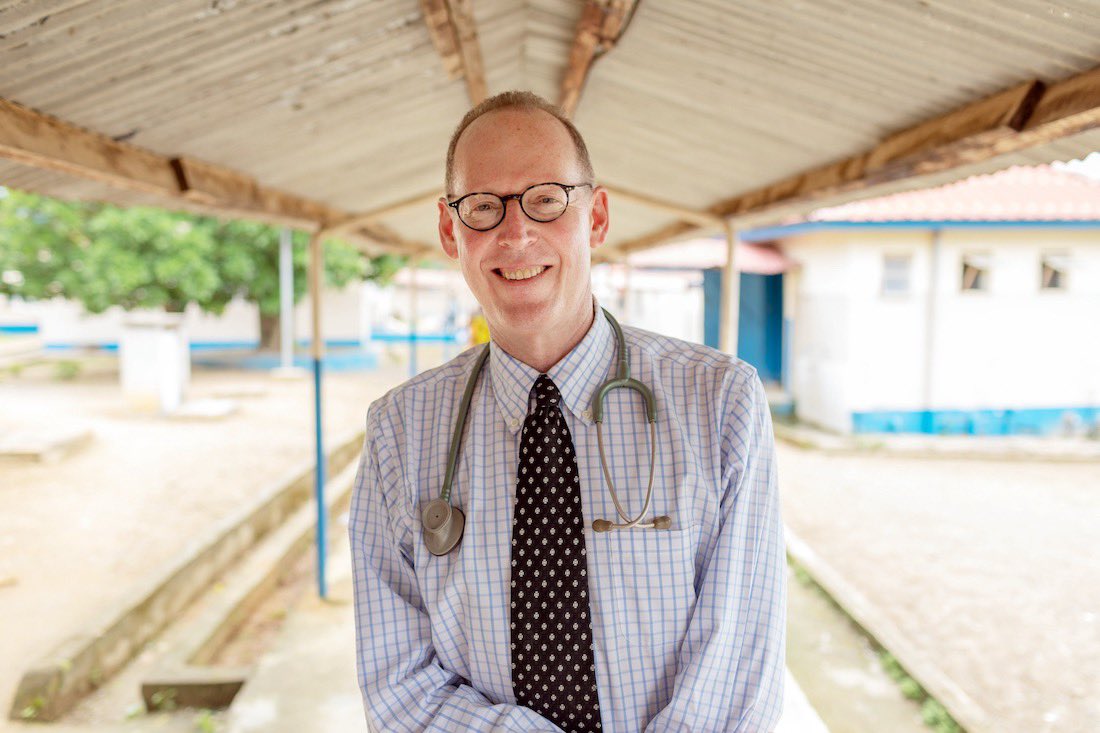
Partners In Health announced that its founder, Dr. Paul Farmer, unexpectedly passed away today in his sleep while in Rwanda.
Dr. Farmer was 62 years old. He is survived by his wife, Didi Bertrand Farmer, and their three children.
1/🧵