Just before PMQs, at the despatch box, she called one of my MPs a racist. She’s just said it again on Radio 4.
The hordes of Labour MPs rushing to twitter to whine about me calling her “spiteful” are just exposing their own hypocrisy.
They love to dish it but they can’t take it.
A council is forcing homeowners to rip out their air con, saying they should ‘open a window’ instead.
Why? Because of their Soviet ‘cooling hierarchy’ policy.
This is mad.
We have to end the de facto air con bans in Britain and Make Britain Cool Again!
"Stop treating energy as something to atone for. Energy is the master resource, the thing that buys us nearly every other good. The whole of human history is the story of harnessing ever more energy to improve our lives and to hold the lethal forces of nature at bay." The imperative is to accelerate abundant carbon-free energy (including the n-word). | How Europe Became the World Champion of Heat Deaths https://t.co/1E6LRq1Bf8
Here are the top 20:
1. DEBT: Bring down debt with a new fiscal rule saying that, outside emergencies, public spending will not grow faster than the economy.
2. WELFARE #1: Remove mild/moderate anxiety, depression and musculoskeletal conditions as criteria for claiming benefit and replace it with a guarantee of rapid NHS treatment as happens in Denmark.
3. WELFARE #2: Cap the DWP benefits budget just as defence and NHS budgets are capped. Otherwise the DWP has little incentive to find savings or stop abuse.
4. WELFARE #3: Devolve administration of the welfare system to elected mayors allowing them to keep a proportion of any savings made.
5. WELFARE #4: Require face-to-face benefit assessments with no telephone applications except in exceptional circumstances.
6. WELFARE #5: Replace the triple lock with a guarantee the state pension will always match inflation.
I’m making a show about buildings.
The concept is simple: do for the man-made world what Planet Earth did for the natural world.
But, when I pitched the idea, the answer was that nobody would watch it.
So I released a pilot episode on YouTube. It’s got 5.4 million views, 379k likes, and 23k comments.
People are interested, and now it’s time to make the full show.
Six episodes, filming in the UK, France, Belgium, Germany, Italy, and the USA, and releasing on a streaming service like HBO, Netflix, or Prime.
Why does this show matter?
First: we’re surrounded by buildings all the time. Look around yourself, right now… what do you see? Buildings are the logical conclusion of everything a society believes in. That’s the real focus of this show: not the buildings themselves, but what they say about us.
Second: there’s global dissatisfaction with modern architecture. This feeling gets written about online, but nobody’s given a voice to it on film or TV. That’s what this show will be. But this isn’t just about criticising modernity. That’s easy. This is about learning from the past in order to understand and improve the present, for everybody.
Third: there’s a drought of high-quality culture shows. When I spoke to film executives they said that only documentaries about sports, music, or true crime get funded. That’s a colossal missed opportunity. Galleries are always full, content about architecture goes viral online all the time, and people spend their precious holidays visiting beautiful cities.
Why no shows about architecture, then?
Tourists flock in their millions to see (for example) the buildings of Antoni Gaudí in Barcelona. But, if you asked those same people if they’re interested in “architecture”, they’d probably say no.
To put that another way: not many people want to watch “a show about architecture”, but lots of people want to watch a show that illuminates the real world they’re living in, each and every day.
What will the show be like?
Six episodes, going chronologically through history and arriving at the present, each focussing on the architecture and design of a specific period:
1. Middle Ages
2. Renaissance
3. Enlightenment
4. The Nineteenth Century
5. Art Nouveau & Art Deco
6. Present Day
But, in each case, the point isn’t just to learn about that era; the point is to learn about our modern world through those eras and what they’ve left behind. If you watch the pilot episode (included below) you’ll see what I mean.
So the show’s not really “about” the past; it’s about the twenty-first century.
That’s why it’s called The Modern World.
When you think of a typical history show there are loads of interviews, stock footage, archive photos, historical recreations, and graphics. We’re doing none of that. Everything will be filmed on location, because we’re telling our story only through the real world that exists right now. And, rather than going to the most obvious places, we’ll focus on buildings that aren’t well-known but should be more famous.
But that’s all big picture; what will it be like on screen?
Buildings used to look different in every country, and now they look the same. Why? Because the weather is different everywhere, and buildings were always a way of dealing with that weather, using local materials. Now we have air conditioning and we ship concrete around the world, so we don’t need to design our buildings with regard to local weather or rely on local materials.
Look at really old clocks and you’ll notice something: they don’t have a second hand… because it was only invented 300 years ago! Then you look at the present and you realise we’re surrounded by timers, by seconds ticking down and ticking up relentlessly. If we’re looking for a cause of our anxiety-inducing culture, that might be it.
When you spend time with the sun-softened bricks and time-warped timbers of old cities you notice that synthetic materials like plastic have taken over. When we’re surrounded by things that feel temporary, how do you think it makes us feel?
It’s only by seeing 19th century train stations, designed like cathedrals, that you realise tradition and technology aren’t enemies. New things don’t have to look boring: if the Victorians had designed AI data centres, they’d look like Medieval castles.
In the 1920s, at the zenith of Art Deco, people believed technology would uplift humanity. That’s why they decorated their buildings with statues inspired by electricity. Only by seeing their enthusiasm can we realise our own cynicism, and perhaps begin to fix it.
All of that… and much, much more.
But, above all else, this show is about a way of seeing. If you want to understand any society then you need to look at what it creates, not what it says about itself.
There’s a worldview in every single object; our skyscrapers are designed the same way as our phones. Learn to look at this world, to notice its details, and everything else starts to make sense.
What now?
I’ve been quiet online recently because I’ve been researching and working on scripts for six full-length episodes. Production begins when we’ve raised the funding.
The Modern World is coming.
Offended by a Christian preacher. Called the police. Literally cannot get it into their heads that in England it is not a crime to say something they might not like about the religion of Islam. Well done to the police officer. https://t.co/PsC9SvDAdQ
The United States and Europe belong to a civilization that stretches over continents, crossed over oceans, and persisted for thousands of years: from Athens to Rome to America.
Western Civilization must embrace its noble legacy if it is to reverse its decline.
New Green leaflet in the Gorton & Denton by-election. Reads:
One more push to the collapsing walls of Labour
Punish them for Gaza
Defeat Reform, Vote Green
Vote Green for a strong voice for Muslims
I think it's reasonable to want to promote a domestic industrial base (including steel production) for a number of reasons including national defence, but focusing on subsidies/nationalisation as the default answer to the sector failing is a mistake, IMO.
Even if you end up concluding that the sector does need ongoing state support, the first focus should be on why it has become so uncompetitive and inefficient and what we can do to reduce its input costs. That doesn't necessarily mean laissez faire.
The problem with subsidies and nationalisations is that they probably make their recepients even less efficient and productive by insulating them from competition and other forces that force companies to become better. That ties up talent and resources that would be better used in more productive enterprises, including other industrial ones.
If your goal is (say) to have a domestic steelmaking industry for the purposes of wartime production, you should be terrified at the prospect of having a steel industry that is the industrial equivalent of the NHS in terms of wastefulness and dysfunction.
And there is a related *political* opportunity cost: by treating these as the key intervention, other more effective interventions may be neglected.
For example, maybe part of the answer is to exempt these sectors from green energy policies or strike deals with (eg) Qatar to get them cheaper oil and gas. Or to write off student loans for engineering graduates from good universities. Or to pursue narrow trade deals getting specific sectors easy access to foreign markets, and preferred procurement status for foreign govts/militaries. Or to give them extremely fast approvals for licensing, certification, permits, before we try to improve those economy-wide.
I don't know if any of these ideas are actually good, to be clear! The point is that there are lots of interventions that could actually make the sector more productive instead of just "keeping it alive" as subsidies do. And if you still concluded that you needed to subsidise it after cutting its input costs to the bone, at least then you'd be supporting a much more efficient industry than if you treated direct support as the first and main solution.
https://t.co/B1Bjc9S4aa
Fascism? I’m literally begging people to read a single book.
Fascism is a particular ideology and it doesn’t just mean ‘right wing’. It is expressly collectivist, identitarian, militaristic, anti-parliamentarian, and totalitarian.
There is no serious political party with a paramilitary wing playing street politics.
There is no serious political party calling for economic autarky (except maybe the Greens)
There is no serious political party clamping down on speech forums or supporting the cancellation of elections (except maybe the Labour Party)
There is no serious political party with roots in Nazi-adjacent nationalism (except maybe the SNP and Sinn Fein)
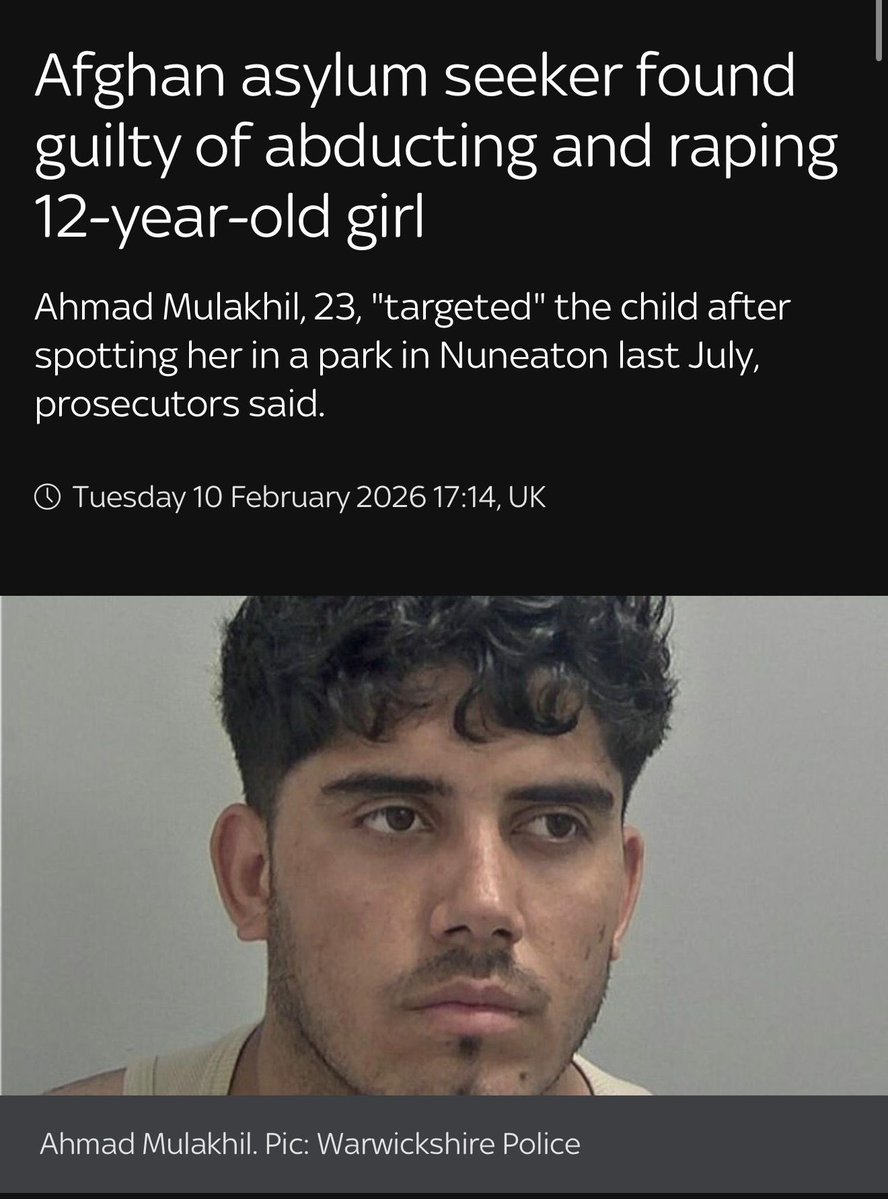
I can’t express just how sickened I am by this story…on so many levels.
As a woman, as a mother. It’s grotesque.
An illegal immigrant treated humanely by our country repays us with a depraved, barbaric act. Only a monstrous creature would do this -to a child, no less.
We have been far too complacent and far too kind and we are failing our children by not getting rid of these monsters.
This is why I’ve toughened Conservative policy.
⚫️Leave the ECHR that stops us sending grifters who’ve learned how to game our system back where they came from.
⚫️ Deport all foreign criminals, no ifs no buts.
⚫️ Many should serve their prison sentences in the places they came from and not be a drain on the British taxpayer (this needs a 3rd country deterrent for those places that won’t take their criminals back).
We’re the only party that has a fully worked up policy on all of this. It’s time to get serious. Stronger borders will create a stronger country.
These costs are clearly absurd.
MPs should:
- ask for a short report to set out which specific laws/regulations are increasing costs and by how much
- pass a short bill that exempts the Palace rebuild from those rules (see Notre Dame)
- pass a wider repeal/reform of those laws
Jaw dropping from the Defence Select Committee this morning.
Former Secretary of State for Defence Ben Wallace explain why the UK military is constantly underfunded and the risks that we are taking on.
@PulaRJS Was the MP coming to the school to talk about Israel? If not, then doesn’t this amount to teachers objecting to people who don’t share some of their political views?
Two things can be true at the same time.
First, Alaa Abd El-Fattah, the former prisoner, should have received a free and fair trial in Egypt. The long years of detention, the suffering of his family, and the lack of due process are not things any democracy should be comfortable with. There ends my sympathy.
There is a second truth. The comments he made on social media about violence against Jews, white people and the police, amongst others, are disgusting and abhorrent.
They were also anti-British, which begs the question how officials rubber-stamped this application without escalating to then Home Secretary.
The Home Secretary should now look at all possible options, including whether his citizenship can be revoked and he can be removed from Britain.
British citizenship is more than a passport. It means subscribing to our values. Our country is our home not a hotel. But let’s ask ourselves how this mad situation occurred.
Celebrities campaigned for his release as Western politicians, various media outlets, and human rights organisations helped sanitise El-Fattah’s story. I was only aware of his case in passing when discussed in parliament and on the news.
El-Fattah was always presented as a symbol of democratic resistance. It’s now clear from the comments which emerged that many who were supporting him had brushed aside his own published political views, including explicit endorsements of violence.
Those views were not obscure in those circles. They were serious enough to cost him a major European human rights award years ago.
It is one thing to work for someone’s release from prison if they’ve been treated unfairly as previous governments did. It is quite another to elevate them, publicly and uncritically, into a moral hero.
The British government did not just work quietly for his release, it rushed to celebrate it: our Prime Minister expressed ‘delight’.
This rush to moral posturing has consequences. Firstly, it risks validating the narrative of Western unseriousness. Middle Eastern authorities have repeatedly expressed concerns about the kid gloves with which the West treats extremists who are not allowed to operate within their borders.
There is a deeper problem here which I have spoken and written about frequently.
Too many people now enter Parliament to act as activists and campaigners, not as legislators. This is not about doing the work of a Foreign Secretary on consular cases, or about campaigning for real human rights victims like Jimmy Lai, it is about those who prioritise virtue-signalling over due-diligence.
Those who push colleagues to act quickly, publicly, and emotionally, without doing the hard work of scrutiny that governing actually requires. It is why we have Prime Minister and Home Secretary who signed letters to stop the deportation of foreign rapists and murderers.
That culture in our parliament has consequences. Yes, it is mostly on the left, but let’s be honest, all parties indulge in this nonsense, including on occasion the Conservatives. I recall senior figures in Reform UK, including David Jones, at the time a Tory MP, leading the charge for El-Fattah’s release in Parliament.
It is inconceivable that no one saw Alaa Abd El-Fattah’s published statements over the years. Ten years ago, some people may have dismissed comments advocating the killing of Jews as offensive but unserious, or merely loose talk. After 7 October 2023, that excuse no longer exists. We now live in a very different world.
Since October 7, we have seen a sharp rise in the intimidation and terrorising of Jewish communities. We have seen antisemitic rhetoric translate into real-world harm with violence and murder in Manchester, in Bondi Beach, and elsewhere. In that context, calls for violence against Jews cannot be brushed aside.
@SteveNickSmith But he didn’t mention Islam.
And if findings did show a link between Islam and this behaviour, then any fear would be rational (i.e. not a phobia).
This on the BBC:
"This" writes the sensible @matthewsyed "is why I’d argue (perhaps optimistically) that this week offers a window of opportunity for the BBC. The courageous move would be to acknowledge Prescott’s findings, perhaps even to admit what is, I think, undeniable: that the corporation suffers from institutional bias. I mean, it is not as if it is alone in this. A survey last month by Electoral Calculus showed that 75 per cent of what it called “the establishment” voted for left-of-centre parties at the general election. The think tank More in Common found that many institutions are dominated by “progressive activists” who constitute just 13 per cent of the population.
And it is worth briefly noting how we got here. Perhaps the original sin was the progressive march through our universities: since the 1960s the ratio of left-wing to right-wing academics has shifted from 3:1 to 8:1. This has not just tilted young, often impressionable minds in a decisively more liberal direction but had further consequences too. It is striking, for example, that graduates today migrate in huge numbers to metropolitan areas (nearly 40 per cent of Russell Group graduates with firsts and 2:1s are living in London within six months of leaving uni), where they join narrow friendship networks connected to the institutions at which they work, creating a double whammy of social convergence.
This is why ensuring true diversity of views at an elite institution like the BBC is about far more than diversity of colour, class or gender. It is about appointing senior editors who (wait for it) are sympathetic to Reform UK; hiring many more who are super-bright but didn’t go to university; constantly encouraging new recruits to express their opinions rather than converge on the predominant ones; perhaps above all, recognising that impartiality is not a destination but an orientation requiring a disciplined awareness of one’s limitations and an insistence on transparency, method and the humility to constantly test assumptions against alternative ones.
The BBC will instinctively feel defensive this week and may be tempted to argue that it has all the necessary policies in place. I’d humbly retort (as a friend) that this would be a terrible strategic error. The role of the BBC has never been more important and it is not too late to preserve it from those who wish to bring it down. But all executives should remember that while a liberal world-view predominates within the walls of the organisation, a majority of licence fee payers believe in the following heresies (ie, common sense): national borders matter; love of nation is admirable; biological males shouldn’t compete in women’s sport; people should be judged on merit, not colour; western history is broadly admirable, not shaming.
Indeed, how about reading out the previous paragraph at the outset of every editorial meeting? It might help mitigate the otherwise irresistible tendency towards elite groupthink."
https://t.co/CIwF7UDvHG